Recent Posts

Monday, 24 February 2014

Three Moral Discussions Two


Firstly, I apologize for the font problems of the last post. I worked on the font for a long time and for some reason a glitch stops me from correcting the size. But, it is readable.

Secondly, the importance of this discussion centers on the large number, perhaps the majority, of people who have been taught incorrectly to be catechists. Even Catholics with Master's Degrees have expressed to me the absence of real teaching concerning conscience and the moral matter of sin.

Sadly, the vast majority of Catholics do not understand two more issues upon which I want to touch.

This second point in three moral discussions is the question of formation of conscience. Now, I have written on this before, but I need to emphasize two points. One is that the language of the Catechism is clear on the importance of conscience, but as formed correctly in and by the Catholic Church.

There is no, absolutely no, correct formation of conscience outside the parameters of the Teaching Magisterium of the Church.  Here are a few of the key points from the CCC. 

1783 Conscience must be informed and moral judgment enlightened. A well-formed conscience is upright and truthful. It formulates its judgments according to reason, in conformity with the true good willed by the wisdom of the Creator. The education of conscience is indispensable for human beings who are subjected to negative influences and tempted by sin to prefer their own judgment and to reject authoritative teachings.

1784 The education of the conscience is a lifelong task. From the earliest years, it awakens the child to the knowledge and practice of the interior law recognized by conscience. Prudent education teaches virtue; it prevents or cures fear, selfishness and pride, resentment arising from guilt, and feelings of complacency, born of human weakness and faults. The education of the conscience guarantees freedom and engenders peace of heart.

1785 In the formation of conscience the Word of God is the light for our path,54 we must assimilate it in faith and prayer and put it into practice. We must also examine our conscience before the Lord's Cross. We are assisted by the gifts of the Holy Spirit, aided by the witness or advice of others and guided by the authoritative teaching of the Church.55


An uninformed conscience is our responsility, not a teacher from our past, not a priest, not our parents. All men and women are called to form their conscience in a supernatural manner, not a natural one.

Again, using the German bishops who are moving towards schism as an example, their consciences prove to be faulty, lying in an informed dissent, rather than in an informed assent to the Teaching Magisterium.

Simply put, there is no such thing as a well-formed conscience which is in opposition to Church Teaching.

To be continued...

Three Moral Discussions-One


Speaking with a certain group of friends who are much younger than I am, I have discovered a huge discrepancy between their theological training as to the meaning of sin, grace and conscience which has shown me the extremely poor teaching happening in some Catholic institutions.

Some of these people are good and want to know the real deal regarding the moral teaching of the Church, but have been taught incorrectly on the above topics. Sadly, there are too many liberal professors talking about ideas of sin, grace and conscience which are not based on Catholic teaching.


I want to cover a few of these points in three parts today. The first is a discussion of sanctifying grace, about which I have written before and one can follow the links at the bottom of the third posting.


Without sanctifying grace, there is not sharing in the participation of the life of God. The Council of Trent clarified the teaching on grace, because of the confusion brought about by the elimination of the sacraments by the Protestants and the false teaching on atonement and justification by Luther.


Without grace, we are, simply, not pleasing to God, and those is mortal sin do not have sanctifying grace.


The Council of Trent makes the point that sanctifying grace is not just the remission of sins, but "the sanctification and interior renovation of man by the voluntary reception of grace, and the gifts, by which man is changed from unjust to just, and from an enemy to a friend."


Enemy is a strong word, but real. Sanctifying grace makes us just, not merely the carriers of the Justice of God, but actually just, as we are renewed through the sacraments.


Now, this entire discussion on the reception of Communion by those in irregular marriages, as brought up by the German bishops lately seems to ignore the entire questions of the participation in the life of God which is sanctifying grace.


When one marries, "outside the Church", a person has chosen to ignore the marriage laws of the Church and has placed themselves in a state of disobedience in a matter which is serious.


Serious matter makes up mortal sin, sin which kills the life of Christ, sanctifying grace in the soul.


The person who approaches Communion in mortal sin, without sanctifying grace, not only cannot receive more grace until he or she goes to Confession and no longer takes part in the marital actions in an irregular marriage, but commits a further sin of sacrilegious. 


Why is this? Sacrilege involves the reception of God in an unworthy state. Now, some liberals claim that we are all in an unworthy state, but to deny that those in sanctifying grace are in a different relationship to God than those who are not, begs the question of  "worthiness".


Father Jordan Aumann writes in relation to the necessity of receiving Communion often.

All of our actions should be centered on Christ. Father states that "To perform one's action through Christ and with Christ denotes a high degree of perfection in one's faith and love, but greater still is that identification with Christ that enables the soul to do all things in Christ."

Without grace, we are not capable of pursuing holiness. Without the sacraments, 
we cannot receive sanctifying grace. The entire argument of the German bishops seems to 
ignore the status of the soul, whether a person is in grace or not. Church law cannot change 
the life of God within us, if Christ, the Second Person of the Blessed Trinity, has told us how
to stay in the life of grace and clarified marriage for us.

These contrary bishops are merely looking at the natural good of something, not the 
supernatural. They emphasize the natural goods they may see in a marriage without 
considering the supernatural state. 

If we are in sanctifying grace, we are in a filial relationship with God. He is our Father and we 
are His adopted children. Filiation is rarely spoken of these days, as many Catholics assume
that all people are naturally sons and daughters of God.

Not so. Baptism makes us so. Through baptism, we are actually the sons and daughter of God.
We live in His life, sanctifying grace. 

Spiritually, we have been reborn, and become more than merely the sons and daughters of our physical 
parents, we become children of God.

So, to depart from this state is what happens in the committing of mortal sin. One may question 
the long history of the Teaching Magisterium of the Church regarding marriage, but one must 
eventually end up with the words of Christ Himself. No church, no set of bishops can change the
teaching of Christ.

It is not the Church which determines what is serious matter for sin, but God Himself.

To be continued............


Waking Up


Some people are waking up in America. Yesterday, after the TLM, some of the young men, all under thirty, were talking about the hard times to come and the purging of the Church-their words.

They see that the crisis of leadership and the lack of vocations are two streams of liberalism merging to form a flood coming soon.

That they are young fathers is significant. That their wives tend to be home schoolers is also significant.

The move to realizing that the Church in the near future will not be the Church of the past becomes more clear daily.

My diocese will have 42 active priests for 100,000 Catholics next year.

Some dioceses must close churches. How bishops will decide this may be determined by two things. The first would be financial stability or viability. In this diocese, all the parishes, amazingly, as in the black. So a secondary manner of determining closing would be a count of how many baptisms, confirmations, marriages, and so on would be coming out of a parish. Parishes which are not growing would be considered not sacramentally viable.

Of course, the mega-churches would get more attention than the small country churches, and this diocese has many, many small country churches.

You should be paying attention to your own dioceses. In addition, one local diocese, not this one, lost twenty-two seminarians recently.

One may ask whether the screening of the seminarians is faulty; whether the seminary is faulty, as in are there still lavender mafias, or is the selection commitee faulty?

Another problem is that many young men have no idea of what it really means to be a priest. They have never had to sacrifice, coming from small families where they did not have to share or meet any expectations.

The truth is that many Catholics in a few years will not have access to daily Mass or regular sacraments.

The laity is heavily to blame, for not encouraging vocations in the family.

The purgation of the Church will include many people waking up and regretting that they did not support vocations, not merely by money, but with the offering of their own children to God.

I think that a bishop should ask this question of his parishes. Which parishes have produced vocations to the priesthood and the religious life in this diocese, and which have not? Close those which have not...........

Sunday, 23 February 2014

Doctors of the Church 2:78 St. Peter Damian

Wednesday, 20 February 2013


Peter Damian and Perfection in the DoC Series


In the rocky solitude of Fonte Avellana,
Peter Damian desired to be with Christ. 
Here he is on contemplative experience.
"I longed to cleave with all my heart,
to the everlasting light. My heart, then
as it seemed, was made of wax, as that
of the Lord's prophet was of flesh.
And, it melted in flame under the breath
of heavenly desire, and my sorrowing
countenance was often watered by rich
tears....I often beheld, by an immediate
perception of my mind, Christ hanging
from the cross, fastened with nails.
and thirstily received His dripping
blood in my mouth. But if I were to
attempt to tell you of the heights
of contemplation which were vouchsafed
to me, both of our Redeemer's most
sacred humanity and of the indescribable
glory of Heaven, the day would be at an
end before I had finished."


Found here. 

Doctors of the Church Series 2:77 St. Peter Damian

Wednesday, 20 February 2013


DoC: St Peter Damian and Perfection


Many years ago, I thought this, that is, that we each one of us, was a little 
Catholic Church, enjoying all the benefits individually of the larger Church, as
well as wearing on our bodies the scars of the Church persecuted.

If the Church is the Bride of Christ, so too we can each be in that intimate 
relationship with Him.


Here is St. Peter Damian on this idea.

Think about this. To be continued............


Now just as the Greeks call man a microcosm, that is to say 
a little world, because his body is comprised of the same four 
elements as the universe itself, so each of the faithful is a little 
Church, since without any violation of the mystery of her 
inward unity each man receives all the sacraments of human 
redemption which are divinely given to the whole Church. If 
one man, then, can be said to receive the sacraments which are 
common to the whole Church, why should he be prevented, 
when alone, from uttering the words common to the whole 
Church, for the sacraments are so much more important than 
any words.

Doctors of the Church 2:76 St. Peter Damian

Wednesday, 20 February 2013


Pope Benedict XVI on the Love of Peter Damian-DoC series


The scholarship of our dear Pope Emeritus is seen clearly in this selection from his talk on St. Peter Damian from Benedict XVI General Audience Address September 9, 2009 found here on the Vatican website.
I am glad to highlight two great men here today.
St Peter Damian, who was essentially a man of prayer, meditation and contemplation, was also 
a fine theologian: his reflection on various doctrinal themes led him to important conclusions for 
life. Thus, for example, he expresses with clarity and liveliness the Trinitarian doctrine, already 
using, under the guidance of biblical and patristic texts, the three fundamental terms which were subsequently to become crucial also for the philosophy of the West: processio, relatio and persona (cf. Opusc. XXXVIII: PL CXLV, 633-642; and Opusc.II and III: ibid., 41 ff. 
and 58 ff). However, because theological analysis of the mystery led him to contemplate the 
intimate life of God and the dialogue of ineffable love between the three divine Persons, he drew 
ascetic conclusions from them for community life and even for relations between Latin and Greek Christians, divided on this topic. His meditation on the figure of Christ is significantly reflected in practical life, since the whole of Scripture is centred on him. The "Jews", St Peter Damian notes, "through the pages of Sacred Scripture, bore Christ on their shoulders as it were" (Sermo XLVI, 15). Therefore Christ, he adds, must be the centre of the monk's life: "May Christ be heard in our language, may Christ be seen in our life, may he be perceived in our hearts" (Sermo VIII, 5). 
Intimate union with Christ engages not only monks but all the baptized. Here we find a strong 
appeal for us too not to let ourselves be totally absorbed by the activities, problems and 
preoccupations of every day, forgetting that Jesus must truly be the centre of our life.
Communion with Christ creates among Christians a unity of love. In Letter 28, which is a brilliant ecclesiological treatise, Peter Damian develops a profound theology of the Church as communion. "Christ's Church", he writes, is united by the bond of charity to the point that just 
as she has many members so is she, mystically, entirely contained in a single member; in such 
a way that the whole universal Church is rightly called the one Bride of Christ in the singular, and each chosen soul, through the sacramental mystery, is considered fully Church". This is important: not only that the whole universal Church should be united, but that the Church should be present in her totality in each one of us. Thus the service of the individual becomes "an expression of universality" (Ep28, 9-23). However, the ideal image of "Holy Church" illustrated by Peter Damian does not correspond as he knew well to the reality of his time. For this reason he did not fear to denounce the state of corruption that existed in the monasteries and among the clergy, because, 
above all, of the practice of the conferral by the lay authorities of ecclesiastical offices; various 
Bishops and Abbots were behaving as the rulers of their subjects rather than as pastors of souls. 
eir moral life frequently left much to be desired.
That St. Peter Damian spent his life helping the Church and the Papacy with many things which needed reforming is a good reason to pray to him today....To be continued......

Doctors of the Church 2:75 St. Peter Damian

Wednesday, 20 February 2013

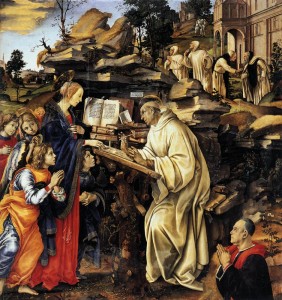
 DoC-St. Peter Damian


This great saint is one of the Benedictines on the list. He is overlooked by many, who may not even realize his contributions to the Church. He lived in amazing times and counselled more than one pope. Notice his cardinal's 
robes lying on the floor in this painting, as he was humble about his office. His dates are 1007-1072. That the man 
was brilliant may be seen in his biography on several sites. Many of his works which use to be on line years ago, 
have been taken off, by the revamping of certain websites. This is sad, indeed, and a warning at taking for granted 
what is on line.


I present selections from his writings on the link found here in the next few posts. I start with one.

His point here is that it is not merely the choice of life, or the vocation of a person which causes perfection, 
but the cooperation of grace therein....

 For it was certainly not that holy and humble man St. Benedict who, at the very beginning of his 
work, sat himself in the master's seat and usurped the place 
of the loving Father: 'Hearken, O my son, to the precepts of 
thy Master, and incline the ear of thine heart; willingly receive 
the admonition of thy loving Father.' 1 Rather, the Holy 
Spirit made his servant the instrument of his voice, just as he 
did at the beginning of the books of prophecy, when he cried, 
through Isaias: 1 have nourished and brought up children." 2 

Let us see, then, to whom he directs what he has to say, for 
what sort of man all that follows is written. He says: 'To thee, 
therefore, my words are now addressed, whoever thou art that, 
renouncing thine own will, dost take up the strong and bright 
weapons of obedience, in order to fight for the Lord Christ, 
our true king.' 3 As far as we can gather from the words of the 
holy man, the school of the holy Rule was established more 
for the learning of obedience than for the performance of 
penance. This is not to say that it excludes either the sinner or 
the just man, or rejects any sort of person; but rather that its 
whole strength and purpose lies in the teaching of the rules of 
obedience. 

I know that in writing in this way I am displeasing some of 
the brethren, namely those who believe that a turning to our 
way of life brings about both the absolution of our offences 
and the perfection of virtue. I hope it may be enough if I reply 
that in setting forth my opinions I have no desire to cast a 
snare upon any man, -as the Apostle says, 4 but rather wish to 
urge you on towards the good.

Must read

http://www.theatlantic.com/magazine/archive/2012/03/how-your-cat-is-making-you-crazy/308873/

thanks to a tweeter....

It is the duty of the laity to pray


We have nineteen new cardinals. Only eight are European. As lay people, it is our duty to pray for the princes of the Church. If we do not have the leaders we want, we get the leaders we deserve. That there is a leadership crisis in the Church is painfully obvious. But, whose fault is this?

Parents no longer have a domestic church in the home. Parents do not say the daily rosary with their children.

Parents do not encourage their sons to go into the priesthood or their daughters to become nuns.

The laity have only themselves to blame.

Pray and stop complaining. Your prayers may make a saint out of a cardinal.

Twenty-three years ago


I made up dozens of stories based on my son's stuffed animals. These animals included a fantastically adorned Mouse King, a Snowshoe Hare. a Snowy Owl, and an Arctic Wolf.

The Mouse King stories spanned at least two years, but I never wrote any of these down on paper.

However, I want to share one which I remember now with you.

One day, Mouse King, (before he was married, and had a Mouse Prince to do fun things with him), decided to take his closest friends, Snowy Owl, Snowshoe Hare and Arctic Wolf to see his hidden cave. They had to walk several miles through the forest, outside of the valley of the palace, to get to the cave. The three stooped down into this secret cave, and Mouse King led them down a long tunnel to a large underground room.

There, to the great surprise of Snowshoe Hare, Arctic Wolf and Snowy Owl, hundreds of jewels popped out of the wall like brilliant flowers on a bank in spring. Diamonds, amethysts, rubies, emeralds, tsavarites, topaz, dotted the rocky, rough walls of the cave. Mouse King invited his friends to each choose a jewel. and when each one did so, the jewels became necklaces to put around their necks. Each animal chose a different jewel.

The Snowshoe Hare chose a ruby. Arctic Wolf chose a sapphire, and Snowy Owl chose an emerald.

Mouse King said to them, "These are friendship stones and each one has a magical property. I shall not tell you what this is until you are ready to learn the secret of the stones."

The friends felt greatly honored, and as the three animals, following Mouse King, walked back the several miles to the palace, they discussed among themselves what this magical property could be.

Each day, the animals wore their necklaces into the court room, and into the special cabinet meetings held by Mouse King. But, over the week, something odd happened to the stones.

Snowy Owl's emerald became foggy, as if the green color was covered with a cheese-cloth. Snowshoe Hare's ruby turned a sour orange looking shade of red. He was greatly disturbed by this. Arctic Wolf's sapphire became more and more brilliant, and shown like a blue sun.

On the last day of the week, the friends stood in the great hall waiting for Mouse King to come and sit on his throne. He came in, and the three approached him, two, at least, in a rather bad mood.

"The jewel you gave me has turned out to be a bad stone, my King," complained Snowshoe Hare. "And, mine has proved to be a false stone, turning into a poor quality emerald, " stated Snowy Owl.  Arctic Wolf said nothing, as his stone had improved over the week.

"Can you help us understand this magic, Sire?" asked Snowshoe Hare, somewhat irritated by his choice.

The three waited while Mouse King came down the steps from his throne and stood among them.

"My friends, these stones show the hearts of those who wear them. The discoloration of the ruby indicates a flaw in the heart of Snowshoe Hare. He has anger in his heart and must repent."

Snowshoe Hare stared at the ground. He knew this was true, and as he stood in humility at being found out for a hidden fault, his stone turned back to ruby red. He was surprised and grateful.

"Snowy Owl's stone reveals a heart marred by deceit."  Snowy Owl was shocked, but then, as he knew Mouse King was correct, a small tear came to his eye and he decided to repent. Just then, his emerald cleared up to reveal a deeper green than originally seen in the cave.

"Arctic Wolf's stone is more brilliant than when he found it, as his heart is pure and good. He has no flaw in his heart, having let God purify him over the years, like gold in the fire."

Arctic Wolf knelt down and kissed Mouse King's ring. "I only serve you and God, and no others."  He then stood up in silence.

Mouse King then said, "Friends must help each other come to know themselves and to repent of flaws. I love you all and trust you. The stones will help you become more perfect."

All were then content and they followed Mouse King into the breakfast room for tea, toast, and jam, marmalade jam.

The end...

Alba's Jewels Part Six

Hugh and Hywel decided to walk off the pathway, past the hut and to the west. They had no idea where the hiding place of Timothy could be located, but Hywel began to wonder if the animals obeyed some sort of sorcerer. He suggested to Hugh that they would follow any animal which moved, such as the deer or the foxes. Sadly, for them, their entire conversation was overheard by the rabbits, which immediately ran and told Timothy that the animals were suspect. Timothy instructed the animals to play "hide and seek",  running this way and that to confuse the two. And, so, for two or three hours, the deer went one east, the badgers west, the foxes obviously south and so on. After half the day had passed, Hugh refused to move another inch. "It is as it they were leading us astray on purpose." Hywel stopped walking. He sat down, exhausted. "Of course, why did I not think of that?" The two men were getting hungry and soon the smell of food wafted from the direction of the hut. "Do you think this sorcerer would poison us?"

Hywel answered, "The food we ate the first day did not hurt us." And, being a bit superstitious, he added, "And, remember, Ralph and Roger did not eat anything and they are dead and gone. Maybe the food protected us."

Hugh thought that was a silly idea but said nothing. The two men walked slowly back to the hut. Hywel began to wonder whether they would find the treasure. Hugh no longer cared. He was pining for the town pubs he left behind so many weeks ago.

The door of the hut remained wide open, as they had left it, as the sun began to set in the sky. The dusk came early at this time of year and Hugh lit a candle in the small room.

Hywel dished up more odd stew and vegetables and made places for two at the table. Soon, the two men were eating and forgetting the craziness of the day, until Hywel saw something which made him stop eating, his spoon in mid-air. Outside the window he was facing stood the most enormous bear he had ever seen.

Hywel had laid the gun on a rack on the wall and ran to get it. But, the bear vanished. This vision created real fear in his soul. For the first time, perhaps ever, Hywel thought of giving up a life of crime and greediness, but sadly, as his habits of mind were so strong, he decided to continue with the quest.

"Did you see anything outside, Hugh?"  Hugh had been facing another direction, towards the door and had not seen the bear. When Hywel ran to get the gun, Hugh had hide underneath the table.

"No, I did not." But, Hugh was lying. He had seen the bear in a mirror on the wall, an ancient, bent mirror but clear enough to show the large, dark shape. Hugh was forming his own plan. Perhaps the bear would end up taking Hywel and Hugh would simply row to the closest shore and leave this haunted island behind.

The man of greed was also forming a plan. If he could get rid of Hugh, then, when he found the treasure, he would not have to share it. Both men remained silent in their evil plans.

Hywel did not know what to do about the bear, but just then, there was a knock at the door, which the men had shut and bolted. Hywel still had the gun in this hand. "Hugh, open it and I can shoot whatever is there."

"Bears do not knock on doors, Hywel", answered Hugh. He was afraid Hywel would shoot him. "You open the door."  The knocking continued. Both men stared at each other. Then Hugh added, "We do not have to open the door."  But, the knocking continued.

Hywel yelled, "I cannot take this anymore," and he turned around and opened the door. Of course, no one was there. A fox had taken a stick in its mouth and knocked on the door, running away into a hedge quickly when Hywel opened it.

The man, now so nervous he could not think properly, stepped outside on the same path where Roger had seen the bear. The door faced due west.and beyond the hedge, Hywel could see a faint light. Hugh stood behind him. "Fairy lights, and dangerous," he said in a heavy voice.

Hywel wanted to follow the light. His level of impatience at not finding the treasure grew hourly. He thought o the bear. So did Hugh. "But, if we are going to find anything, maybe we should follow the light."

So, both men agreed to go out into the dark with the gun and the lamp. They walked due west, towards the small light. It seemed about 400 feet away, but as they walked, it receded and they finally realized after twenty-minutes or so, that they were not any closer to the light.

Hugh was still planning to abdicated his role and play the betrayer, if he could find the sorcerer. Hywel was planning on sacrificing Hugh to the bear, in an effort to get rid of him. But, just as he thought this, Hywel fell into a trap-a simple animal trap, the oldest type in history, a hole in the ground which had been covered with reeds, moss and bracken. The trap was about twenty feet deep, a really deep hole, partially natural and partially dug out to be deeper. "Hugh, help me out of here."  But, Hugh yelled back, "Throw me the gun first, as I am afraid the bear will return while I am helping you."

"No, I am keeping the gun," replied Hywel. Hugh backed away quietly and ran towards the light so far away. He was convinced the light could lead him to the sorcerer. And, he would leave Hywel to the bear. After all, Hywel had the gun.

"Hugh, Hugh, where are you? Get me out of here, now, you idiot." But, all Hywel heard was the low growl of a large bear. "I shall have to try and kill this bear with one shot, which is all I have left. And, I cannot see in the dark."  He tried to remain calm, but the growling continued. "Maybe it got Hugh."

Then, all was silent. Hywel felt so tired, he could hardly stand up. The ferns and bracken at the bottom of the bottom of the hole looked like a soft bed. He wondered it he could just lay down until morning. He was too short to jump out of the hole and it the bear was up on the surface, Hywel felt it would not come into the hole. How would the bear get out?

In the meantime, Hugh ran into the small forest and kept running to the light. He yelled, "Sorcerer, I want to talk with you. Magician, hear me. I give up. I want to go home."

Timothy heard his voice from his small cave. He said to Belsay, "Go out and meet the man and pretend you are a sorceress. Ask him what he wants. Be careful. But, he seems to be a coward and cowards do not attack Arctic wolves."

Belsay bowed her head, "Yes, Master and this will be fun."  She ran towards the clearing where Hugh now stood and halted in front of him. Hugh was terrified. "I, I , I  want to leave in the boat. I shall never come back. I no longer want any treasure. Please let me go. You have the other man in the hole."

"So, Evil Man, you would sacrifice your comrade and leave him here to danger, while you left freely? Men are cowards. No animal on this island would do such a thing, and why should we let you go, to do evil deeds on the mainland?"

Hugh could not believe a sorcereess, as Belsay's voice was that of a female, could talk to him in this accursed place, as he saw it.

"What choice do I have? Do I have a choice?" Hugh felt sorry for himself, as he usually did in these situations.

"You always have a choice to choose good, Evil Man. Choose one now. Go back and help the other man out of the pit and we shall let both of you go in the boat, but only if you promise never to speak of this
place and to repent of your evil, doing good for the rest of your short days."

Hugh shook, "Yes, yes, I shall go back and agree to your terms. Do you promise to help us leave? But, what if the other man will not leave?

Belsay continued, "If the other Evil Man does not want to leave, we shall still let you go, if you try to help him."

Hugh agreed. Belsay said, "I myself will lead you back to the pit. The bear will not harm you if I am with you."

Hugh followed the wolf back to the pit, but the wolf disappeared back into the forest as soon as he knelt at the edge of the hole. "Hywel, I met a sorceress. She looks like a wolf and she told me that she would help us get off  this horrible island if I helped you out of the hole. She protected me from the bear. Now, I shall get a heavy branch and pull you out."

Hywel yelled back, "Alright, get me out of here, now." He did not believe Hugh, but Hugh was helping him out of the pit.

As Hugh pulled Hywel out of the hole, the greedy man said to him, "I suppose I have to thank you, but I do not believe your story. And, why should I leave without the treasure? You give up to easily. I never wanted you with us and now I am getting rid of you. Hywel pointed the gun at Hugh, but just as he pulled the trigger, the bear lunged at him from the side and pushed him back into the hole. The gun blew up and Hywel fell breaking his neck.

Hugh looked at the bear, and the bear looked at Hugh. "I am sorry. I did not want Hywel to die. I am so tired of games and treasure hunting. I just want to go home."

Belsay came up to the side of the pit. Hywel lay dead at the bottom. "We need to discuss what to do with you. Go back to the hut, sleep and in the morning, you will see more magic."

Hugh practically ran back to the hut, slammed the door and bolted it. He threw himself in the bed, but before he did, he did something he had not done since he was a child. He prayed.

In the morning, Hugh was awakened by a large bird, a raven, pecking at north window. He rose and opened the window. The raven spoke to him. "Follow me to the beach and you will be told by another how you are to leave. You may take five jewels with you for your travels, but you are never to speak of this time again."

Hugh rushed out and followed the raven, which handed him a sack of the five jewels found by Hywel . Hugh, at first, did not want to take the jewels, but he was in an obedient mood and followed the raven to the beach.

There, at the edge, was the largest turtle he had ever seen. In its face, it resembled an old, wise man. The turtle spoke. "If you are willing to repent and abide by the directions you were given last night, I shall take you to the shore, but you will have to ride on my back. Are you willing? You must trust me."

Now Hugh had never trusted any man in his life, much less a turtle. "Why cannot I have the boat," he asked. "Is this a trial?"

If turtles could smile, Ringsend would have smiled. "Yes, it is a test. You have been given one more test to see if you are worthy to return to men and live a good life."

Hugh felt that his self-centeredness was melting away. He began to cry, even though he was a grown man.

"I actually feel something new. I feel gratitude. Yes, I shall go with you."

Hugh put the satchel of jewels around his neck. He climbed on the back of the great turtle and the animal slide into the waves of the sea.

"Hang on to my shell. The trip is only two hours". Hugh did as he was told. The turtle swam around the eastern shore of the island and into the strait between the island and the mainland. Hugh, in his old habits, began to complain. "It is too hard to hang on to you. This is harder than I thought. How long will this take?"

The turtle answered, "You must not complain. You should stay in that grateful grace you were given on the island. This will be only two hours of your entire life."

Hugh;s hands hurt. He never let himself endure pain before this. He always found a way out of painful situations and always sought the easiest way out. Now, he was slipping back into his old thoughts of self-pity and weakness. His narcissism was not strong enough to demand success, only comfort.

Hugh said, "I cannot do this," and he let go and sank into the sea.

The turtle turned around. He could not see the man sinking farther and farther into the depths. Ringsend swam back to the island, around to the south side, where Belsay and Timothy waited for him. Sadness circled the wise eyes of the old turtle.

"You see, Timothy, old habits of evil make men weak of will. You have been spared to do good and remember these lessons. I shall never see you again as I am going to the warm seas and there I shall die. May our Creator be with you."

Timothy knelt down and kissed the head of the turtle. "Goodbye, Grandfather Ringsend, I shall never forget you."

The turtle answered, "One more thing. You have never looked at the treasure as your heart is pure, Now, take it back to your hut, and look at it, but first bury the man in the pit on the mainland, as no one is buried in Eden."

The turtle slipped back into the sea and was gone. Timothy stood there for awhile, and then went to the pit. The bear had somehow carried the body out of the hole and Timothy wrapped Hywel's body up in a blanket. He took it to the boat and within six hours, with the badgers, had returned to the island. That night, Timothy took the chest of Alba into his hut and opened it up. The first layer of jewels seemed usually brilliant-emeralds, rubies, diamonds lay on top of another box.  Timothy reach into the lower part of the chest and pulled out the box. It was black leather and was closed with a latch. Timothy unlatched the box and in it were several things he did not recognize. But an old letter written in the same language of long ago, Latin, lay on top of these golden things. Timothy had learned Latin from his Bible, as he had two Bibles, one in Latin and one in an old English tongue he had deciphered. He could always read and never knew a time when he could not.

The letter was from Alba, as her large signature gracefully ended the paragraphs. The letter read, "Dear one of my descendants. I, Alba, bequeath to you the Mass vessels used at the last Mass attended by the great King and Saint, Edmund, dear martyr of our people. These vessels, sacred and revered, came from Rome hundreds of years ago brought by the first Christians to East Anglia. Some say this cup was that of Christ Himself, used at the Last Supper. Dear Descendant, for my sake, take these back to our country, if it is at peace and give them back to the altar of God. These are my jewels. Alba."

Timothy wept. These things were mysteries to him but he knew what he had to do. Ever since he was a very young child, left on this magical island by his parents, he felt that he had belonged to God Himself. When he read the words of the Last Supper, his heart had burned with a great desire to serve God. When he read the words of Paul on the priesthood in the Letter to the Hebrews, his heart swelled with love.

Now, he knew what he must do. And, so did his creatures. All the animals came out of their hiding places and bowed to the Master. Timothy instinctively did something he would do hundreds of times in the future. He blessed them.

Then, taking the jewels of Alba, Timothy rowed away in the boat to the mainland. Years later, many years later, stories of a holy priest in a hermitage near old Beodericsworth, a holy hermit who said Mass with the oldest chalice the locals had ever seen. Some said it was from the treasures of the old Villa Faustina, where the Christian Romans had built a small chapel. Some said the hermit looked like the old families of East Anglia, which once was honored by the beautiful Alba, whose jewels had disappeared centuries ago, after the death of the saintly king.

Timothy lived to be very old and another legend grew up around him. People claimed that at night, a she-wolf would come and visit him, speaking with him in an old language of the East Angles. Such was Belsay, who had vowed to guard her master until his death.


Sad days ahead

Nearly one in five U.S. parishes do not have a resident priest pastor. Seven in ten have a diocesan priest serving in this capacity and religious priests serve as resident pastors in 11% of parishes. In 17% of parishes a priest is serving as a non-resident pastor…in 2.5% of all parishes, due to a shortage of priests, a deacon or lay person is entrusted with the pastoral care of a parish…[who]….must still do their best to arrange for priests to be available for Masses and other sacraments.
Priests cannot be in two places at once and there are only so many hours in a Sunday. We have a good understanding of how many parishes there are in the United States and how many priests are available. The map below (click for full size) shows the number of active diocesan priests subtracted from number of parishes in each diocese…. In 60% of dioceses, those marked in yellow and red, there is no surplus of diocesan priests active in ministry relative to the number of parishes in the diocese. The green areas on the map have more active diocesan priests than parishes. [2]


A reminder.....

Saturday, 22 February 2014

Prayers

http://www.thecatholicuniverse.com/catholic-university-mourns-lecturer-killed-kiev/

Lenin topples in the Ukraine

Another "wow" for the day-sixteen statues of Lenin struck down.

http://www.hln.be/hln/nl/960/Buitenland/article/detail/1798743/2014/02/22/16-Lenin-monumenten-gesloopt-in-Oekraine.dhtml

Alba's Jewels Part Five

In the afternoon, Timothy prayed and read the Book of Daniel. These words seemed to speak to his heart. "Many shall purify themselves, and make themselves white, and be refined; but the wicked shall do wickedly; and none of the wicked shall understand; but those who are wise shall understand."

He felt that his entire young life had been one of purification. His solitude brought him closer to God daily.

Timothy could not share how alone he felt with his animal family. They loved him and called him Master. The bear and the turtle knew the Scriptures and could give Timothy advice, but they were not his kin in the matters of the soul. Timothy yearned for those with whom he could share and live out his life with God. The story of his ancestor who lived as hermit for a while burned in his heart. He was almost sixteen and he wanted to be among humans. His parents were buried on the mainland, as no persons had ever been buried in Eden. In fact, early in the morning, Timothy and the badgers, who accompanied him in the row boat, took the bodies of the two men and went the two hours to the mainland to bury them. Timothy said some prayers from the Psalms as the badgers dug and the young man hoped that in some way these men had done one thing good in their lives to merit heaven. He then rowed back to the island and waited for the next event.

He was surprised at what followed. The deer watched Hywel from a small hill as they ate grass. Hywel moved down the beach and was surprised to see the row boat in another place. Timothy decided to leave it where the last two men could find it to facilitate a departure on their part. He had been instructed by Ringsend not to confront the men unless absolutely there was no other alternative. That situation had not arisen, yet.

Hywel saw the boat and was looking at it intently. He was trying to decide whether to leave or try and find the treasure. His greedy heart overcame common sense, and he was not even thinking of Hugh at all, when Hugh came up behind him.

"So, you are thinking of leaving. I think that is a great idea. I hate this place."

The goodness in the air of Eden annoyed Hugh's lazy heart. He could sense calls to prayer and reflection, but his old habits of turning down good ideas from his guardian angel or from the last, tiny part of his hardening heart made him decide that he could not stand the rarefied air of the island.

"No, I am not leaving, and now that I know there is a man on this island who can row and boat and carry two bodies somewhere, I know what I have to overcome. No spooks here." Hywel encouraged himself with his words.

"And, if there is a treasure, then we must find it." Hywel showed Hugh Roger's gun, which he had taken after the accident. "And, we have means to get this treasure."

Hugh said, "Well, I am not too sure I want to be part of any violence or fighting. You know I am not a fighting man." Hywel grimaced. He was never sure why Hugh, "The Sloth" had been chosen by Roger to be part of this group, anyway. Hywel saw Hugh as "dead wood".

"Well, I cannot see how we can fight unseen animals and a man who disappears at will. Maybe he is a ghost." Hugh remarked, strongly.

"A ghost does not row a boat," replied Hywel.

One of the deer removed itself from the small herd and found Timothy in the woodland hiding place. The bear slept in the back of the small cave. Belsay stood by the opening.

Timothy thanked the deer and asked her to check out all the guardians on the shores. Then, it leaped into the undergrowth and was gone.

Hugh thought about this entire adventure. The leader upon whom all depended was gone. The youngest and strongest member was gone. His laziness inclined him to another plan, which was to find the man on the island and give himself up, thinking that this person would reward him for turning in Hywel. His treacherous plan grew from a lack of conviction about anything. Such was the slothful mind. Inconstancy and narcissism marked his soul, perhaps more black than the others', as his soul was always seeking the husks rather than striving for meat and potatoes. His attitude, formed by years of taking the easy way out, always feeling sorry for himself when things went wrong. Indeed, why Roger, so quick to judgment and anger decided on Hugh as part of the "team" seemed a great mystery.

But, what Hywel missed in his thoughts was that Greed, his main fault, and Sloth have much in common, beginning with selfishness. The last two evil men, although they may not have been able to discern these traits, shared in a narcissism which pushed their ideas and decisions.

Basically, Hugh said to himself, "This adventure is not worth the trouble."  However, Hywel said to himself, "I need to get the treasure, now."

Hugh told Hywel that he agreed with him on continuing. The two men then decided to try and follow trails to find the lone man on the island. Again, a fox in the brush ran to Timothy, and related that these men wanted to find him and Alba's chest.

Timothy consulted with his heart and the bear. He did not know where the great turtle swam and trusted that if Ringsend needed to tell Timothy something, the animal of the sea would find a way.

In the meantime, Hugh was trying to find a way to split from Hywel in order to make his way to Timothy and turn himself in....he had to come up with a plan, something he simply was not disciplined to do. So, he thought he would "go with the flow" until an opportunity for betrayal occurred.

Timothy's surprise came from the reports from his "spies" of the odd conversation between Hywel and Hugh. Timothy began to see into the hearts of the evil ones, a new experience for him, which caused him pain. He realized that he had been preserved from the temptations and bad company which could have led him astray. In his heart and mind and soul, Timothy, again, dedicated his life to God in deep gratitude.

To be continued...............


WOW! Comments needed from Californians


The proposal aims to split the state -- America's most populous with around 38 million inhabitants -- into "six smaller state governments, while preserving the historical boundaries of the various counties, cities and towns."
In 2012, California was tied with Russia and Italy -- all with a GDP of approximately $2.0 trillion -- for eighth place in world GDP rankings, according to the Center for Continuing Study of the California Economy.
The proposal would create a state out of Silicon Valley, home to tech giants Google, Facebook and Apple. It would also create South California, which would include Hollywood and the US entertainment industry.
West California, Central California, North California, and Jefferson in the most northern part of the state, would also go it alone.
According to the proposal, voters overwhelming approved dividing California in two in 1859, but Congress did not act due to the Civil War.
http://news.yahoo.com/plan-split-california-six-states-gains-ground-222139687.html

Irish Memorare Count

Keep them coming--up to 83,051.


Irritating Days for Willow


Jet has joined a friend of mine's household. And, Willow is annoyed....such is life.


Another STM Manifesto


Something has changed in the atmosphere of Catholic life. We use to be normalized in America to working in the background, behind the trenches, quietly moving groups who were pro-abortion, or pro-contraception or pro-homosexual "rights". Most of the cardinals and bishops actually were trained to dialogue with evil and try to work with groups instead of hitting the problems from the front, as it were.

Now, in military terms, a rear guard action is determined by the enemy, not be the tacticians, who respond to evil instead of taking the offensive. A rear guard actions are basically working out of a retreat.

No more will this be possible if the Church is to survive in America.

We can no longer have detente with evil. And we can, no more, be content with rear guard actions, letting others determine how we respond and what we do.

If you and I are not actively evangelizing, if we are not actively creating communities, if we are not strong is building pods and determining the future of the Church in our own areas, we shall not only lose ground but we shall lost the war in our generation.

A frontal assault is the only way to win a battle. I shall repeat this. Taking the offensive is the only way to wind a battle.

One of the great evils of our times has been the dropping of history in high schools and in colleges as required subjects. Two generations now have no concept of strategic warfare or the dangers of false negotiating. False negotiating led to the stupidity of the Yalta Agreement, where the United States gave up the chance to control the march of communism under Stalin. The fact that when we were in a strong position and gave up the chance to even stop Stalinism, and by force after the war, meant that million of people suffered and that the Catholic religion was destroyed in several countries, not yet revived, such as in the Czech Republic.

So, as Catholics, you must decide to become more and more aggressive in the Faith. To think that the Early Church was passive is revisionist history.

The Church spread the Faith not only by the blood of the martyrs, but by writing, teaching and setting up schools, preaching, and being active in art as well.

You can decide whether you want to act like a soldier in retreat or to be on the frontal attack.

We can choose..............


This is the college I am helping to promote

The new Newman College needs help. The Memores are part of this effort.

http://www.cardinalnewmansociety.org/CatholicEducationDaily/DetailsPage/tabid/102/ArticleID/2391/Prayers-Requested-for-Founding-of-New-Irish-Catholic-College.aspx

And here is the Ave Maria report:

A site with appropriate buildings has been identified in the Cork area, says Healy, but adds that at least $8 million must be raised for the project by the end of September. Currently about $1 million has been committed, most of it from an anonymous donor in the United States.
The U.S. will be the focus of the fundraising campaign, according to Healy.
There are about 40 million people in the U.S. who have Irish heritage, he says, and he’ll be targeting those who are “grateful for the faith handed down by their Irish ancestors and grateful for what Ireland has done for the world.”
If you want to help financially, contact Nick Healy at Ave Maria.

President Emeritus Nick Healy of Ave Maria University (AMU), who worked with founder Tom Monaghan during the school’s fledgling years, has set his sights on a new project: helping to start up a Catholic college in Ireland largely structured on the AMU model.

Kathy Sinnot, host of EWTN Radio's "Celtic Connections" program, is heavily involved with founding the future Irish Catholic college.  She is working to get the word out about the campaign to reach 3.5 million Memorare prayers for the college.  Kathy wrote:
We have made significant progress towards this end [founding the college] but have still some big hurdles to jump or rather be lifted over by Our Mother Mary. To this end we have promised Her 3.5 million Memorares. ... the main thing is to pray for the college to open and play its crucial part in the renewal of the faith in
- See more at: http://www.cardinalnewmansociety.org/CatholicEducationDaily/DetailsPage/tabid/102/ArticleID/2391/Prayers-Requested-for-Founding-of-New-Irish-Catholic-College.aspx#sthash.cmPdDxIm.dpuf