Recent Posts

Monday, 19 May 2014

Perfection in The Church


In The Temporal Mission of the Holy Ghost, Cardinal Manning delineates points which prove that the highest form of the use of Reason is the acceptance of Revelation.

Of course, as he notes in this book, this idea contradicts the Rationalists, and the Protestants.

Rationalists maintain that only what can be understood by Reason may be considered valid.

The good Cardinal also notes that the sign of the perfection of Reason is the acceptance of the Revelation of the Catholic Church.

In other words, he underscores the point I have been stressing for several years concerning perfection,that the first step is the acceptance of the Teaching Magisterium of the Church.

In other words, the first rung on the step of perfection is orthodoxy. This has been a theme on this blog for a long time.

Cardinal Manning writes that to submit to the “Voice of the Holy Spirit in the Church is the absolute condition to attain a perfect knowledge of revelation.”

What the Protestants deny is the continual Presence of the Holy Spirit in the Church from the time of Christ to the present day.

The two huge errors in rational thinking may thus be summarized in these notes:

1)      Atheists, agnostics, pagans, those of other “faith” and Protestant cannot begin to climb the road to perfection with assent to orthodoxy, as passed down in the Catholic Church;
2)      Those who belong to Protestant groups which deny orthodoxy in any way are actually denying the work of the Holy Spirit in the world, only fully in and through the Catholic Church.


Cardinal Manning writes that Reason is illuminated by God to bring all to the Catholic Church, and that this “mission” of the Holy Spirit has been entrusted to the Church.

He believes, as I do, that the natural moral laws, which are part of the soul of all humans and part of the conscience of humans, also can lead people to the truth. This is the basis of the seeking of God-moral natural law.

In addition, Cardinal Manning elaborates on the fact that all philosophies point to the truth of the Catholic Church. He also states that nature itself leads one to God and to the truth of the Church. Obviously, the Church has had a missionary effort, until modern times, to help those who have come to some truth to find the fullness of truth.
Cardinal Manning emphasizes that there are not many “Christianities”, but that there is one Christianity and that is Catholicism.

One of the weaknesses in modern catechesis has been the ignoring of the fact that one cannot become perfect, follow the road to perfection, without the acceptance of the Creed and the teaching of the Eucharist.

Also, many Catholics who have fallen away, or even some who attend weekly Mass, move away from orthodoxy in some way. I know one woman in her 80s, who is Irish and believes that the Church is wrong about women priests. She has moved off the road to perfection by adamantly refusing to accept St. John Paul II’s infallible statement on this fact.

To depart from the teaching of the Church interrupts one’s progress. Some step off the ladder because of contraception, divorce and remarriage without annulment, acceptance of homosexual sins, and so on.

One must conform one’s mind to the mind of Christ. Thankfully, if we “fall off the ladder” and repent, God is there is pick us up and lead us onward and upward.

At baptism, one becomes a child of God and heir of heaven. Not until then is one given the virtues necessary for the way of perfection. The Indwelling of the Trinity means that the Catholic who follows Church teaching does so in a unity of grace. Those who deny something which is given through the Holy Spirit to the Church have caused a division in that Indwelling of the Trinity. Manning compares the present day divisions of Protestant faiths with the myriad groups of pagans at the time of the Coming of Christ-and that the Incarnation ended all possible assents to paganism. St. Augustine states that since Satan could no longer tempt those to give up Reason through paganism, that he caused the divisions in the Church through heresies.

Strong words from a great Doctor of the Church and words which are ignored by those involved in false ecumenism.

How have we moved so far from the truth that Protestant sects are not “religions” as states in Dominus Iesus, and that there are few differences in these sects either among themselves or with Catholicism?

How have priests come to accept the fallacy of mixed marriages as not being a serious harm to the growth of perfection and the pursuit of saintliness? There are Hahns who can testify to success in mutual support for conversion.

Cardinal Manning refers to St. Cyprian on “One God, one Christ, one Church”, as a statement which caused him to realize that moral unity was dying among Christian denominations.

Do we not see this with the almost universal acceptance of divorce and remarriage, homosexual relationships, and contraception among those denominations?

Reason has not lead to a full acceptance of Revelation in the Church because of sin. The “intrinsic anarchy” of the Protestant Revolt continues, which is one reason why the Church cannot canonize either pagans or Protestants. The anarchy of relativism only adds to the institutionalized chaos of those who have chosen to depart from the unity of the Trinity, which is found in and through the Catholic Church only.

Can one be saved outside the Church? Only through the merits of the Church and this puts the onus on all of us to become saints, as we gain the merits for this Church.

Pray for those who are separated from the Church. Pray for those who continue in anarchy against the Teaching Magisterium.

Sadly, the remnant may become very small, indeed.

More on this excellent book later-- Cardinal Manning’s section on the Church being immutable throughout all ages in knowledge, discernment, and enunciation of the truth is truly exciting reading.

Rumbles of Revolt


The role of the Catholic media has never been more important than today. Most of the teachings of the Catholic Church have been misrepresented by many of the msm outlets and even the big Catholic media outlets.

One reason I continue the blog is to make sure Catholics get the “real deal”. For example, a Catholic newspaper which is popular in this area reported serious errors regarding the role of the pope and the supposed new changes that will happen in the Church regarding divorce and remarriage and the reception of Communion.

To put is simply, the newspaper made it seem like the pope was going to change a law, which God Himself ordained. Of course, no pope can do this.

It is highly likely that some diocesan bishops and even cardinals will become schismatic over the issue of those who are divorced and remarried, without annulments, being able to receive the Body and Blood of Christ.

This law of the Church cannot be changed, as those who are in second marriages without annulments are in the state of adultery. However, some media outlets conveniently ignore this fact.

Connected to this point is that the German hierarchy may be pushing this not for pastoral reasons, but for financial reasons, which I pointed out last year.

The Church tax in Germany gives money directly to the religions of the tax-payer. If the tax-payer has left the Church because of an irregular marriage, that person will not be marking their mark on the box marked Catholic.

Ergo, fallen away Catholics, who have chosen to leave the Church of their own free wills, would not, of course, want to give money to the Catholic Church.

To choose to marry outside the Church and leave the safety and security of Catholicism may be a huge decision for some, but, honestly, some ex-Catholics do not care.

Pray for the upcoming conference on the family. I am confident that this pope, as promised to us by Christ Himself, would not perjure himself, or present an idea contrary to Church teaching, based on the Second Person of the Blessed Trinity.

Too many people have no faith in the Holy Spirit guiding the Church. Never in 2,000 plus years of history has a pope made an infallible statement contrary to the teachings of Christ.

If there is to be schism, so be it. This has happened before.  

Does anyone think that the Church which survived the English Revolt and the Protestant Revolt will not stand up against the enemies of the Church in 2014?


Positive Parent Alert


If you have not listened to Jason Evert on “How to Date Your Soulmate”, please do and pass it on to your teens and college age kids.

This Lighthouse CD is one of the best on how to choose a mate and how to move towards the vocation of marriage.

Teachers should listen to this as well.

Some parishes have this free in the back of the churches.

God bless parents in the raising of their children.

This is worth the time and effort to get it.

No “missionary dating”-which means the girl thinks she is going to change the guy. Nopey, does not happen. “Date a person, not a project.”

An inspired talk…a great talk.

He encourages youth to not look for a spouse, but look for God. He said if one runs after God, look who is running with you.

Yellow Journalism


When one is in a place where there is no Internet access, one realizes that many people in America never get real news. Those who do not access excellent news sites have nothing with which to compare the horrible news on the television.

The best thing all American Catholics could do is to throw the TVs out and find the real news sources on line.

I wrote about this a long time ago, and I am still amazed at intelligent people using TV as their main news source.

Also, if one is not reading excellent Catholics newspapers or periodicals, again, one is not getting the real deal.

Too much journalism has become “yellow journalism” full of agendas, half-knowledge and even ignorance.

The fact that some Catholics actually accept the media as not being totally antithetical to the Catholic Church amazes me.

One short sentence will do the trick.

The mainstream media hates God and His Church.

Period.

Sunday, 18 May 2014

From John Smeaton

Thank God for Northern Ireland Protestant politicians for defending marriage

smeaton20120510


Friday, 16 May 2014

Thank God for Northern Ireland Protestant politicians for defending marriage

Caitriona Ruane (centre in white)
On 29 April, the Northern Ireland Assembly at Stormont debated a motion by Sinn Féin which called for the recognition of same-sex marriage. Thankfully the motion was defeated by 51 votes to 43. The votes in favour of same-sex marriage came from Members of the Legislative Assembly (MLAs) of Sinn Féin, Social Democratic and Labour Party (SDLP), the Alliance Party and the Green Party, plus two members of the Ulster Unionist Party (UUP) and two members of NI21, a liberal Unionist party . The votes against same-sex marriage came from the Democratic Unionist Party (DUP) and the UUP, plus two Protestant MLAs of the Alliance Party who thus voted against their party's policy. 6 SDLP MLAs abstained or were absent. Thus, no Catholic MLA actually voted against same-sex marriage.

Thank God for the leadership of members of the Protestant community in safeguarding families and safeguarding marriage as the permanent exclusive union of a man and a woman. I say that as chief executive of the Society for the Protection of Unborn Children (SPUC), which passed aresolution opposing same-sex marriage legislation on the basis that real marriage between a man and woman has been proved to be protective of unborn children. And I say this too as a Catholic father who is deeply worried about the lack of anything approaching powerful Catholic witness, except on the part of exceptional bishops in Britain and elsewhere, in defence of marriage and the family.

Northern Ireland has now rejected calls for the legalisation of same-sex marriage three times, thanks entirely to its Protestant politicians. The Social Democratic and Labour Party, the principal nationalist party in Northern Ireland, traditionally seen as representing the Catholic community, supports the redefinition of marriage, as does Sinn Féin. The stark Protestant-Catholic divide on this issue clearly reflects a deeper problem within the Catholic world.

Anthony Ozimic, SPUC communications manager, has prepared this most helpful analysis of the Stormont debate last month:
The day before the debate, the Catholic bishops of Northern Ireland published anopen letter to the Assembly. They said (inter alia) that the motion :
"misuses the principle of equality. It is a fact of nature that same-sex unions are fundamentally and objectively different from the complementary sexual union of a woman and a man which is of itself naturally open to life."
Caitriona Ruane, the Sinn Féin MLA who moved the motion, attacked
"wild nonsense peddled about incest and polygamy".
However, polygamous unions have already occurred in Massachusetts and Brazil. And some advocates of same-sex marriage also advocate abolishing laws against incest.

Ruane also derided the argument that same-sex marriage threatens family values, claiming that this argument was used to justify the Magdalene laundries and anti-miscegenation laws under the apartheid regime. Ruane is clearly unfamiliar with the concept that that two wrongs don't make a right. Towards the end of the debate, Megan Fearon, another Sinn Féin MLA, confirmed Sinn Féin's contempt for the family, saying:
"The old narrative that a child needs a man and a woman to be raised properly is totally incorrect."
Ruane went on to deride conscience also, saying:
"We are not here to legislate according to our consciences; we are here to legislate on the basis of equality."
I suggest that Ruane familiarise herself with the life of St Thomas More and the importance of the role of conscience for a legislator.

Mervyn Storey, DUP, opposing the motion, said:
"Marriage has only one definition. It is the lifelong commitment between one man and one woman. That has been the accepted position since the dawn of creation. It is a creation institution."
Mr Storey also pointed out that:
"The European Court and other legislators have ruled that same-sex marriage is not a human rights issue."
Importantly, he said:
"During the campaign for civil partnerships, we were told that those partnerships would ensure equal rights in law for same-sex couples and that there would never be any campaign for full marriage. Here we are today"
Danny Kennedy (UUP) said:
"Redefining marriage would have far-reaching consequences for our entire society. Furthermore, I do not believe that there is widespread public support in Northern Ireland for such a proposal."
Chris Lyttle (Alliance Party) implied that retaining legal marriage as a heterosexual institution would be to impose religious belief on the civil law. He said:
"I take very seriously my responsibility as a democratically elected representative to uphold not only the principle of freedom of religion but freedom from religion, and equality before the law for all citizens ... The proposal before us is that state-provided civil marriage be extended to same-sex couples..."
This argument was echoed later by Daithí McKay of Sinn Féin:
"People, of course, have the freedom to disagree with same-sex marriage on the basis of their individual religious views. However, as legislators, we have to legislate for everybody. The legislation we are proposing will not cover religious groups; it is civil marriage ... They say that marriage is sanctity, but marriage is what you make of it. Marriage is unique to each and every one of us. "
Paul Givan (DUP) said:
"The Assembly has voted conclusively on two previous occasions — I trust that it will do so again today — to uphold the institution of marriage as the union between one man and one woman to the exclusion of all others. That definition of marriage has been the foundation of our society, predating Governments. However, over time, Governments have recognised that union, because of its undeniable benefits, as opposed to creating the institution ... Marriage being between a man and a woman is not discriminatory; it is the recognition of the natural truths that men and women are different and complementary, and the biological fact that reproduction depends on a man and a woman."
Lord Morrow (DUP) argued that same-sex marriage is about:
"redefining marriage, thereby bringing about a societal change in the understanding of what marriage is. This would be a radical redefinition of society's most fundamental institution and a radical deconstruction of the institution of marriage. The terms "husband" and "wife", and, indeed, "father" and "mother", would become meaningless ... Marriage would be redefined for everyone... That new definition of marriage would become the norm and would be taught in our schools as being the norm, even to young children, thereby interfering with parents' rights to pass on their own values to their children ... Redefining marriage as a genderless institution would mean merging two things that are radically dissimilar under the single word 'marriage'."
Bronwyn McGahan (Sinn Féin) confirmed that her party supports an elastic redefinition of the family:
"All family forms should be given equal respect and value in law. The traditional family form based on marriage should not be given higher status in law or practice than any other family form. Law and social policy should recognise the diversity of family life in Ireland. All families, including unmarried families, have the same rights to respect, care, support, protection and recognition."
Like Caitriona Ruane, Colum Eastwood (SDLP) tried to enlist past controversies in a fight against today's upholding of natural marriage in law:
"Marriage is an institution that has evolved over time. One hundred and fifty years ago, Catholics and Protestants in Ireland could not be married at all; now they can. Marriage used to be a property transaction rather than an institution in which two people loved each other and wanted to commit to each other. It used to be the case that, if a man was accused of rape, it would be all right if the victim was his wife. That is how far we have come in society. Adultery used to be a criminal offence. Divorce in Ireland was not legal."
Basil McCrea (NI21) echoed Caitriona Ruane's attack on conscience:
"I think that it is really wrong that we allow personal morals to influence what should be a legislative assembly. I do not think that this should be a free vote. I think that it should be a proper whipped vote..."
Simon Hamilton (DUP), the Minister of Finance and Personnel, pointed out that protections for clergy against same-sex marriage:
"do not protect the religious beliefs of others, such as teachers or registrars, and it is entirely possible that faith organisations in Great Britain will be precluded from accessing public funding, services or public buildings because they object to same-sex marriage."
Megan Fearon (Sinn Féin) attacked:
"hetero-normativity...and distinct gender roles"
and made the flamboyant claim that:
"The battle for LGBT rights is the equivalent of the civil rights movement for my generation".
Thankfully the majority of Unionist MLAs were not fooled by such false rhetoric coming from the Marxist revolutionaries of Sinn Féin, and the motion was defeated.
As a footnote, I would just add this: At one point in the debate Michael Copeland, one of the two Ulster Unionists who supported the motion said:
"I do not consider myself to be a worthy person to sit in judgement, moral or otherwise, on the emotions of other human beings."
This is a mantra being increasingly echoed, in all kinds of inappropriate contexts, around the world.

Judging is what legislators do for a living. They judge what is for the common good of humanity – beginning with the common good of the family. As article 16 (3) of the Universal Declaration of Human Rights states:
“The family is the natural and fundamental group unit of society and is entitled to protection by society and the State.”
Michael Copeland is judging. He is judging that same-sex marriage serves the good of society – despite overwhelming empirical evidence to the contrary.

Comments on this blog? Email them to johnsmeaton@spuc.org.uk 

Note from Kathy Sinnott


Three significant reports were voted in parliament this year....Estrela, Zuber and Lunacek. None of our sitting MEPs in the Republic consistently voted for life, marriage and religious liberty. Only Diane Dobbs of Northern Ireland never compromised.

Of course Labour, former Labour and Socialist MEPs have a voting record worse than other.

I know Theresa Heaney personally. She has campaigned to protect life and the family. I would urge you to support her with your number 1 vote. Also Ronan Mullen.


God bless
Kathy

MYOB!


Watching one’s language is a clue to pursuing holiness. I have found that people who dwell on negativity speak negatively most of the time, complaining about everything. I have found that people who want to be saints, speak of God, and His love for us all.

Pay attention to your own speech patterns. Are you falling into habits of whinging? Are you trying to build up those around you by being positive as to their good habits?

Are you thinking of Christ first, in all conversations?  Are you concentrating on the goodness of those around you and not merely their faults?

To create a community of faith, one must be practicing the virtues of faith, hope and charity, not only towards God, but towards one’s companions.

Think well of others. Anticipate that they mean well unless it is obvious that someone is living in malice.

Encourage good behavior in yourself, your spouse, your children.

When someone begins to speak negatively about another, change the subject or, even better, think of some positive characteristic of that person and share that. Better yet, do not talk at all about others and their faults.

As we say in Iowa, Mind Your Own Business.

St. James writes about the tongue. 

James 3:1-12

New Revised Standard Version Catholic Edition (NRSVCE)

3 Not many of you should become teachers, my brothers and sisters,[a] for you know that we who teach will be judged with greater strictness. 2 For all of us make many mistakes. Anyone who makes no mistakes in speaking is perfect, able to keep the whole body in check with a bridle. 3 If we put bits into the mouths of horses to make them obey us, we guide their whole bodies. 4 Or look at ships: though they are so large that it takes strong winds to drive them, yet they are guided by a very small rudder wherever the will of the pilot directs.5 So also the tongue is a small member, yet it boasts of great exploits.

How great a forest is set ablaze by a small fire! 6 And the tongue is a fire. The tongue is placed among our members as a world of iniquity; it stains the whole body, sets on fire the cycle of nature,[b] and is itself set on fire by hell.[c] 7 For every species of beast and bird, of reptile and sea creature, can be tamed and has been tamed by the human species, 8 but no one can tame the tongue—a restless evil, full of deadly poison. 9 With it we bless the Lord and Father, and with it we curse those who are made in the likeness of God. 10 From the same mouth come blessing and cursing. My brothers and sisters,[d] this ought not to be so.11 Does a spring pour forth from the same opening both fresh and brackish water? 12 Can a fig tree, my brothers and sisters,[e] yield olives, or a grapevine figs? No more can salt water yield fresh.


When should one keep praying?


Recently, in the past several weeks, I wrote many posts on when to persist in catechesis or evangelization, and when to walk away.

Now, someone has asked me when do we stop praying for someone or something?

This is not an easy question to answer. Sometimes, rarely, God does speak to one’s heart and one hears loudly and clearly, “Stop praying.” This has happened to some holy prayer warriors I know concerning people for whom they were praying who had died.

“Stop praying” for a certain dead person may either reveal that the person is already in heaven, or worse, that they have chosen hell. But, none of us know for sure who is in hell.

As long as people are living, or one has a strong sense that a person is in purgatory, one should not stop praying.

However, this can happen-that one’s prayers change as one prays for a person.

For example, a person may be praying for one thing, one request, on intention for another, and find out that the prayer is really about something else entirely.

I have prayed for years for some aspect or situation in a friend’s life, only to discover over a period of time, that the prayer is really aimed at a totally different aspect or situation.

For example, I was praying for months to get back to Europe, and gradually, I discovered in prayer that I should be praying that all obstacles which are keeping me from living there be removed.

That emphasis slightly changed my prayers, as the key to getting back is not what I can see, but what I cannot see. These obstacles may even be in me, as God might want me to return in a state of His living grace higher than where I am now.

One may be praying for someone to be healed of cancer, and in those long days of prayer, the prayer may change to one of asking God to bring that person closer to Him.

Do not stop praying for those who have breath. Do not stop praying for those in purgatory, unless you have a sense the person has been freed.

Pray in the Will of God, but ask for specifics. St. Teresa of Avila noted that those who do not ask for specifics insult God. These people lack faith and hope in Divine Providence.

If something is on your heart and mind, pray, pray, pray. Trust that God has put the desire for good in your soul.

To be continued….

One of My Loves

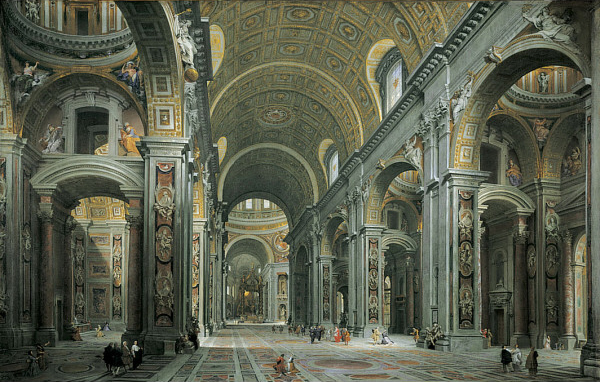
http://upload.wikimedia.org/wikipedia/commons/3/3e/Giovanni_Paolo_Panini_-_Interior_of_St._Peter


Some people fall in love with individuals. Hopefully, this love bears fruit and the two people involved get married.

But, sometimes, people fall in love with a family. I have witnessed this type of love several times, especially in the young. But, even those who are older can fall into a love for an entire clan. Many moons ago, Americans had a love affair with the Kennedys. Some Catholic loved the von Trapp family.

Charles Ryder in Brideshead Revisted fell in love with a family.  I know another young person who fell in love with a family, as he had practically no family at all. If the good families recognize this love, they invite the person to become part of the family.

One can fall in love with God’s family, the one, true, holy, Catholic, and apostolic Church. One of the gifts that God has given me for almost my entire life, as long as I can remember, is a great love for the Church.

I am passionate about the Church.

I love the Mystical Body, the Body of Christ in all the glory of God, and even in the darkness of certain times.If one loves the Church, one does not merely love the ideal, but the reality of the Church.

To love the Church is to suffer pain. To love the Church is to love the Bride of Christ which is not always as perfect as she could be. But, Christ sees the Church pure, spotless, in all eternity as the great Love He bestowed on the is earth for our benefit.

No matter if there are blemishes, Love sees with the eyes of faith and hope. From love flows faith in the Church as Christ’s creation for our salvation on earth. From love comes hope for her renewal.

I cannot tell you, I cannot put into words the love I feel for the Church. It is almost a “priestly” love, a love of the celibate, a love which has no bounds. Perhaps this is one reason I pray for seminarians and why I have many priest friends.

A long time ago, my mother asked me why so many of my friends were priests and nuns. I thought about this and realized that it was the Church I loved, and these chosen ones were clear representatives of my Love. Another person in my family got sick of my pre-occupation with the Church. Do we not become “full” of the person we love?
Do we not want to talk about our beloved all the time? Do we not think of our loved one constantly and want to be with him and serve him?

Christ founded the Church for me, for you, for all humans.

Can you not love the Church passionately as well? Love covers a multitude of sins.

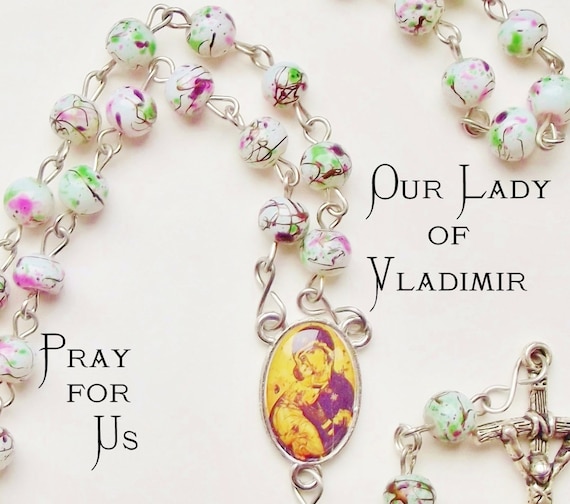
Beautiful Rosaries


I must praise the work of the rosary creator, Tigga Wild. Her work is incredibly beautiful. I highly recommend her rosaries.


Thank God for Coffee Shops-And, The Creche of The Church


Someone said to me that people are born saints. I remind them through this post that only two people were born without Original Sin. The Blessed Virgin Mary, who is the Immaculate Conception, and St. John Baptist, who was cleansed of sin and filled with the Holy Spirit will in the womb, at the Visitation.

All the rest of mankind has had to deal with concupiscence, the tendency to sin, as well as the results of Original Sin, such as a weakened will, a clouded intellect and the rule of the passions.

That some people are given tremendous graces early in life cannot be doubted. St. Padre Pio and St. Gemma Galgani were blessed with graces as youth.

Some saints experienced great life in God only later, such as St. Benedicta of the Cross, a convert or St. Mary Magdalen, a reformed sinner.

Firstly, one should never compare states of holiness. Not only is this a waste of time, but severely damages one’s perspective and interferes with one’s natural growth in grace.

The Holy Spirit, given to us in baptism and further stirred into our hearts, minds, souls, and bodies in confirmation, comes to us a “substantial manner” which Henry Edward Cardinal Manning reminds us in his wonderful book, The Temporal Mission of the Holy Spirit, is found in the Church.

To be a saint, secondly means, that one is in the Church, where one has access to grace, from babyhood on to the end of one’s life.

Manning writes this, “Wherefore they who do not partake of Him (the Spirit) and are not nurtured into life a the breast of the mother (the Church), do not receive of that most pure fountain which proceeds from the body of Christ, but dig out for themselves broken pools from the trenches of the earth, and drink water stained with mire, because they turn aside from the faith of the Church, let they should be convicted, and reject the Spirit let they should be taught.”

What a condemnation of those who have been given grace, but have deliberately walked away from the sacraments, the life of grace in the Church.

Thirdly, becoming a saint requires work and attention.  Again, Manning is helpful here, when he quotes Tertullian on our creedal statement at baptism:

“But forasmuch as the attestation of (our) faith and the promise of our salvation are pledged by three witnesses, the mention of the Church is necessarily added, since where these are—that is, the Father, Son, and Holy Ghost—there is the Church, which is the Body of the Three.”

To begin to be a saint, therefore, begins with the Creed, the assent to the primary teachings of the Catholic Church.  The Indwelling of the Trinity reveals these to each baptized person, and guides each person who seeks, to find the Truth.

How does one become a saint?  By cooperating with natural law, which is “permanent and immutable”, as Manning writes, and by moving into the life of grace given to the Church by Christ Himself for our salvation.

Salvation is not merely the first rung on the ladder of perfection. It is the beginning of the life of adventure which marks the saint. All things then come together for the good of the person, in Christ, through Divine Providence, and with the oversight of Mother Church.

Few are born saints. Most are bred in the nursery of the Catholic Church. Those who want to love God first, seeking the Bridegroom, will not be turned away. The Church is like the Pole Star, a fixed mark which guides us home to heaven.

to be continued…


Saturday, 17 May 2014

Friday, 16 May 2014

Cow-Minds

The small herd of Black Angus across the gravel road, begin eating about four in the morning. These animals, and their young, eat all day. Grass and hay form the main stuff of their diet.

Sometimes, they move to another part of the hilly farm. Sometimes these huge animals lay down around some small plum trees, or stand in the shade under some stunted maples.

One male turkey of an impressive size and one rather scrawny female turkey live in the same field. Deer use to come out of the woods to the field, which consists of a few low hills, but since the cows basically live in the fields all day and all night, the deer have moved on.

Black Angus eat and then die in the autumn. The entire purpose for their existence is to provide food for Americans. These animals have no idea of the future or their ultimate destiny.


Some Catholics are acting in a similar manner, eating, drinking, enjoying the sunshine, without any life of reflection.

Catholics are not dumb beasts which live on instincts. However, too many Catholics, both NO and trads, seem to living as if they were unaware of their destinies as well.

We are all created for a purpose. That purpose was determined in the Mind of God from all eternity. God knows us and our purpose. He watches over us, like the agents to tend this farm across the road. But, God waits for us to awake to our vocation and the pursuit of fulfillment in Him.

People with cow-minds never think, never reflect, merely react. These people may live relatively good lives, but lives without purpose.

Think, pray, reflect, act. Become a full human being.


Pray for Internet Access

I may be in a place for four days without Internet access. Please pray I can find a way to blog. Thanks.

STM

Bernardine of Siena-Two

St. Bernardine and St. John Capistrano by Alanso Cano
Two small points from St. Bernardine may make him come alive for you.

He always spoke with a great awareness of the needs of men and women in the world. His sermons refer to real problems, real stresses of married and family life. For example, he did not think that merchants should stay too long away from their wives, so as not to all into sin. He also condemned soundly sodomy as one of the worst sins. His words could not be stronger.

A second point is that St. Bernardine calls all people to holiness. No one is exempt. But, the way is simple:


Know that the devil hath taught the opposite of this 
to the malice of men, to bring them into danger and also 
those who listen to them. Have faith therefore in that which 
thou seest made so clear by reason. Who dost thou believe 
is more powerful, God or the angels? God. Who is more 
powerful, the angels or the soul ? The angels. Which has 
more power, the 'soul or the constellations ? The soul. 
Which has more power, the constellations or the human 
body? The body. Which has more power, the reason or the 
senses? The reason. Which has more, Holy Church and 
her Doctors or thine own opinion? Holy Church. Attach 
thyself then to that which Holy Church teaches and believes 
and holds, and forsake that which in thine own opinion 
thou hast held true; for free will was given to man, and 
hath never been taken from him, and never will be while 
he shall exist in mortal flesh. 

Bernardine of Siena-One


Reading a book on the sermons of St. Bernardine of Siena has been an adventure. His sermons provide a revelation of an earthly man, completely in touch with reality.

His advice on the pursuit of perfection covers many aspects, but I want to highlight one, as his feast is approaching on May 20th.

Bernardine cautions all who are seeking holiness to do so within the vocation to which each is called. He warns us that we must not compare ourselves with the greatest of saints, such as SS. Francis and Bernard of Clairvaux. Instead, each man and woman is to look at when, where and how God has called each one to become a saint.

He notes that St. Francis could fast for forty days. And, Bernardine tells his listeners in his sermon that one cannot copy this type of behavior, if God has not given the grace.

However, he challenges us to be open to as much grace as God wants to give. Whether one is a large window or a small window, the openness to grace is all that matters.


Lay to thy heart this example, which doth show 
thee how the Grace of God cometh to men. Seest thou those 
windows? One of them is wholly open, one open but a 
little way, and one less. Even by way of those which are 
shut fast there doth enter some of the Grace of God, since 
that there are certain tiny crevices therein. And by way 
of every one of those windows there doth enter something 
of the splendour of the sun, but here more and there less; 
for so much or so little brightness doth enter there within 
according as each is more or less open. So is it with those 
who wish for Grace from God, according as he doth dispose 
himself so hath he Grace: if he doth show himself very 
well disposed, God giveth him very much of it; if he doth 
show himself but little disposed, then God giveth him but 
little Grace. And to the man who doth shut himself away 
from it, even to him God would give of his Grace. 

to be continued...

BTW, St. Bernardine is patron of those with respiratory illnesses. Those of us 
with asthma can ask him for healing.

Cynicism in The Young


Can there really be people who do not believe in love?

I have met several on this blog, commentators who doubt that God is Love to the point where they insult Love.

I do not post their comments. They rage against love. They cannot believe that anyone can truly love another.

More and more, I am grieved by those who are young who have no concept of the Sacrificial Love of Christ on the Cross. These Millennials have become cynical for one reason.

They have grown up without love. 

Love is not things, like computers, one's own room, a car, cell phone or money. Love is not unlimited liberty.

Part of the problem is that too many young people are growing up in homes where they are either the only child or one of two. These young people never had to share space, or wait for the use of the shower, or wear hand-me-down clothes. They have had everything they have desired, and grown up in families where their parents did not deny themselves things, either. These young people have never had to wait or work for something, but just got it. They have an expectation, a consumerism, and the need to never be denied anything they want "right now".

Sacrificial love is learned by denying one's self, one's needs, one's comforts. Those who have never denied themselves anything cannot understand sacrificial love.

The cynic cannot trust. The cynic no longer cares about others. The cynic cannot do anything, as she is denying herself the power of love.

Where do we start evangelizing those who do not know real love, or those who are cynical?

Where do we start but in prayer?

The Sin of Malice

I never knew, deep down inside, until recently, that there were people who actually took pleasure in causing other people distress. I had assumed that those who perpetrated great evils had at least some false reasoning why they acted in despicable ways.  I understood those who killed, for example, may have done so out of anger, spite, fear, envy, power, but to kill or hurt out of sheer malice seemed impossible for human beings. A person who is a sado-masochist may do things out of malice, but one does not need to be such a monster to be soaked in malice. One can be a smaller, more pitiable human being.

Sadly, recently, I have come up against sheer malice. Malice is hatred for hatred's sake; it is the desire to inflict pain. But, it is also a desire to be a "negative god" and be in control through hatred.

What has shocked me is that malice can be a sin found in mothers and fathers. Imagine, parents hating their own children...I have only seen this recently in a friend of mine's family. Thinking on malice made me realize that the Father of Malice, Satan, has trained some people who have given him power over their wills.

Malice is not a simple passion or an act which comes from an occasion, but a movement of the disordered will.

St. Thomas Aquinas writes this in the Summa Theologica under "malice":

The will is related differently to good and to evil. Because from the very nature of the power, it is inclined to the rational good, as its proper object; wherefore every sin is said to be contrary to nature. Hence, if a will be inclined, by its choice, to some evil, this must be occasioned by something else. Sometimes, in fact, this is occasioned through some defect in the reason, as when anyone sins through ignorance; and sometimes this arises through the impulse of the sensitive appetite, as when anyone sins through passion. Yet neither of these amounts to a sin through certain malice; for then alone does anyone sin through certain malice, when his will is moved to evil of its own accord. This may happen in two ways. First, through his having a corrupt disposition inclining him to evil, so that, in respect of that disposition, some evil is, as it were, suitable and similar to him; and to this thing, by reason of its suitableness, the will tends, as to something good, because everything tends, of its own accord, to that which is suitable to it. Moreover this corrupt disposition is either a habit acquired by custom, or a sickly condition on the part of the body, as in the case of a man who is naturally inclined to certain sins, by reason of some natural corruption in himself. Secondly, the will, of its own accord, may tend to an evil, through the removal of some obstacle: for instance, if a man be prevented from sinning, not through sin being in itself displeasing to him, but through hope of eternal life, or fear of hell, if hope give place to despair, or fear to presumption, he will end in sinning through certain malice, being freed from the bridle, as it were.

A long time ago, I met a woman who worked with me who delighted in being negative about everything. She took a strange pleasure in "stirring up the pot" at work. She was one of the most unhappy persons I have ever met.

But, even her activities may not have been those from a bent will, a will bent on malice.

However, seeing a person manipulate those around her for evil has revealed to me that some just take a perverse pleasure in causing pain and suffering. Malice goes beyond fear of the Lord, as St. Thomas points out. Malice goes beyond presumption. No longer does the person care for anything accept his own will to be done. Malice has a deformed will. 

Out of malice comes a bloated narcissism, driving out all love, even self-love. I pray that my friend can free herself from her family of malice and find peace of mind. She also needs to find herself. (See my posts on identity.) She was formed in a house of malice and she is not free to be who God created her to be. 

God have mercy on all involved.

Dark Night Series Continues

One of the things about this blog which I love are the wonderful readers who share their experiences with me and encourage me in my writing.

There are many saints reading this blog and I am humbled by their comments and insights.

One of the readers has shared with me her own Dark Night experiences. She has experienced the Light, which St. Padre Pio states, is just behind the shadows, just barely visible to the one in the Dark Night.

That God hides from one until that person is pure enough to experience Him rather than experience one's own idea of Him is a mystery of the Dark Night.

How many times do people fall in love with an "idea" rather than with a real person. To love a real person is a wonderful experience and those of us who have experienced this are grateful for that love.

Christ waits for us until we are ready to experience Him as He wants to reveal Himself.

Many times, people are afraid of love and back away from real relationships. Perhaps these people have been hurt and do not trust anyone. Perhaps they are afraid of someone "finding out" what one is really like.

Of course, real love accepts a person as he is, and not as one imagines that person to be. Such is the freedom of love and such is the wonderful freedom one experiences when God allows Himself to be found.

If God is not letting one find Him, it means the person is not ready to experience the love of God. The bride in the Song of Songs goes searching for her beloved. And, when she does this, it is night.

This is an allegory of the Dark Night.


Song of Solomon 3

Douay-Rheims 
3 In my bed by night I sought him whom my soul loveth: I sought him, and found him not.
2 I will rise, and will go about the city: in the streets and the broad ways I will seek him whom my soul loveth: I sought him, and I found him not.
3 The watchmen who keep the city, found me: Have you seen him, whom my soul loveth?
4 When I had a little passed by them, I found him whom my soul loveth: I held him: and I will not let him go, till I bring him into my mother's house, and into the chamber of her that bore me.