Recent Posts

Monday, 17 March 2014

Perfection Series II: liv

Reposts from March, 2012


Perfection Part Eleven -Silence


On Perfection continued...

These posts seem to be popular, so I shall do two today. It is Lent, and such meditations may be helpful for some, including myself.


The overlap of the Carmelite, Benedictine and Dominican spiritual ways can be clearly seen in the the call to some silence during the day. Now, as busy lay people, we must create these little shells of silence so that we can hear 
the Voice of God, the small, still Voice. Without silence, one is not in touch with one's own soul or with God.

I have known extremely busy people. Not only are these people busy during the day, but when they come home at night, they have the television on until they go to bed. From the minute they wake up in the morning, when they 
turn on the radio, read the paper, run about doing necessary or unnecessary activities, these Catholics are never 
silent. I would be exhausted without silence.

If I do not have time in the morning and in the evening, at the very least, for reading Scripture, one of the Hours, 
such as Vespers, I cannot act as a serene, human being. Silence gives me grounding for the entire day, and if I practice silence, it can remain within me for the entire day. This is the beauty of silence, it becomes a wellspring of 
life within us, overcoming other noises and confrontations.

Silence breaks down anxiety and fear. The most fearful people I know cannot bear silence. They must keep moving, keep doing, even if they are retired. The rhythm of life which includes silence gives a richness to one's existence 
and keeps one from falling into superficiality.

Why some people are afraid of silence is that they are afraid of suffering. In silence, I see my sins, my failings, my failures. In silence, I face the need for conversion daily. In silence, I meet God, who is All Goodness, All Innocence, 
All Perfection.

Only in Faith can one approach silence, as in silence one meets the God of Mercy and Forgiveness.

I have talked with friends as to how to create more silence in their day. Some want to do so and some want to keep running away from God, which to me, is running away from Love.

Silence is never boring, as some may believe, unless one thinks God is boring. The Infinite is so beyond me, that
only is silence can I meet God.

We are fast approaching Holy Week, when in the Passion of Christ, we see Him keeping silent before both the Sanhedrin and Herod. Christ said little in front of Pilate, but He was calling Pilate to Himself, and was trying to 
make the Roman see. Christ remained silent because He did not need to defend Himself. He is God. He is Man. 
e stood in silence, in Perfection, and those who judged Him unfairly could not see the Silence which stood before them, as they had never met Him in silence. Those who meet God, know Him when they see Him.

Perfection Part Ten-Docility


Reading Garrigou-Lagrange again and again, I am struck with the idea of docility. Now, some of us are made more 
or less docile. As a person with a strong will and strong character, docility is something I have had to learn. Not all 
of us are created the same. The idea of modern psychologically which states in popular terms that we can be all we want to be is simply 
not true in one sense and very true in another. Garrigou-Lagrange insists that docility may be learned or acquired by all, and should be the goal of the saint. In fact, one cannot grow in holiness without docility.

Now, docility is not “wimpiness” or a lack of character. One must have character and person-hood in order to seek spiritual docility. To live in fear, fear of anything or anyone, is no docility. In fact, really craven fear hinders one from coming to trust in Providence, another great theme of Garrigou-Lagrange. Unless one trusts in Providence, one
 cannot grow in docility of spirit.

Perhaps two of the most individual and strong saints, mentioned last week on this blog, SS. Teresa of Avila and Therese, the Little Flower, demonstrated in their autobiographies, that they had powerful, personal characters. They knew who they were, they knew their talents and limitations, they were capable of facing their own lack of perfection and cooperating with grace to attain such perfection.

In my little mini-series on perfection, in which I have tried to make Garrigou-Lagrange more accessible to modern readers, I have found that the simple message of perfection rests in the desire and seeking of docility. Now, for any woman in the modern world who is a feminist, my statement sounds like heresy. In the age of the emerging woman, which is a false idea by the way, as one only has to look at the great saints here mentioned, plus SS. Etheldreda, Gertrude, Brigid, Bridget, Matilda, Hilda, Eanswyth, Catherine of Siena, and so on to see powerful women acting in public spheres in the Church for centuries, women are supposed to be what I call “Bolsheviks”, that is, contradictory and totally independent. Of course, this is a physical, psychological and spiritual impossibility, created to destroy vocations as well as society. The Bolshevik mentality lends itself to splendid and, indeed, painful isolation. Some 
men fall into this mode of being, to the loss of their soul's growth and even salvation, as it is in dying to self that one gains heaven.

Docility requires greater courage than action. One must control one's desires, tongue, plans, in fact, give up control one's own life and trying to control the lives of others. This is also a goal of the Benedictine Rule, which I love so 
much. To be obedient to one's superior is to give up control. To give up control, is to become docile.

Obedience, dying to self, docility. The great spiritual masters, 
such as Garrigou-Lagrange and St. Benedict tell us that this is the 
only way to happiness and holiness.

As Garrigou-Lagrange notes, the ultimate docility is the giving of our soul completely to God. This action is connected to detachment and to listening in contemplation. By the way, without some silence in one's life, one cannot attain either docility or detachment. Silence is the absolute sine qua non of the spiritual life.

Posting an oldie because of a commentator who is deluded

On False Prophets and Supposed Seers

repost from March 20, 2012

I must again repeat another theme while I am here in France and have a little time to post. It has been brought 
to my attention by friends in Ireland and Great Britain that many ladies and some gentlemen have been reading prophecies online on the last days and the Second Coming. Now, most of these so-called seers are harmless, but some are heretics. I have found many doctrinal errors looking briefly at some of the sites to indicate to me that 
most should be avoided. If those people I know would spend their time reading the encyclicals and the CCC, they would be much better off than following false prophets. I wrote about this earlier, in January and I use the same facepalm photo to get my point across. Part of the problem is in this post, on the dumbing down of lay expectations....
http://supertradmum-etheldredasplace.blogspot.fr/2012/01/apostolicam-actuositatem-and-dumbing.html

 For many will come in my name, claiming, ‘I am the Messiah,’ and will deceive many. Matthew 24:7

We are warned by Christ not to follow false prophets, and the existence of the Internet makes these people have a much larger audience than one would suspect. While I was in Ireland, I was told of three people who are now supposedly seeing the Blessed Virgin Mary regularly, and these false visions are not even on the Net, which has enough nonsense floating into people's unsuspecting souls. Most of these false prophets are anti-intellectuals, 
who do not have a solid grasp of the Teaching of the Catholic Church. I have already mentioned the causes at this post,http://supertradmum-etheldredasplace.blogspot.fr/2012/01/sometimes-i-prefer-secular-humanism.html

One of the most popular in the British Isles and in Ireland is this website, http://www.thewarningsecondcoming.com/ where just on the section on the Second Coming, I found
 twelve errors, including four doctrinal errors. When I have pointed these out to people, I am told that priests are supporting these statements. I hope not.

Some of the errors fall into these categories: one, that Revelation is still being given by Christ. NO, in the answer, 
as all Revelation ended with the death of the last Apostle, St. John. Anything else is blatantly false and should be suspect. Here is the pertinent section from the CCC on this one point.

Here is part of that section:
66 "The Christian economy, therefore, since it is the new and definitive Covenant, will never pass away; and no new public revelation is to be expected before the glorious manifestation of our Lord Jesus Christ."28 Yet even if 
Revelation is already complete, it has not been made completely explicit; it remains for Christian faith gradually to grasp its full significance over the course of the centuries.
67 Throughout the ages, there have been so-called "private" revelations, some of which have been recognized by 
the authority of the Church. They do not belong, however, to the deposit of faith. It is not their role to improve or complete Christ's definitive Revelation, but to help live more fully by it in a certain period of history. Guided by the Magisterium of the Church, the sensus fidelium knows how to discern and welcome in these revelations whatever constitutes an authentic call of Christ or his saints to the Church.
Christian faith cannot accept "revelations" that claim to surpass or correct the Revelation of which Christ is the fulfillment, as is the case in certain non-Christian religions and also in certain recent sects which base themselves 
on such "revelations".


68 By love, God has revealed himself and given himself to man. He has thus provided the definitive, superabundant answer to the questions that man asks himself about the meaning and purpose of his life.
69 God has revealed himself to man by gradually communicating his own mystery in deeds and in words.
70 Beyond the witness to himself that God gives in created things, he manifested himself to our first parents, 
spoke to them and, after the fall, promised them salvation (cf. Gen 3:15) and offered them his covenant.
71 God made an everlasting covenant with Noah and with all living beings (cf. Gen 9:16). It will remain in force as 
long as the world lasts.
72 God chose Abraham and made a covenant with him and his descendants. By the covenant God formed his 
people and revealed his law to them through Moses. Through the prophets, he prepared them to accept the 
salvation destined for all humanity.
73 God has revealed himself fully by sending his own Son, in whom he has established his covenant for ever. 
The Son is his Father's definitive Word; so there will be no further Revelation after him. 


The seer on the website claims the opposite.

Secondly, the false prophet states that there is a thousand years of peace after the Second Coming. NO, the 
Second Coming is the end of time and the judgement of all. Again, one only has to look at the CCC, here linked 
for this information. A few lines from this section are sufficient: 680 Christ the Lord already reigns through the 
Church, but all the things of this world are not yet subjected to him. The triumph of Christ's kingdom will not come about without one last assault by the powers of evil.
681 On Judgment Day at the end of the world, Christ will come in glory to achieve the definitive triumph of good 
over evil which, like the wheat and the tares, have grown up together in the course of history.
682 When he comes at the end of time to judge the living and the dead, the glorious Christ will reveal the secret disposition of hearts and will render to each man according to his works, and according to his acceptance or 
refusal of grace.

Another glaring error is the indication that one can pray for a Seal of some sort, to mark that person as saved. 
NO, we receive seals in Confirmation, completely our Baptism, and some men, who are priests, get an mark of the priesthood. All these are given within the context of the Sacraments. The seer is a Protestant. Again, the CCC can 
be used for enlightenment Again, I share a small segment: 
1304 Like Baptism which it completes, Confirmation is given only once, for it too imprints on the soul an indelible spiritual mark, the "character," which is the sign that Jesus Christ has marked a Christian with 
the seal of his Spirit by clothing him with power from on high so that he may be his witness.121
1305 This "character" perfects the common priesthood of the faithful, received in Baptism, and "the confirmed 
person receives 
the power to profess faith in Christ publicly and as it were 
officially (quasi Ex officio)."122


There are more errors, which I elucidate later if people are 
interested. Another false and dangerous site is http://www.courlisius.org/  which includes many people condemned 
by their local bishops. I would steer clear of all those listed on this site. The lack of Catholic Teaching and Catholic discernment means not only that many of those who read these sites are wasting their time, but that they are led astray into theories of the end times which have nothing to do with reality.

We are warned and we need to keep close to the Church in order to decide what is true and what is false. A person can lose one's immortal soul by following these deceived seers. All these prove that the prideful desire for inside knowledge, instead of the pursuit of the True Faith, leads many people into serious error. I ask priests to clarify such things for those who come to them and even from the pulpit.

And, I am simply tired of hearing the argument, such as those from some of my friends involved in Bayside, 
which has been condemned, that one does not have to obey a liberal bishop on matters of private revelation. Since when?

On The Mundane

I have been looking at luggage. The airlines broke two of my suitcases. One was ripped on the side, and the other had both the bottom ripped, and the place where one places the lock broken off. I shall publicly tell you not to buy Rockport luggage, as after one trip these things happened.

However, looking at replacements has proven to be a difficult task. Most of the luggage on sale at a local shop is not first or second rate, but third.  And, the TSA now has approved locks. Sigh, the days of using old Samsonites from the 1960s seems over.

Simpler days.  I remember flying when customers were wooed by airlines, when customers were treated to comfortable seats with leg room, when customers felt like humans and not sardines in "squeezy jets".

Buying luggage complicated my entire day, as looking at consumer ratings took much longer than I expected. The older brands we knew and loved are no longer the best buys or the sturdy suitcases. I have used Delsey in the past, but the prices of this good brand have skyrocketed-no pun intended.

The best ones listed on surveys and consumer "digests" cost way too much for my very small budget, and the sales seem to be clearances of lines no longer applicable to fitting into the new rules for cabin bags. Some airlines now only accept 10 kgs in the cabin, and 20 kgs in the hold. People must buy stuff at the other end of their journeys.

If I could take a ship back to Europe, I would.

http://en.wikipedia.org/wiki/File:QV_in_Southampton.JPG

Sunday, 16 March 2014

Comments?

http://www.telegraph.co.uk/news/politics/10700499/Scotland-vote-threatens-to-derail-2015-election.html

Challenge to British Readers

What has happened at the Catholic Herald?

Once the best of a bad lot of Catholic publications in Great Britain, the Catholic Herald is beginning to sound more and more like The Tablet.

Perhaps it is time for a group of Catholics who are Catholics to begin a new Catholic newspaper or journal.

I would be glad to help any English person who is interested in setting up a really new paper which has an editiorial policy of printing Catholic news from a Catholic point of view.

Anyone interested? I want to start a Catholic newspaper in Great Britain which is really Catholic. I want this to be the vanguard news source for Catholic issues, full of excellent Catholic commentary and articles by such good priests who celebrate the TLM.

Any takers? Are there any donors out there who would help with this venture? I can start with a website, but I need a donor.

Perhaps the collapse of the last really Catholic newspaper is a sign either that a new one is necessary, or that is the age of the news blog.

Ideas, comments?  Many think this age is, indeed, of electronic newspaper. What do you all think?

I want to start up a website newspaper for English consumption. Who will help with this? We would need a person in Rome, to start with....and money. I would, as you all know, be willing to relocate to the EU asap.

I think paper is not the way to go....

Perhaps, that the CH is in demise as a really Catholic paper, shows that the electronic media is the only means of reading really Catholic news and opinion.


Perfection Series II: liii


A dangerous position for writers studying the path of holiness is that scholarship overtakes experience. I have tried to hold back on writing on the Illuminative State, as, obviously, I am not "there". But, for those of you who are on a path beyond where I am, and for those of you aspiring to holiness, I can share the outlines of this remarkable state.

The Illuminative State involves the end of the active types of prayer and leads one into the passive type of contemplation. This type of prayer happens when Christ, the Bridegroom, takes over prayer, and the soul remains in the passive position of the Bride.

Some of the great saints, such as Bernard of Clairvaux, experienced this state, before moving on to the Unitive State, very early in life, of course, and were fortunate in their ability to share in words what this stage involved.

God allows Himself, finally, to be found, to be apprehended by the soul, which is now purified. God can take over the soul and loosen the bonds which held back the complete life of the virtues. The second chapter of the Song of Songs delineates the Illuminative, and finally, the Unitive State. Once the soul, mind and body are pure, God allows us to find Him.


He brought me into the cellar of wine, he set in order charity in me.
Stay me up with flowers, compass me about with apples: because I languish with love.
His left hand is under my head, and his right hand shall embrace me.
I adjure you, O ye daughters of Jerusalem, by the roes, and the harts of the, fields, that you stir not up, nor make the beloved to awake, till she please.
The voice of my beloved, behold he cometh leaping upon the mountains, skipping over the hills.
My beloved is like a roe, or a young hart. Behold he standeth behind our wall, looking through the windows, looking through the lattices.
10 Behold my beloved speaketh to me: Arise, make haste, my love, my dove, my beautiful one, and come.
11 For winter is now past, the rain is over and gone.
12 The flowers have appeared in our land, the time of pruning is come: the voice of the turtle is heard in our land:
13 The fig tree hath put forth her green figs: the vines in flower yield their sweet smell. Arise, my love, my beautiful one, and come:
14 My dove in the clefts of the rock, in the hollow places of the wall, shew me thy face, let thy voice sound in my ears: for thy voice is sweet, and thy face comely.

Garrigou-Lagrange notes these characteristics of the Illuminative State:

time of contemplation which is no longer active but infused;
gift of wisdom under practical form (especially for those in the active life);
extraordinary visions and revelations attached to contemplation;

One thinks of Padre Pio and his great gifts in the confessional, along with his ability to bi-locate, for example. That he attained the Unitive State is heralded by the Church in his canonization.

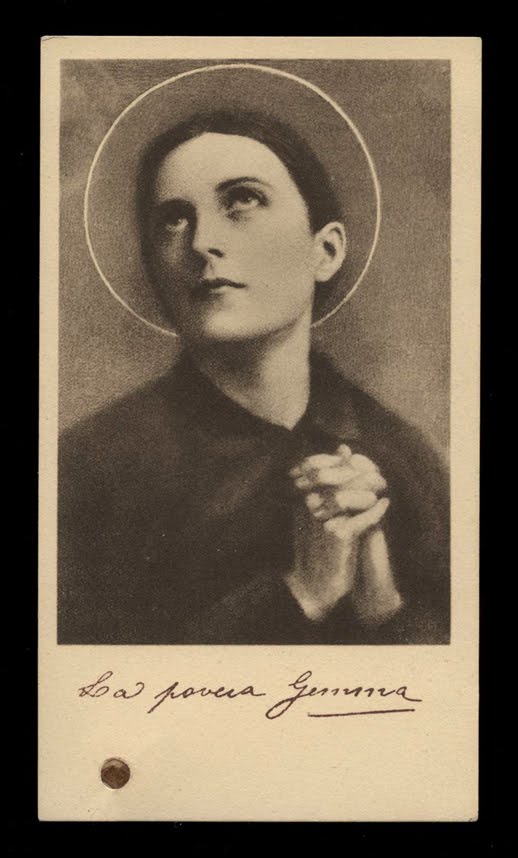
Gemma Galgani reveals the Illuminative and then the Unitive State. Like Padre Pio, the complete union with Christ may involve the saint suffering the real pains of the Passion of Christ.

However, in the Illuminative State, one is still not in complete union, or union as it is possible while one is still on earth, body and soul.

Again, I have met a few people who have attained this state-very few. One was an Opus Dei priest, whose wisdom and deep spirituality in the confessional provided me with great guidance when I was in Ireland.

Pray for the purgation necessary to reach this state of Illumination. Then, truly, you will be building the Kingdom of God, allowing God to use you, now stripped of all egotism and the predominant fault.

To be continued....

Why are priests not asking for prayers for our brothers and sisters from the pulpits?

Human Rights Watch says in a report that the attacks by Boko Haram are having a devastating impact on the population of north-eastern Nigeria.
Quoting United Nations figures, it says some 300,000 people have fled their homes over the past year.
"Even if the government can't stop the attacks, at the very least, it can meaningfully assist the people who have been most devastated by them," says HRW's Africa director Daniel Bekele.
Boko Haram was founded in Maiduguri in 2009. It wants northern Nigeria to become an Islamic state.

Perfection Series II: lii


Perhaps the most obvious state of perfection to see in the world is the Illuminative State, or stage. At this level, the Catholic works in obvious ways to build up the Kingdom of God. As noted before, this is the stage of the foundation of orders, the formation of schools, hospitals, as well as the work of holy scholars.

One can see the Illuminative State physically and spiritually in the person who lives the life of virtue easily, without any barriers, having had sin and the tendencies to sin cleansed from the imagination, intellect, soul and body.

One point, which must be made, involves the fact that some saintly people at this state suffer intensely. Suffering may be found in all stages of holiness, which confuses some people, who expect saints to stop suffering after years of purification.

By the way, some good works can be done purely out of faith, such as the foundation of orders when the founder remains in the Dark Night, without the release of the virtues witnessed in the Illuminative State. However, this phenomenon would be rare, and God would allow this to teach the Church that living solely by faith in God, while in great darkness and without any consolations, forms a great good. Such a journey was seen in the life of Blessed Mother Teresa of Calcutta, whose long, long Dark Night of fifty years, did not hinder her from creating a new order. God allowed her to suffer those long years of solitude in darkness to teach the Church to have faith in dark times.

Her long suffering matches the long years of physical suffering of Blessed John Paul II. The public suffering of this Pope reveals, again, that suffering is necessary for holiness. 

Too many priests teach that saints are imperfect. This is not the view of the writers we have followed on this blog. Preaching that one does not need to actively seek for purification and perfection may be one reason why the Church remains so weak. People say, "Would it not be a good time for a great saint, like Ignatius or Augustine, to renew the Church?"

Yes, it would be, but we are the people who God calls to be saints, and to sit in mediocrity, aiming only at
getting into purgatory, remains one of the sad lies of our century.

To respond to the call of saintliness means that those in the Church are willing to say "yes" to the suffering necessary to arrive at the Illuminative and Unitive States.

I have met a few people in the Illuminative State. I have not met anyone in the Unitive State. Why?

Saints respond to the call of God, through suffering, to the life of the virtues.

to be continued....


Saturday, 15 March 2014

London no longer number one?

http://www.businessweek.com/news/2014-03-15/new-york-steals-london-s-mantle-as-world-s-top-financial-center


Repost of a repost mark two

Tuesday, 11 February 2014

Perfection Series II: xxiii


Thoughts on Sunday morning re-post


When I was in the monastery, I was allowed time for reading and personal discernment. I read many books, 
mostly on the nature of the religious life and the way of perfection. As a person seriously considering and being considered, I had to write notes to Mother Prioress on my progress. We only spoke rarely, but it is the duty of the postulant or seeker to share insights and problems. However, for that order, as explained to me, the Rule of St. Benedict lived daily provides discernment, as well. If one manages to live by the Rule and is inspired by the 
Holy Spirit the Rule is actually a daily way of examination of conscience which happens immediately, all day long. 
For me, obedience was not difficult. But, God deals directly with a person under obedience in two ways. 
One way is directly through the Rule and, in one's superior. The second way of obedience is through one's direct relationship with God especially in deep prayer. The Tyburn order has the great advantage of daily long hours of Adoration, providing time for the postulant to wait on God for insights and direction. Lectio Divina and one's personal reading and to spiritual growth and formation. 

A lay person seeking this perfection, which we are all called to do, must do. to be continued... By the way, 
I heard a fantastic sermon this morning which I shall share in the next post.

Remember, all the laity are called to perfection, although the convent and monastery are short-cuts.

All are called to be perfect. What is hard is to persevere seeking Christ the Beloved without the short-cuts.

For those in the Dark Night stage, this chart may be useful. Found in Garrigou-Lagrange, part four....

Signs of the passive purification of the senses
Psychological Description
According to St. John of the Cross
Theological Explanation By the Gifts of the Holy  Ghost
3. Great difficulty in meditating discursively, an attraction for the simple affective gaze toward God.Inspiration of the gift of understanding, beginning of infused contemplation.
2. Keen desire to serve God, thirst for justice, and fear of sin. Resistance to temptations.Inspiration of the gift of fortitude, which in the midst of difficulties preserves the hunger and thrist for justice, and influence of the gift of fear to resist temptations.
1. Sensible aridity, no consolation in the things of God, or in created things.Inspiration of the gift of knowledge, which shows the vanity and emptiness of everthing created, the gravity of sin, whence the tears of true contrition.
40. Cf. R. de Sinety, Psychopathologie et direction, 1934, pp. 66-87.

Helping the Confused on the Levels of Prayer

The last stage of the Illuminative State is when people start working for God full-blast, without egotism. This is the time when such saints as Thomas Aquinas wrote the Summa, Benedict set up his Rule, Ignatius began his order and so on. At that last state, one is no longer actively praying, but praying in passive contemplation. The Unitive State is when one actually becomes a saint, and one can see in lives, such as John Paul II, public purgation, which resulted in Illumination and finally, Union.


SYNTHESIS OF THE TREATISE ON THE THREE AGES OF THE INTERIOR LIFE BY GARRIGOU-LAGRANGE
(To be read from the bottom up)

Unitive life of the perfect
◊ full◊ extraordinary, e.g., with the vision of the Blessed Trinity
◊ weak
◊  ordinary
• eminent contemplative form
• apostolic form
◊ initial◊ not very continual union, often interrupted
Illuminative life of proficients
◊ full infused contemplation
◊ extraordinary or accompanied by visions, revelations
◊ ordinary
clearly contemplative form
 active form, or form ordained to action, e.g., gift of wisdom under practical form
◊ weak◊ transitory acts of infused contemplation (d. The Dark Night, Bk. I, chap. 9)
◊ initial◊ passive purification of the senses more or less well borne (initial infused contemplation)
Purgative life of beginners
◊ full or generous◊ fervent souls pious and devout souls
◊ weak◊ tepid or retarded souls, not without relapses
◊ initial◊ first conversion or justification

Repost of a repost

Tuesday, 5 November 2013

Repeat Post on Prayer

Sunday, 29 September 2013

The Next Levels of Prayer-After the Dark Night

People ask me is God can skip steps. God can, but people cannot. We are made up of body and soul, and our nature is such that we grow in steps spiritually as well as physically. The timing of the steps can vary, of course, with great young saints, such as St. Gemma Galgani reaching great heights through grace quickly.


God decides our time-table, but, we must cooperate. Too often, we choose not to cooperate, as it is too hard to face the purgation which must happen in the Dark Night. Now, some people, especially young saints, do not have much purgation. Obviously, the more sinful we are and the older we are having lived, perhaps, unreflective lives, the more intense, and, therefore, perhaps, the longer the Dark Night. We cannot imagine so wonderful a soul as Blessed Mother Teresa as being in the Dark Night for such a long time, but that was God's Will for her.

After the Dark Night, the infused prayer of the passive recollection occurs, which is the beginning of contemplation. This is a prayer of quiet and these stages are part of Mystical Prayer.


St. Teresa describes initial infused prayer, that of supernatural or passive recollection, which precedes the prayer of quiet, as follows, with Garrigou-Lagrange's comments towards the end:
This is a kind of recollection which, I believe, is supernatural (like the prayer of quiet). There is no occasion to retire nor to shut the eyes, nor does it depend on anything exterior; involuntarily the eyes suddenly close and solitude is found. Without any labor of one's own, the temple of which I spoke is reared for the soul in which to pray; the senses and exterior surroundings appear to lose their hold, while the spirit gradually regains its lost sovereignty. . . . 
But do not fancy you can gain it [this recollection] by thinking of God dwelling within you, or by imagining Him as present in your soul. . . . By the divine assistance everyone can practice it, but what I mean is quite a different thing. Sometimes, before they have begun to think of God, . . . the soul is keenly conscious of a delicious sense of recollection. . . . Here it is not in our power to retire into ourselves, unless God gives us the grace. In my opinion, His Majesty only bestows this favor on those who have renounced the world. . . . He thus specially calls them to devote themselves to spiritual things; if they allow Him power to act freely, He will bestow still greater graces on those whom He thus begins calling to a higher life.(30)
The saint adds: "Unless His Majesty has begun to suspend our faculties, I cannot understand how we are to stop thinking, without doing ourselves more harm than good," (31) for then we would remain in idleness or the somnolence of the quietists.

"The supernatural recollection" which St. Teresa describes in the preceding passages is clearly a mystical prayer, the beginning of infused contemplation, for which simplified affective meditation prepares the soul.(32)

Now, I have written on quietism on this blog before-it can be a dangerous trap. The real infused recollection, leading into infused contemplation and the prayer of quiet are the fifth and sixth states of prayer found only in the Illuminative State. This can happen according to some writers after the complete purification of the senses and before the complete purification of the soul, while some authors state that the purification of the senses and that of the soul happen together before the Illuminative State.

In other words, the Dark Night would, in either case, completely finished before the Unitive State, and before the levels of prayer in that state, the subject of the next two posts on this subject.

To be continued.....

Get The Ways of Mental Prayer which Fr. Ripperger recommends. I have not read this myself, but would love to do so

Confusion on The Levels of Prayer

I have been following Garrigou-Lagrange's charts on the levels of prayer. There is a bit of complication regarding that great author's definitions and those of Dom Vitalis Lehodey. Now, the complication is not a contradiction, but merely different ways of explaining similar levels of prayer.

If you want to go back and look at the series on prayer, check out the dates of September 29th, September 30th, 2013 and February 9th and 10th of this year.

However, let me clarify a few points again. First of all, Affective Prayer comes during the Dark Night of the Soul, when one can no longer meditate and one can only give God loving "glances" as well as short prayers. The suffering of the Dark Night takes much energy, as purification is painful.

That this type of prayer is simple means that it is not the complex type of either active contemplation or passive contemplation.

It is interesting that Lehodey believes that Affective prayer happens in the Illuminative State and he follows it with the prayer he calls simple prayer. In Garrigou-Lagrange, simple prayer is found in the beginning states, before the Dark Night and before the Second Conversion. The Illuminative State at the last stage is truly one of power and getting things done. In other words, this state is one of true light and life.

To use these terms is, therefore, confusing for some who go to spiritual direction and are told to engage in simple prayer.

I would avoid the term simple prayer or the prayer of simplicity. To move from Affective Prayer to Active Contemplation, one is in an active state of prayer. Not so with Passive Contemplation. This latter type of prayer is not one of striving, but waiting on God.

Active Contemplation, and this is repetition of earlier posts, demands that the one praying is thinking on the Attributes of God, such as Beauty, Truth, Goodness and so on.

This happens in the Illuminative State. Affective Prayer according to Lehodey begins in the Illuminative State, but according to Garrigou-Lagrange, it happens in the Dark Night of the Spirit. This makes more sense, as loving, short prayers to God during the day is all one can do in the Dark Night.

Active Contemplation is the last level of the Dark Night of the Spirit and the Passive Contemplation marks the entrance into the state of Union with God.

to be continued....


Repost on virtue formation

Monday, 30 January 2012

Perfection Part Three-Thomism and the Spiritual Life

The concept of grace is rarely taught in catechesis and yet, a Catholic needs an excellent grasp on the concept of, especially, sanctifying grace, in order to grow in the interior life. The other concepts which an adult Catholic needs 
to understand are the virtues, or the life of virtue. The title of a key book, based on many sources, but none more than St. Thomas Aquinas, is Garrigou-Lagrange's The Three Ages of the Interior Life. When St. Paul writes of 
giving his converts "meat", this is meat, not milk. And, a caution to the pilgrim is that one can learn something intellectually and not have such concepts actually be part of the interior life of the soul, but only head knowledge. 
An excellent spiritual director is a necessity and good luck trying to find one in this day and age. Also, before one engages the ideas of Garrigou-Lagrange, I highly suggest at least the lay version of the Spiritual Exercises of St. Ignatius, again under a director. Again, good luck trying to find an orthodox, conservative director and not one 
involved in New Age interpretations of the classic thirty day retreat.

In a mini-series, of which this is the third part, I want to cover a basic approach to perfection, with an emphasis 
on the life of the virtues. One can read the complete discussion in Garrigou-Lagrange's great book, but I shall 
outline a few things on this blog just to interest readers. In this installment, I want to look at the infused virtues 
and in the next posting,  the seven gifts of the Holy Spirit, which we all receive in Baptism. Here is a useful chart 
from the book:

V
I
R
T
U
E
S
Theological
 Charity -->
 Faith -->
 Hope -->
Gift of Wisdom
Gift of Understanding
Gift of Knowledge
Gift of Counsel
Gift of Piety
Gift of Fortitude
Gift of Fear
G
I
F
T
S
Moral
 Prudence -->
 Justice
 - Religion -->
 - Penance
 - Obedience
 Fortitude -->
 - Patience
 Temperance-->
 - Humility
 - Meekness
 - Chasity


The Theological Virtues are infused, that is given to us by the Father. These are, of course, Faith, Hope and Charity. St. Thomas and Garrigou-Lagrange explain that the Theological Virtues are directed towards God as the End. 
We are given these virtues, but we must use and incorporate them into our souls. This is the job for each one of us, given these wonderful virtues at Baptism. One can read Garrigou-Lagrange for more detail. 

The Moral Virtues, however, help us get to Heaven-these are a means to that end. I highly recommend Josef Pieper'sThe Four Cardinal Virtues: Prudence, Justice, Fortitude, Temperance, a book I have used in class with 
great success in the past. These Cardinal Virtues may be considered Moral Virtues, but there are more Moral 
Virtues, while there are only the Four Cardinal Virtues.  I am not going into the entire list here. You can look here
One cannot be in mortal sin and develop the acquired Moral Virtues. Here is Garrigou-Lagrange: a man must no 
longer be in the state of mortal sin, but his will must be set straight in regard to his last end. He must love God 
more than himself, at least with a real and efficacious love of esteem, if not with a love that is felt. This love is impossible without the state of grace and without charity.(4) But after justification or conversion, these true acquired
 virtues may come to be stable virtues; they may become connected, relying on each other. Finally, under the 
influx of infused charity, they become the principle of acts meritorious of eternal life. For this reason, some theologians, such as Duns Scotus, have even thought it not necessary that we should have infused moral virtues.

As much as I would not like to do so, I shall leave Duns Scotus for another time. But, notice two words being used here-acquired and infused. Even pagans, state Aquinas, using Plato and Aristotle, can acquire virtues; however, 
an example from Garrigou-Lagrange helps here: As St. Thomas remarks,(8) acquired temperance has a rule and formal object different from those of infused temperance. Acquired temperance keeps a just medium in the matter 
of food in order that we may live reasonably, that we may not injure our health or the exercise of our reason. Infused temperance, on the contrary, keeps a superior happy mean in the use of food in order that we may live in a 
Christian manner, as children of God, en route to the wholly supernatural life of eternity. Infused temperance thus implies a more severe mortification than is implied by acquired temperance; it requires, as St. Paul says, that man chastise his body and bring it into subjection,(9) that he may become not only a virtuous citizen of society on earth, but one of the "fellow citizens with the saints, and the domestics of God." (10)

Part of the distinction here is the "end", the "reason" for the virtues. The Moral Virtues are practical to a certain 
extent, but if these are directed towards God, these become steps to heaven. Although the atheist, for example, 
may eat in a temperate manner, he is not directing his actions towards the Almighty and eternal life. He is acquiring virtue rationally, but without the supernatural motive. This is one of Aquinas' examples, as seen above.

There is a difference between motives and action. The Christian does all for the love of God and others, and not 
merely for one's self. Before moving on, I want to refer to a footnote here. Babies who are baptized receive all these virtues. This is why it is so important to have babies baptized and for parents to raise their children with the idea of cultivating these virtues. Here is the note:
Clement V at the Council of Vienna (Denzinger, Enchiridion, no. 483), thus settled this question, which was formulated under Innocent III (Den­zinger, no. 410): "Whether faith, charity, and the other virtues are infused into children in baptism." He answers: "We, however, considering the gen­eral efficacy of the death of Christ, which is applied by baptism equally to all the baptized, think that, with the approval of the sacred Council, we should choose as more probable and more consonant and harmonious with the teachings of the saints and of modern doctors of theology, 
the second opinion, which declares that informing grace and the virtues are bestowed in baptism on infants as well 
as adults." By these words, "and the virtues," Clement V means.not only the theological virtues, but the moral 
virtues, for they also were involved in the question formulated under Innocent III.

As I wrote earlier this week, there is no reason why a child cannot become a saint.

St. Artemius Died at AgeTwelve
And, it is imperative that Catholic parents are aware of the life of the virtues in order, not only to become holy themselves, but to nurture holiness in their children.

The virtues grow together and are all based on love, the love for God and neighbor. If one advances in one virtue, one will advance in all. But, it is imperative that the person is in sanctifying grace, receiving the sacraments regularly, and praying. Too many Catholics believe all this life in the virtues will "just happen". Not so. And, sadly, many Catholics do not even realize that the life of virtue must be lived in order to become perfect, as we are all called to be. We are all called to be perfect. Even those who could not read in the Middle Ages looked towards their books of stone for these truths. We have or are in danger of losing these truths today. We see a crisis in character formation all around us, in politics, in youth, in ourselves. Without virtue, there is no character. To be continued..

to be continued...