I have over twenty names of beloved dead from my readers, prayers for whom will take many weeks.
Thanks for responding, but I cannot take anymore. If I can pray for more, I shall let you know.
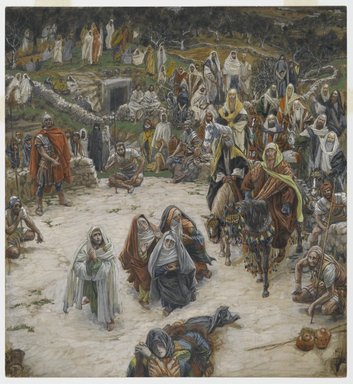
This is Tissot's Ce que voyait Notre-Seigneur sur la Croix.
Christ died for all and His sacrifice makes it possible for us to enter into the merits of the Catholic Church for intercessory prayers for those in purgatory.
Thursday, 11 September 2014
Wednesday, 10 September 2014
Need Info from Readers
Posted by
Supertradmum
Some people in this area have asked me if there is a pamphlet on the teachings of the Church regarding secret societies, such as the Masons, Elks, Grangers, etc. Of course, I have all this info from different sources, but not in a pamphlet form.
If anyone knows of such a publication, please let me know so I can pass on this info.
Chaos and Responsibility
Posted by
Supertradmum
Continuing on from the questions in the last post, the answers follow the questions. I start with the last first.
But, what if someone is not facing his suffering? What if one is in denial of chaos in the soul? Can an entire culture, an entire society be blinded to suffering and disorder?
Many, if not most, people in Western societies may be described as T. S. Eliot did in The Wasteland.
Unreal City, 60
Under the brown fog of a winter dawn,
A crowd flowed over London Bridge, so many,
I had not thought death had undone so many.
Sighs, short and infrequent, were exhaled,
And each man fixed his eyes before his feet.
Flowed up the hill and down King William Street,
To where Saint Mary Woolnoth kept the hours
With a dead sound on the final stroke of nine.
There I saw one I knew, and stopped him, crying "Stetson!
"You who were with me in the ships at Mylae! 70
"That corpse you planted last year in your garden,
"Has it begun to sprout? Will it bloom this year?
"Or has the sudden frost disturbed its bed?
The curse of modern society has been the acceptance of the dulling of the pain of sin. Living death is a result of mortal sin, of sin which denies natural law and the consequences. One of the points of Fr. Ripperger's book is that mental illness can be a result of mortal sin. Why? Because sin denies the end to which all humans were made. We deny our own happiness in eternal life with God when we sin. Therefore, when we choose deliberately to go against why we were created and who we are, that is creatures of a Loving God, a sort of spiritual division occurs in our souls, minds, bodies. Such denial causes chaos in the soul, which is ignored by so many psychologists.
Eliot's cry that death had undone so many is the cry of the modern prophet, who see the sadness, the false happiness, "each man fixed his eyes before his feet", an image of modern isolation.
Mylae was the decisive battle of the Romans over the Carthaginian fleet. Carthage was a horrible society of human sacrifice and war, a society even the Romans hated for its barbarity and violence. Stetson, the name of the famous cowboy hat, means more than a hat, the "Boss of the Plains". This name is supposed to remind us of false utopias, like those expected in the Gold Rush or through Manifest Destiny.
The buried corpse is the dead soul. Will it bloom in the new year, or will the frost of modern sins keep it dead and buried? No resurrection here.
Yes, an entire society can have false ideals, consumerism, materialism, greed, hatred for the poor, hatred for the rich, and so on. Acceptance of all types of sexual sins is now part of our culture in the West, except for those in the remnant, who still cling to natural law philosophy, Revelation, and the Good New of the Bible.
A person or a people can drug themselves with entertainment, things, sex and so on to curb the niggling doubt that something is not right. And, if the wills are bent towards evil from a lack of religious belief and practice, yes, an entire society can be bent. This is what we are now seeing, not only in America and Europe, but in other countries which have departed, even for centuries, from the only spirituality which can help man become and stay human-Catholicism.
Such were the Five Cities. Can an entire culture, an entire society be blinded to suffering and disorder?
Genesis 19 Douay-Rheims
19 And
the two angels came to Sodom in the evening, and Lot was sitting in the
gate of the city. And seeing them, he rose up and went to meet them:
and worshipped prostrate to the ground,
2 And
said: I beseech you, my lords, turn in to the house of your servant,
and lodge there: wash your feet, and in the morning you shall go on your
way. And they said: No, but we will abide in the street.
3 He
pressed them very much to turn in unto him: and when they were come
into his house, he made them a feast, and baked unleavened bread and
they ate:
4 But before they went to bed, the men of the city beset the house both young and old, all the people together.
5 And
they called Lot, and said to him: Where are the men that came in to
thee at night? bring them out hither that we may know them:
6 Lot went out to them, and shut the door after him, and said:
7 Do not so, I beseech you, my brethren, do not commit this evil.
8 I
have two daughters who as yet have not known man: I will bring them out
to you, and abuse you them as it shall please you, so that you do no
evil to these men, because they are come in under the shadow of my roof.
9 But
they said: Get thee back thither. And again: Thou camest in, said they,
as a, stranger, was it to be a judge? therefore we will afflict thee
more than them. And they pressed very violently upon Lot: and they were
even at the point of breaking open the doors.
10 And behold the men put out their hand, and drew in Lot unto them, and shut the door:
11 And them that were without, they struck with blindness from the least to the greatest, so that they could not find the door.
12 And
they said to Lot: Hast thou here any of thine? son in law, or sons, or
daughters, all that are thine bring them out of this city:
13 For we will destroy this place, because their cry is grown loud before the Lord, who hath sent us to destroy them.
14 So
Lot went out, and spoke to his sons in law that were to have his
daughters, and said: Arise: get you out of this place, because the Lord
will destroy this city. And he seemed to them to speak as it were in
jest.
15 And
when it was morning, the angels pressed him, saying: Arise, take thy
wife, and the two daughters which thou hast: lest thou also perish in
the wickedness of the city.
16 And as he lingered, they took his hand, and the hand of his wife, and of his two daughters, because the Lord spared him.
17 And
they brought him forth, and set him without the city: and there they
spoke to him, saying: Save thy life: look not back, neither stay thou in
all the country about: but save thyself in the mountain, lest thou be
also consumed.
18 And Lot said to them: I beseech thee my Lord,
19 Because
thy servant hath found grace before thee, and thou hast magnified thy
mercy, which thou hast shewn to me, in saving my life, and I cannot
escape to the mountain, lest some evil seize me, and I die:
20 There
is this city here at hand, to which I may flee, it is a little one, and
I shall be saved in it: is it not a little one, and my soul shall live?
21 And he said to him: Behold also in this, I have heard thy prayers, not to destroy the city for which thou hast spoken.
22 Make
haste and be saved there, because I cannot do any thing till thou go in
thither. Therefore the name of that city was called Segor.
23 The sun was risen upon the earth, and Lot entered into Segor.
24 And the Lord rained upon Sodom and Gomorrha brimstone and fire from the Lord out of heaven.
25 And
he destroyed these cities, and all the country about, all the
inhabitants of the cities, and all things that spring from the earth.
26 And his wife looking behind her, was turned into a statue of salt.
27 And Abraham got up early in the morning and in the place where he had stood before with the Lord,
28 He
looked towards Sodom and Gomorrha, and the whole land of that country:
and he saw the ashes rise up from the earth as the smoke of a furnace.
29 Now
when God destroyed the cities of that country, remembering Abraham, he
delivered Lot out of the destruction of the cities wherein he had dwelt.
to be continued...
Virtue and Suffering
Posted by
Supertradmum
Reason is shown to be so much the more perfect, according as it is able to overcome or endure more easily the weakness of the body and of the lower powers. And therefore human virtue, which is attributed to reason, is said to be "made perfect in infirmity," not of the reason indeed, but of the body and of the lower powers.
Thomas Aquinas.... First Part of the Second Part; Question 55 (same source as previous post).
Why it is necessary to suffer in order to be holy? If one is not convinced by the long perfection series, one may ponder on Aquinas' reflection here and on St. Paul.
Disorder comes from the darkened heart (or intellect-see previous posts on this distinction). Foolishness indicates disorder, as do actions against nature, against natural law
If virtue is order, one can easily see how the opposite, vice, is disorder. St. Paul clearly states this in Romans 1: with Challoner's notes in blue.
[16] For I am not ashamed of the gospel. For it is the power of God unto salvation to every one that believeth, to the Jew first, and to the Greek. [17] For the justice of God is revealed therein, from faith unto faith, as it is written: The just man liveth by faith. [18] For the wrath of God is revealed from heaven against all ungodliness and injustice of those men that detain the truth of God in injustice: [19] Because that which is known of God is manifest in them. For God hath manifested it unto them. [20] For the invisible things of him, from the creation of the world, are clearly seen, being understood by the things that are made; his eternal power also, and divinity: so that they are inexcusable.
[21] Because that, when they knew God, they have not glorified him as God, or given thanks; but became vain in their thoughts, and their foolish heart was darkened. [22] For professing themselves to be wise, they became fools. [23] And they changed the glory of the incorruptible God into the likeness of the image of a corruptible man, and of birds, and of fourfooted beasts, and of creeping things. [24] Wherefore God gave them up to the desires of their heart, unto uncleanness, to dishonour their own bodies among themselves. [25] Who changed the truth of God into a lie; and worshipped and served the creature rather than the Creator, who is blessed for ever. Amen.
[26] For this cause God delivered them up to shameful affections. For their women have changed the natural use into that use which is against nature. [27] And, in like manner, the men also, leaving the natural use of the women, have burned in their lusts one towards another, men with men working that which is filthy, and receiving in themselves the recompense which was due to their error. [28] And as they liked not to have God in their knowledge, God delivered them up to a reprobate sense, to do those things which are not convenient; [29] Being filled with all iniquity, malice, fornication, avarice, wickedness, full of envy, murder, contention, deceit, malignity, whisperers, [30] Detractors, hateful to God, contumelious, proud, haughty, inventors of evil things, disobedient to parents,
Now, the underlines bits have to do with suffering in Challoner's notes here in blue. Once sin and, therefore, disorder are chosen, God lets a person literally "go his own way". The Bridegroom stops wooing the bride, that is, the soul.
His grace is withdrawn, which is the meaning of the phrase the "death of the soul" with regard to "mortal sin". Those in mortal sin, those in disorder, have no sanctifying grace.
How does suffering pull one out of disorder? Disorder and suffering are described in Chapter Three, but why is suffering necessary?
Here is Paul in Chapter Six:
[6] Knowing this, that our old man is crucified with him, that the body of sin may be destroyed, to the end that we may serve sin no longer. [7] For he that is dead is justified from sin. [8] Now if we be dead with Christ, we believe that we shall live also together with Christ: [9] Knowing that Christ rising again from the dead, dieth now no more, death shall no more have dominion over him. [10] For in that he died to sin, he died once; but in that he liveth, he liveth unto God:
We must be joined to the suffering of Christ in order to break away from the habits of sin, from the predominant faults. Yes, Christ died for us, but in our bodies we must work out that salvation.
Herein is a huge difference between us and our Protestant brethren, who have destroyed sacramental life in their churches. The sacraments restore us to grace--there is no other way.
And, suffering humble us to seek out the sacraments. Only the proud do not want the sacraments.
Grace frees us to obey, to see justice, to want discipline. As "servants of justice" we also seek mercy, knowing through our suffering that God is Just.
The realization of justice and mercy come only through facing one's sins, in suffering, in humility.
[16] Know you not, that to whom you yield yourselves servants to obey, his servants you are whom you obey, whether it be of sin unto death, or of obedience unto justice. [17] But thanks be to God, that you were the servants of sin, but have obeyed from the heart, unto that form of doctrine, into which you have been delivered. [18] Being then freed from sin, we have been made servants of justice. [19] I speak an human thing, because of the infirmity of your flesh. For as you have yielded your members to serve uncleanness and iniquity, unto iniquity; so now yield your members to serve justice, unto sanctification. [20] For when you were the servants of sin, you were free men to justice.
Disorder brings pain, brings chaos into one's soul. mind, body, but, as St. Paul states, thanks be to God for His gift of salvation and for the Church's sacramental life of grace.
But, what if someone is not facing his suffering? What if one is in denial of chaos in the soul? Can an entire culture, an entire society be blinded to suffering and disorder?
to be continued...
Thomas Aquinas.... First Part of the Second Part; Question 55 (same source as previous post).
Why it is necessary to suffer in order to be holy? If one is not convinced by the long perfection series, one may ponder on Aquinas' reflection here and on St. Paul.
Disorder comes from the darkened heart (or intellect-see previous posts on this distinction). Foolishness indicates disorder, as do actions against nature, against natural law
If virtue is order, one can easily see how the opposite, vice, is disorder. St. Paul clearly states this in Romans 1: with Challoner's notes in blue.
[16] For I am not ashamed of the gospel. For it is the power of God unto salvation to every one that believeth, to the Jew first, and to the Greek. [17] For the justice of God is revealed therein, from faith unto faith, as it is written: The just man liveth by faith. [18] For the wrath of God is revealed from heaven against all ungodliness and injustice of those men that detain the truth of God in injustice: [19] Because that which is known of God is manifest in them. For God hath manifested it unto them. [20] For the invisible things of him, from the creation of the world, are clearly seen, being understood by the things that are made; his eternal power also, and divinity: so that they are inexcusable.
[21] Because that, when they knew God, they have not glorified him as God, or given thanks; but became vain in their thoughts, and their foolish heart was darkened. [22] For professing themselves to be wise, they became fools. [23] And they changed the glory of the incorruptible God into the likeness of the image of a corruptible man, and of birds, and of fourfooted beasts, and of creeping things. [24] Wherefore God gave them up to the desires of their heart, unto uncleanness, to dishonour their own bodies among themselves. [25] Who changed the truth of God into a lie; and worshipped and served the creature rather than the Creator, who is blessed for ever. Amen.
[26] For this cause God delivered them up to shameful affections. For their women have changed the natural use into that use which is against nature. [27] And, in like manner, the men also, leaving the natural use of the women, have burned in their lusts one towards another, men with men working that which is filthy, and receiving in themselves the recompense which was due to their error. [28] And as they liked not to have God in their knowledge, God delivered them up to a reprobate sense, to do those things which are not convenient; [29] Being filled with all iniquity, malice, fornication, avarice, wickedness, full of envy, murder, contention, deceit, malignity, whisperers, [30] Detractors, hateful to God, contumelious, proud, haughty, inventors of evil things, disobedient to parents,
[26] God delivered them up: Not by being author of
their sins, but by withdrawing his grace, and so permitting them, in
punishment of their pride, to fall into those shameful sins.
[31] Foolish, dissolute, without affection, without fidelity, without mercy.
[32]
Who, having known the justice of God, did not understand that they who
do such things, are worthy of death; and not only they that do them, but
they also that consent to them that do them. Now, the underlines bits have to do with suffering in Challoner's notes here in blue. Once sin and, therefore, disorder are chosen, God lets a person literally "go his own way". The Bridegroom stops wooing the bride, that is, the soul.
His grace is withdrawn, which is the meaning of the phrase the "death of the soul" with regard to "mortal sin". Those in mortal sin, those in disorder, have no sanctifying grace.
How does suffering pull one out of disorder? Disorder and suffering are described in Chapter Three, but why is suffering necessary?
Here is Paul in Chapter Six:
[6] Knowing this, that our old man is crucified with him, that the body of sin may be destroyed, to the end that we may serve sin no longer. [7] For he that is dead is justified from sin. [8] Now if we be dead with Christ, we believe that we shall live also together with Christ: [9] Knowing that Christ rising again from the dead, dieth now no more, death shall no more have dominion over him. [10] For in that he died to sin, he died once; but in that he liveth, he liveth unto God:
We must be joined to the suffering of Christ in order to break away from the habits of sin, from the predominant faults. Yes, Christ died for us, but in our bodies we must work out that salvation.
Herein is a huge difference between us and our Protestant brethren, who have destroyed sacramental life in their churches. The sacraments restore us to grace--there is no other way.
And, suffering humble us to seek out the sacraments. Only the proud do not want the sacraments.
Grace frees us to obey, to see justice, to want discipline. As "servants of justice" we also seek mercy, knowing through our suffering that God is Just.
The realization of justice and mercy come only through facing one's sins, in suffering, in humility.
[16] Know you not, that to whom you yield yourselves servants to obey, his servants you are whom you obey, whether it be of sin unto death, or of obedience unto justice. [17] But thanks be to God, that you were the servants of sin, but have obeyed from the heart, unto that form of doctrine, into which you have been delivered. [18] Being then freed from sin, we have been made servants of justice. [19] I speak an human thing, because of the infirmity of your flesh. For as you have yielded your members to serve uncleanness and iniquity, unto iniquity; so now yield your members to serve justice, unto sanctification. [20] For when you were the servants of sin, you were free men to justice.
Disorder brings pain, brings chaos into one's soul. mind, body, but, as St. Paul states, thanks be to God for His gift of salvation and for the Church's sacramental life of grace.
But, what if someone is not facing his suffering? What if one is in denial of chaos in the soul? Can an entire culture, an entire society be blinded to suffering and disorder?
to be continued...
Where Virtue Begins
Posted by
Supertradmum
In this day and age, in these troubled times, we see clearly religions which teach and promote virtues and those which do not. I use Thomas Aquinas here.
Here is a reminder of what the virtues actually are: virtues are good use of free will.
"When we say that virtue is the order or ordering of love, we refer to the end to which virtue is ordered: because in us love is set in order by virtue"
Now, read this again from Aquinas.
Virtue, from the very nature of the word, implies some perfection of power, as we have said above (Article 1). Wherefore, since power [The one Latin word 'potentia' is rendered 'potentiality' in the first case, and 'power' in the second] is of two kinds, namely, power in reference to being, and power in reference to act; the perfection of each of these is called virtue. But power in reference to being is on the part of matter, which is potential being, whereas power in reference to act, is on the part of the form, which is the principle of action, since everything acts in so far as it is in act.
Now man is so constituted that the body holds the place of matter, the soul that of form. The body, indeed, man has in common with other animals; and the same is to be said of the forces which are common to the soul and body: and only those forces which are proper to the soul, namely, the rational forces, belong to man alone. And therefore, human virtue, of which we are speaking now, cannot belong to the body, but belongs only to that which is proper to the soul. Wherefore human virtue does not imply reference to being, but rather to act. Consequently it is essential to human virtue to be an operative habit.
Reply to Objection 1. Mode of action follows on the disposition of the agent: for such as a thing is, such is its act. And therefore, since virtue is the principle of some kind of operation, there must needs pre-exist in the operator in respect of virtue some corresponding disposition. Now virtue causes an ordered operation. Therefore virtue itself is an ordered disposition of the soul, in so far as, to wit, the powers of the soul are in some way ordered to one another, and to that which is outside. Hence virtue, inasmuch as it is a suitable disposition of the soul, is like health and beauty, which are suitable dispositions of the body. But this does not hinder virtue from being a principle of operation.
Reply to Objection 2. Virtue which is referred to being is not proper to man; but only that virtue which is referred to works of reason, which are proper to man.
Reply to Objection 3. As God's substance is His act, the highest likeness of man to God is in respect of some operation. Wherefore, as we have said above (Question 3, Article 2), happiness or bliss by which man is made most perfectly conformed to God, and which is the end of human life, consists in an operation.
The fact that virtues are habits means these can be trained, as I have noted in my long series from last summer on virtue training.
A virtue, as Aquinas notes in the above passage, "is an ordered disposition of the soul, in so far as, to wit, the powers of the soul are in some way ordered to one another, and to that which is outside."
Action follows disposition. Without virtue active in the soul, action cannot be "good" or even "neutral". And reason is needed for the practice of virtues.
We daily choose what we think is the good, the true, the beautiful, but these choices are rooted in our disposition. If our minds, souls, hearts are conformed to God, then we shall exhibit virtue.
So, when people compare religions, one question they may ask is this, "Which religion leads to the formation of a correct disposition which will choose the good, the good which involves love of self, love of neighbor, as coming from love of God?"
To be continued...
Here is a reminder of what the virtues actually are: virtues are good use of free will.
"When we say that virtue is the order or ordering of love, we refer to the end to which virtue is ordered: because in us love is set in order by virtue"
Now, read this again from Aquinas.
Virtue, from the very nature of the word, implies some perfection of power, as we have said above (Article 1). Wherefore, since power [The one Latin word 'potentia' is rendered 'potentiality' in the first case, and 'power' in the second] is of two kinds, namely, power in reference to being, and power in reference to act; the perfection of each of these is called virtue. But power in reference to being is on the part of matter, which is potential being, whereas power in reference to act, is on the part of the form, which is the principle of action, since everything acts in so far as it is in act.
Now man is so constituted that the body holds the place of matter, the soul that of form. The body, indeed, man has in common with other animals; and the same is to be said of the forces which are common to the soul and body: and only those forces which are proper to the soul, namely, the rational forces, belong to man alone. And therefore, human virtue, of which we are speaking now, cannot belong to the body, but belongs only to that which is proper to the soul. Wherefore human virtue does not imply reference to being, but rather to act. Consequently it is essential to human virtue to be an operative habit.
Reply to Objection 1. Mode of action follows on the disposition of the agent: for such as a thing is, such is its act. And therefore, since virtue is the principle of some kind of operation, there must needs pre-exist in the operator in respect of virtue some corresponding disposition. Now virtue causes an ordered operation. Therefore virtue itself is an ordered disposition of the soul, in so far as, to wit, the powers of the soul are in some way ordered to one another, and to that which is outside. Hence virtue, inasmuch as it is a suitable disposition of the soul, is like health and beauty, which are suitable dispositions of the body. But this does not hinder virtue from being a principle of operation.
Reply to Objection 2. Virtue which is referred to being is not proper to man; but only that virtue which is referred to works of reason, which are proper to man.
Reply to Objection 3. As God's substance is His act, the highest likeness of man to God is in respect of some operation. Wherefore, as we have said above (Question 3, Article 2), happiness or bliss by which man is made most perfectly conformed to God, and which is the end of human life, consists in an operation.
The fact that virtues are habits means these can be trained, as I have noted in my long series from last summer on virtue training.
A virtue, as Aquinas notes in the above passage, "is an ordered disposition of the soul, in so far as, to wit, the powers of the soul are in some way ordered to one another, and to that which is outside."
Action follows disposition. Without virtue active in the soul, action cannot be "good" or even "neutral". And reason is needed for the practice of virtues.
We daily choose what we think is the good, the true, the beautiful, but these choices are rooted in our disposition. If our minds, souls, hearts are conformed to God, then we shall exhibit virtue.
So, when people compare religions, one question they may ask is this, "Which religion leads to the formation of a correct disposition which will choose the good, the good which involves love of self, love of neighbor, as coming from love of God?"
To be continued...
More from Fr. Chad Ripperger
Posted by
Supertradmum
One of the great blessings given to the world through the ages has been education. One thinks of the many Benedictine schools beginning in the so-called Dark Ages, the universities, the copying of classical texts, and so on.
One of the reasons why real Catholics have valued education has to do with the formation of the will. Without being over-simplistic, I want to parse out a few ideas from Fr. Ripperger's book from his long section on the will. One of the reasons in our day and age we see people floundering with either the idea of free will, or using the will is that they have not had formation in thinking, in the intellect, which informs the will.
Here is a snippet and then a comment:
The "possible intellect is the only immaterial knowing power in the soul, it is that which moves the will, i. e. the will is moved by the apprehension of reason or the possible intellect. Since the will is moved by the intellect, the good as grasped by the intellect, i.e. the understood good, moves the will. Since the will is moved by a universal power, i.e. the possible intellect grasps universals, the object it presents to the will is the end or good in general."
The greatest problem youth in our Western culture experiences is that of the lack of knowledge to use when making decisions. How many times have I heard parents say that, for example, they will let their children decide on what religion these children want when they are old enough to decide.
This approach and another approach, which is not to give any rational training to the intellect, allow the will to be weakened because the very power which could inform the will is missing.
Many discussions I have had in the past with young people revolve around a denial of free will. The decadence of the education systems in the West, with the downgrading of true liberal education, which taught youth how to think, has led to the lack of discipline of the passions, which can no longer be ruled by the will, which is missing the intellectual necessaries to choose between good and evil.
"If it feels good, it is right", is, of course the relativist's claim.
I honestly believe that the only people who are training the will at this time in the West are parents who home school in the Catholic tradition, or those teachers who are teaching in classical education, schools such as NAPCIS schools.
The training of the intellect forms the soul, and creates sanity, that is, a mind which can apprehend reality, the reality of sin and virtue.
I have picked out this bit for today as so many people blame circumstances, environment, nurture and nature for weak wills, when the main cause is rather simple--the loss of liberal education, which teaches humans how to think.
One may also comment on the idea of "universals", but that is another post.
to be continued...
One of the reasons why real Catholics have valued education has to do with the formation of the will. Without being over-simplistic, I want to parse out a few ideas from Fr. Ripperger's book from his long section on the will. One of the reasons in our day and age we see people floundering with either the idea of free will, or using the will is that they have not had formation in thinking, in the intellect, which informs the will.
Here is a snippet and then a comment:
The "possible intellect is the only immaterial knowing power in the soul, it is that which moves the will, i. e. the will is moved by the apprehension of reason or the possible intellect. Since the will is moved by the intellect, the good as grasped by the intellect, i.e. the understood good, moves the will. Since the will is moved by a universal power, i.e. the possible intellect grasps universals, the object it presents to the will is the end or good in general."
The greatest problem youth in our Western culture experiences is that of the lack of knowledge to use when making decisions. How many times have I heard parents say that, for example, they will let their children decide on what religion these children want when they are old enough to decide.
This approach and another approach, which is not to give any rational training to the intellect, allow the will to be weakened because the very power which could inform the will is missing.
Many discussions I have had in the past with young people revolve around a denial of free will. The decadence of the education systems in the West, with the downgrading of true liberal education, which taught youth how to think, has led to the lack of discipline of the passions, which can no longer be ruled by the will, which is missing the intellectual necessaries to choose between good and evil.
"If it feels good, it is right", is, of course the relativist's claim.
I honestly believe that the only people who are training the will at this time in the West are parents who home school in the Catholic tradition, or those teachers who are teaching in classical education, schools such as NAPCIS schools.
The training of the intellect forms the soul, and creates sanity, that is, a mind which can apprehend reality, the reality of sin and virtue.
I have picked out this bit for today as so many people blame circumstances, environment, nurture and nature for weak wills, when the main cause is rather simple--the loss of liberal education, which teaches humans how to think.
One may also comment on the idea of "universals", but that is another post.
to be continued...
Note
Posted by
Supertradmum
http://wdtprs.com/blog/2014/09/action-item-book-from-5-cardinals-in-defense-of-marriage-and-tradition/
Would someone like to order this for a seminarian and a deacon? Let me know, please.
Tuesday, 9 September 2014
From SPUC
Posted by
Supertradmum
9 September 2014: The Society for the Protection of Unborn Children (SPUC) www.spuc.org.uk has been banned on spurious grounds by Dundee University Students' Association (DUSA) from its Freshers' Fayre.
DUSA claims that SPUC's campaigns are contrary to DUSA's Constitution, and that SPUC has engaged in extreme behaviour at past Freshers' Fayres. DUSA has, however, failed to provide any evidence to back up their claims.
Rachel Kidd of SPUC Scotland http://spucscotland. org/
said: "DUSA has quoted several sections of its Constitution against
SPUC, but none of those sections contains anything opposed by SPUC.
Also, DUSA has been asked to back up with evidence its claim of extreme
behaviour by SPUC at Freshers' Fayres, but has failed to provide any
evidence.
"From 2005 onwards, SPUC held a stall at Freshers’ Fayre for eight consecutive years without any problems. The stall simply offered factual information on the development of the unborn child and real help to women who may find themselves in a crisis pregnancy situation.
Miss Kidd concluded: "DUSA makes a great deal of noise about being fair and unprejudiced towards groups with differing views. SPUC's effectiveness in communicating the pro-life message on campus seems to have provoked DUSA to treat SPUC in an unfair and biased way."
SPUC Scotland can be contacted on:
signup.
DUSA claims that SPUC's campaigns are contrary to DUSA's Constitution, and that SPUC has engaged in extreme behaviour at past Freshers' Fayres. DUSA has, however, failed to provide any evidence to back up their claims.
Rachel Kidd of SPUC Scotland http://spucscotland.
"From 2005 onwards, SPUC held a stall at Freshers’ Fayre for eight consecutive years without any problems. The stall simply offered factual information on the development of the unborn child and real help to women who may find themselves in a crisis pregnancy situation.
Miss Kidd concluded: "DUSA makes a great deal of noise about being fair and unprejudiced towards groups with differing views. SPUC's effectiveness in communicating the pro-life message on campus seems to have provoked DUSA to treat SPUC in an unfair and biased way."
SPUC Scotland can be contacted on:
- landline: 0141 221 2094
- email: info@spucscotland.org
- Twitter: @spucscotland
- mobile 07939 177683
- direct dial landline 020 7820 3129
- email news@spuc.org.uk
- Twitter @spucprolife
A quiet down day and early mornings....
Posted by
Supertradmum
I need a quiet down day which will consist of reading more of Fr. Chad Ripperger's great book and trying to get some needed rest.
But, before I leave off blogging for the day, I want to mention that several friends of mine have been awakened, since 2011, early in the morning to pray. I mean early, like four or four-thirty. These good people have been asked to pray more. I now know six or more people who get up at fourish and pray for others, saying extra rosaries, and some of these people are still working, not retired.
This has happened to me since November of 2011. When I am well, and not fighting asthma all night, I get up and pray early. God is moving some of us to do this. Pay attention. If you are waking up and do not know why, it could be that God is calling you to extra prayer.
We need extra prayer for reparation for the sins of ourselves and others, for the Church, which is assaulted on various fronts. We need to pray for those who may be facing great trials in the middle of the night, such as despair or loneliness.
As Catholics, we have the great Theotokos, Mary, the Mother of God, as our greatest intercessor.
Pray, and do not stint in prayer.
See you all tomorrow, a bit later in the day.
Wiki Is Sometimes Surprisingly Interesting
Posted by
Supertradmum
Do you all know about this? Do any readers have more reliable info on this group? I have not studied this group and came across it quite by accident.
http://en.wikipedia.org/wiki/Club_of_Rome
http://www.clubofrome.org/
The book which set this group into play is Limits to Growth. One can see the influences which are contrary to Catholic teaching in this article.
http://en.wikipedia.org/wiki/The_Limits_to_Growth
Just look at the list of books on the last entry.
I admire Pope Paul VI more and more, as his encyclical Humanae Vitae was written in the ambience of these types of groups.
Thankfully, I missed the rise of these ideas, converted in 1971 from stupidity and ideologies which could have led to this type of thinking. But, God protected me and renewed my excellent Catholic Classical education in my soul, heart and mind.
I am sure those university students right behind me read some of this stuff. Of course, we studied Malthus, the evil genius of abortion and contraception as necessaries, an Anglican buried in Bath Abbey. The fact that Maltus visited Germany and Switzerland, which have connections to the Club of Rome seems more than coincidental.
His bio is linked to Limits to Growth on wiki.
http://en.wikipedia.org/wiki/Club_of_Rome
http://www.clubofrome.org/
The book which set this group into play is Limits to Growth. One can see the influences which are contrary to Catholic teaching in this article.
http://en.wikipedia.org/wiki/The_Limits_to_Growth
Just look at the list of books on the last entry.
I admire Pope Paul VI more and more, as his encyclical Humanae Vitae was written in the ambience of these types of groups.
Thankfully, I missed the rise of these ideas, converted in 1971 from stupidity and ideologies which could have led to this type of thinking. But, God protected me and renewed my excellent Catholic Classical education in my soul, heart and mind.
I am sure those university students right behind me read some of this stuff. Of course, we studied Malthus, the evil genius of abortion and contraception as necessaries, an Anglican buried in Bath Abbey. The fact that Maltus visited Germany and Switzerland, which have connections to the Club of Rome seems more than coincidental.
His bio is linked to Limits to Growth on wiki.
Again, A Warning to Catholic Parents
Posted by
Supertradmum
Do not let or encourage your sons and daughters to have any college debt. It would be better for them to go to the local community college, (some of which have superb teachers), than get into debt.
This is a repeat of something I put on the blog a long time ago, a long time ago. Those debts will be the direct cause of enforced labor or military work for the government when the economy collapses.
I have heard people say that they do not care if they get into debt as there will be a collapse anyway. This is a deceitful and non-Christian view of good stewardship.
One should live within one's means. I learned this the hard way and God corrected me years ago. I had to sell my beloved house rather than not pay the mortgage when I lost a job. I had to throw away and not use credit cards. This is a good discipline. I left the madness of debt. Simple living is possible and one can do it with God's help.
But, for the youth, this situation of debt may be used as a sword over their heads. Do this....or pay up...
Debtor's prisons may not be seen again, but governments have other ways of making people pay debt. Although, people could go to jail for contempt of court for not paying loans, credit cards and so on.
America had debtor's prison, which although federally abolished in 1832, lasted in some states until 1849.
Debt is slavery.
I distinctly remember a speech by Obama when he was running for president the first time in which he said he supported a draft. It was in September of 2008 when he gave a speech referring to this.
I wish I had kept the transcript. What if any president said that a youth's college debt would be forgiven for so many years of military service?
Wake up, Catholic parents, please.
And, I thank those readers who helped a poor seminarian get out of a small debt. He is debt free.
This is a repeat of something I put on the blog a long time ago, a long time ago. Those debts will be the direct cause of enforced labor or military work for the government when the economy collapses.
I have heard people say that they do not care if they get into debt as there will be a collapse anyway. This is a deceitful and non-Christian view of good stewardship.
One should live within one's means. I learned this the hard way and God corrected me years ago. I had to sell my beloved house rather than not pay the mortgage when I lost a job. I had to throw away and not use credit cards. This is a good discipline. I left the madness of debt. Simple living is possible and one can do it with God's help.
But, for the youth, this situation of debt may be used as a sword over their heads. Do this....or pay up...
Debtor's prisons may not be seen again, but governments have other ways of making people pay debt. Although, people could go to jail for contempt of court for not paying loans, credit cards and so on.
America had debtor's prison, which although federally abolished in 1832, lasted in some states until 1849.
Debt is slavery.
I distinctly remember a speech by Obama when he was running for president the first time in which he said he supported a draft. It was in September of 2008 when he gave a speech referring to this.
I wish I had kept the transcript. What if any president said that a youth's college debt would be forgiven for so many years of military service?
Wake up, Catholic parents, please.
And, I thank those readers who helped a poor seminarian get out of a small debt. He is debt free.
A Good Pastor
Posted by
Supertradmum
Interview with Bishop Philip Egan found here.
http://spuc-director.blogspot.co.uk/2014/09/interview-with-bishop-philip-egan-on.html
God bless good leaders, good pastors
http://spuc-director.blogspot.co.uk/2014/09/interview-with-bishop-philip-egan-on.html
God bless good leaders, good pastors
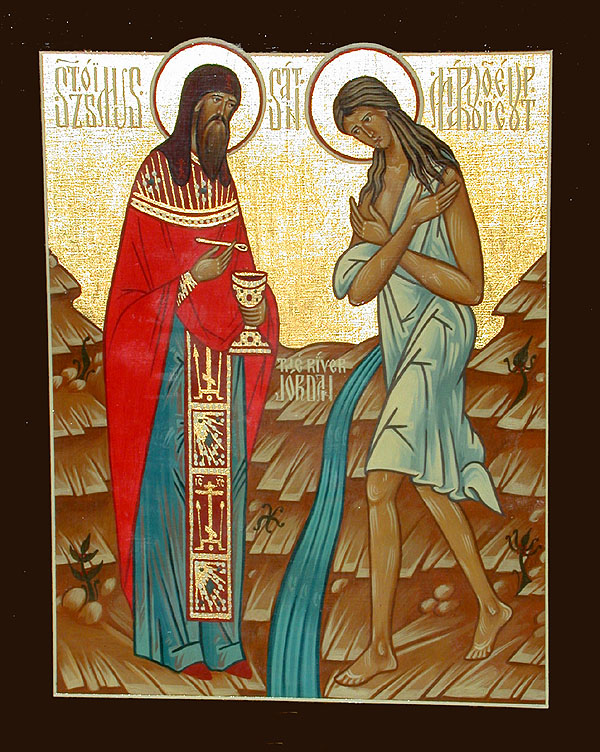
St, Mary of Egypt
Posted by
Supertradmum
In my youth, especially my twenties, I was addicted to the music of Mahler. In his Eighth Symphony, in that monumental work, he refers to St. Mary of Egypt. Mahler was taken by the story of this famous saint of the Jordan area.
Apparently, as early as the age of twelve, she was driven by lust, until she had a conversion in Jerusalem.
Deciding to repent and become a hermit, and being under the care and direction of Mary, Mother of God, St. Mary of Egypt left all with only three loaves of bread, after receiving forgiveness in Confession. St. Zosimas met her and gave her Communion on the day she died, after she spent fifty years or so in the desert making reparation for her early life of serious sin. A lion helped St. Zosimas bury her body. She is a saint who overcame her predominant faults in the isolation of prayer and fasting.
Her life was written down by St. Sophronius, Patriarch of Jersusalem. For those struggling with inordinate passions, St. Mary is an excellent patron.
Her dates are disputed, but her death in 522 seems reasonable to most scholars.
Here are the prayers from her feast day, April 3.
Troparion (Tone 8) [1]
Apparently, as early as the age of twelve, she was driven by lust, until she had a conversion in Jerusalem.
Deciding to repent and become a hermit, and being under the care and direction of Mary, Mother of God, St. Mary of Egypt left all with only three loaves of bread, after receiving forgiveness in Confession. St. Zosimas met her and gave her Communion on the day she died, after she spent fifty years or so in the desert making reparation for her early life of serious sin. A lion helped St. Zosimas bury her body. She is a saint who overcame her predominant faults in the isolation of prayer and fasting.
Her life was written down by St. Sophronius, Patriarch of Jersusalem. For those struggling with inordinate passions, St. Mary is an excellent patron.
Her dates are disputed, but her death in 522 seems reasonable to most scholars.
Here are the prayers from her feast day, April 3.
Troparion (Tone 8) [1]
- The image of God was truly preserved in you, O mother,
- For you took up the Cross and followed Christ.
- By so doing, you taught us to disregard the flesh, for it passes away;
- But to care instead for the soul, since it is immortal.
- Therefore your spirit, O holy Mother Mary, rejoices with the Angels.
- Having been a sinful woman,
- You became through repentance a Bride of Christ.
- Having attained angelic life,
- You defeated demons with the weapon of the Cross;
- Therefore, O most glorious Mary you are a Bride of the Kingdom
St. Paul on Perfection
Posted by
Supertradmum
The Apostle of the Gentiles calls the leaders of the Church to perfect the flock. If the leaders of the Church are not doing so, we must follow Christ and move towards holiness anyway.
Time to form community is fast flying away. Do so today. Support each other, closely. Move, if you must, to pod and surround yourselves with holy people
EPHESIANS
CHAPTER 4.
Therefore, a prisoner in the Lord, beseech you that you walk worthy of the vocation in which you are called, 2 With all humility and mildness, with patience, supporting one another in charity. 3 Careful to keep the unity of the Spirit in the bond of peace. 4 One body and one Spirit; as you are called in one hope of your calling. 5 One Lord, one faith, one baptism. 6 One God and Father of all, who is above all, and through all, and in us all. 7 But to every one of us is given grace, according to the measure of the giving of Christ. 8 Wherefore he saith: Ascending on high, he led captivity captive; he gave gifts to men. 9 Now that he ascended, what is it, but because he also descended first into the lower parts of the earth? 10 He that descended is the same also that ascended above all the heavens, that he might fill all things. 11 And he gave some apostles, and some prophets, and other some evangelists, and other some pastors and doctors, 12 For the perfecting of the saints, for the work of the ministry, for the edifying of the body of Christ: 13Until
we all meet into the unity of faith, and of the knowledge of the Son of
God, unto a perfect man, unto the measure of the age of the fulness of
Christ; 13 Until
we all meet into the unity of faith, and of the knowledge of the Son of
God, unto a perfect man, unto the measure of the age of the fulness of
Christ; 14 That
henceforth we be no more children tossed to and fro, and carried about
with every wind of doctrine by the wickedness of men, by cunning
craftiness, by which they lie in wait to deceive 15 But doing the truth in charity, we may in all things grow up in him who is the head, even Christ: 16 From
whom the whole body, being compacted and fitly joined together, by what
every joint supplieth, according to the operation in the measure of
every part, maketh increase of the body, unto the edifying of itself in
charity. 17 This then I say and testify in the Lord: That henceforward you walk not as also the Gentiles walk in the vanity of their mind, 18 Having
their understanding darkened, being alienated from the life of God
through the ignorance that is in them, because of the blindness of their
hearts. 19 Who
despairing, have given themselves up to lasciviousness, unto the
working of all uncleanness, unto the working of all uncleanness, unto
covetousness. 20 But you have not so learned Christ; 21 If so be that you have heard him, and have been taught in him, as the truth is in Jesus: 22 To put off, according to former conversation, the old man, who is corrupted according to the desire of error. 23 And be renewed in the spirit of your mind: 24 And put on the new man, who according to God is created in justice and holiness of truth. 25 Wherefore putting away lying, speak; ye the truth every man with his neighbour; for we are members one of another. 26 Be angry, and sin not. Let not the sun go down upon your anger. 27 Give not place to the devil. 28 He
that stole, let him now steal no more; but rather let him labour,
working with his hands the thing which is good, that he may have
something to give to him that suffereth need. 29 Let
no evil speech proceed from your mouth; but that which is good, to the
edification of faith, that it may administer grace to the hearers. 30 And grieve not the holy Spirit of God: whereby you are sealed unto the day of redemption. 31 Let all bitterness, and anger, and indignation, and clamour, and blasphemy, be put away from you, with all malice. 32 And be ye kind one to another; merciful, forgiving one another, even as God hath forgiven you in Christ.
Like A Thief in The Night
Posted by
Supertradmum
1 Thessalonians 5
1 But of the times and moments, brethren, you need not, that we should write to you; 2 For yourselves know perfectly, that the day of the Lord shall so come, as a thief in the night. 3 For
when they shall say, peace and security; then shall sudden destruction
come upon them, as the pains upon her that is with child, and they shall
not escape. 4 But you, brethren, are not in darkness, that that day should overtake you as a thief. 5 For all you are the children of light, and children of the day: we are not of the night, nor of darkness. 6 Therefore, let us not sleep, as others do; but let us watch, and be sober. 7 For they that sleep, sleep in the night; and they that are drunk, are drunk in the night. 8 But
let us, who are of the day, be sober, having on the breastplate of
faith and charity, and for a helmet the hope of salvation. 9 For God hath not appointed us unto wrath, but unto the purchasing of salvation by our Lord Jesus Christ, 10 Who died for us; that, whether we watch or sleep, we may live together with him. 11 For which cause comfort one another; and edify one another, as you also do.
As usual, St. Thomas Aquinas has some wisdom for us on this subject. Here are a few quotations: ST, Supplement, q 73.
I answer that, When Christ shall come to judge He will appear in the form of glory, on account of the authority becoming a judge. Now it pertains to the dignity of judicial power to have certain signs that induce people to reverence and subjection: and consequently many signs will precede the advent of Christ when He shall come to judgment, in order that the hearts of men be brought to subjection to the coming judge, and be prepared for the judgment, being forewarned by those signs. But it is not easy to know what these signs may be: for the signs of which we read in the gospels, as Augustine says, writing to Hesychius about the end of the world (Ep. lxxx), refer not only to Christ's coming to judgment, but also to the time of the sack of Jerusalem, and to the coming of Christ in ceaselessly visiting His Church So that, perhaps, if we consider them carefully, we shall find that none of them refers to the coming advent, as he remarks: because these signs that are mentioned in the gospels, such as wars, fears, and so forth, have been from the beginning of the human race: unless perhaps we say that at that time they will be more prevalent: although it is uncertain in what degree this increase will foretell the imminence of the advent. The signs mentioned by Jerome are not asserted by him; he merely says that he found them written in the annals of the Hebrews: and, indeed, they contain very little likelihood.
Reply to Objection 1. According to Augustine (Ad Hesych., Ep. lxxx) towards the end of the world there will be a general persecution of the good by the wicked: so that at the same time some will fear, namely the good, and some will be secure, namely the wicked. The words: "When they shall say: Peace and security," refer to the wicked, who will pay little heed to the signs of the coming judgment: while the words of Luke 21:26, "men withering away," etc., should be referred to the good.
We may also reply that all these signs that will happen about the time of the judgment are reckoned to occur within the time occupied by the judgment, so that the judgment day contains them all. Wherefore although men be terrified by the signs appearing about the judgment day, yet before those signs begin to appear the wicked will think themselves to be in peace and security, after the death of Antichrist and before the coming of Christ, seeing that the world is not at once destroyed, as they thought hitherto.
Reply to Objection 2. The day of the Lord is said to come as a thief, because the exact time is not known, since it will not be possible to know it from those signs: although, as we have already said, all these most manifest sings which will precede the judgment immediately may be comprised under the judgment day.
Reply to Objection 3. At His first advent Christ came secretly, although the appointed time was known beforehand by the prophets. Hence there was no need for such signs to appear at His first coming, as will appear at His second advent, when He will come openly, although the appointed time is hidden.
I think most of us should be more concerned about our particular judgment than the final one. Too much theorizing about the End Times can be a distraction, taking us away from considering our own souls and our state of sinfulness or holiness at the time of our deaths.
Subscribe to:
Posts (Atom)

(1).jpg)
(1).jpg)
.jpg)
.jpg)
.jpg)