Recent Posts

Friday, 2 January 2015

Instincts and More On The Eve of My Birthday


About two and a half weeks ago, I sensed a huge shift in evil and good in and over Malta and Europe. Something happened. This instinct is not based on the increased persecution of the Christians by the Muslims, nor the saber-rattling of the Russians, which have the Poles, Finns, and Lithuanians nervous.

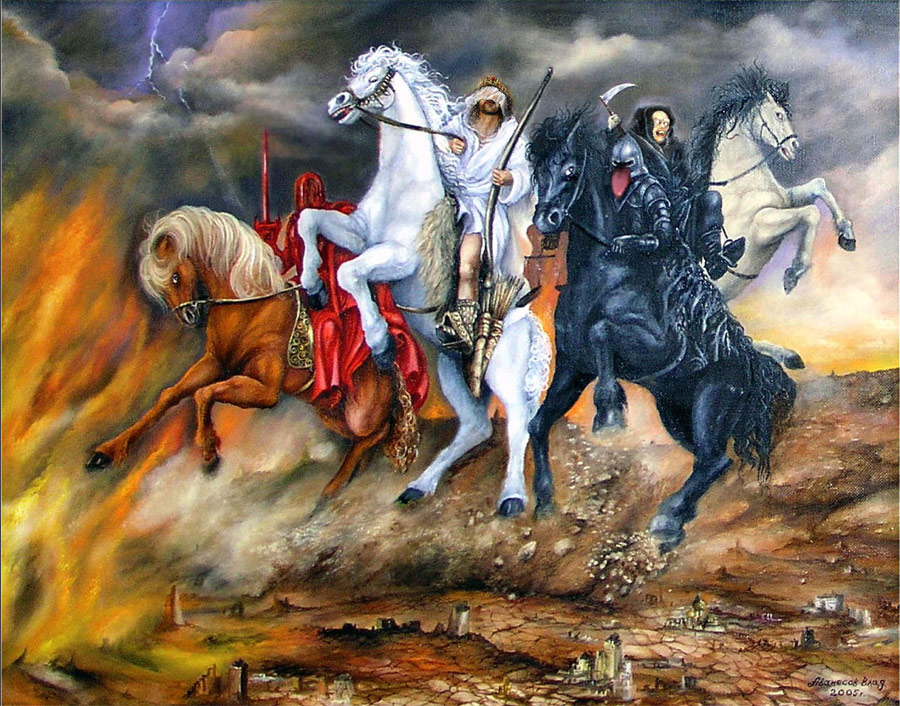
God has allowed something to change, and we have been warned for a long time about the last, great tribulation of the Church.  He is removing His protective Hand and allowing Satan a time to sift us all.  I have written some fiction based on three days of visions I saw in the summer of 2008, some of which was verified by two other people, one who lived hundreds of miles away. As you know, I am not into private revelations, and believe that God merely inspires our imaginations. But, I was first warned by a small voice, in French, which is interesting. to pay attention to what was going to be shown to me over the next three days at the time. Again, details do not matter much, but as Hamlet said, "The readiness is all." When we see things like this, we are not adding to revelation, but being warned of what has already been revealed. There is no new revelation.

My novellas are partly base on those visions, which happened when I was wide awake, starting in the evening, moving into the night, and in the day time as well as into the night for three days. Twice I have had messages in French, which indicates something to me personally. I understand some simple things in French, my third language after English and Latin.

Since 2000, I warned my Catholic students that they were in the Age of the Martyrs. It has begun in earnest. If you think you can avoid suffering by moving somewhere, forget it. All the West will be engulfed by evil.

The reason why I want to stay in Europe is that this is part of my "destiny" as I cannot avoid suffering here. There are different kinds of suffering.

I do not need to go into detail and I am not infallible, nor a seer, but God showed me plainly in July, 2008, a series of happenings involving the States and the Western World. It does not matter what the details are, but the message was "get ready".

Now, many others see the same thing by watching politics and by paying attention. This is good, as we are rational creatures and need to use our brains.

2008 was seven years ago, and we have had time to do what we need to do to get ready for the greatest era of suffering the Church has ever seen.

The Church will be so weakened that only those who have a relationship with God the Father, the Son of God Christ and the Holy Spirit will keep the Faith. This is why I have written the perfection series, to help you all get holy, and ready for persecution.

Do not think America or Europe will emerge unscathed from the Wrath of God brought on, mostly by the millions of aborted babies crying out for justice. One other sin which cries out to God for vengeance, and I have written about this on the blog, is sodomy. If you do not believe me, here again, is the CCC note on this fact: 1867 The catechetical tradition also recalls that there are "sins that cry to heaven": the blood of Abel,139 the sin of the Sodomites,140 the cry of the people oppressed in Egypt,141 the cry of the foreigner, the widow, and the orphan,142 injustice to the wage earner.143


Do not think that you will have access to Mass or the sacraments to keep you going. You will have to keep yourself going and this is why I have begged you to pod.

I cannot impress upon my readers enough the coming catastrophes. which God will permit for four reasons: one, to create saints for His Kingdom, two to bring about converts, three, to chastise us all, and four, to purify the Church.

I cannot count the ostrich photos on this blog or the number of posts on the stages of persecution. The Church has many, many enemies, both within and without.

Are you ready?

If not, get ready. We are heading for the Last Battle, which will not be short, but will result in the glory of God.


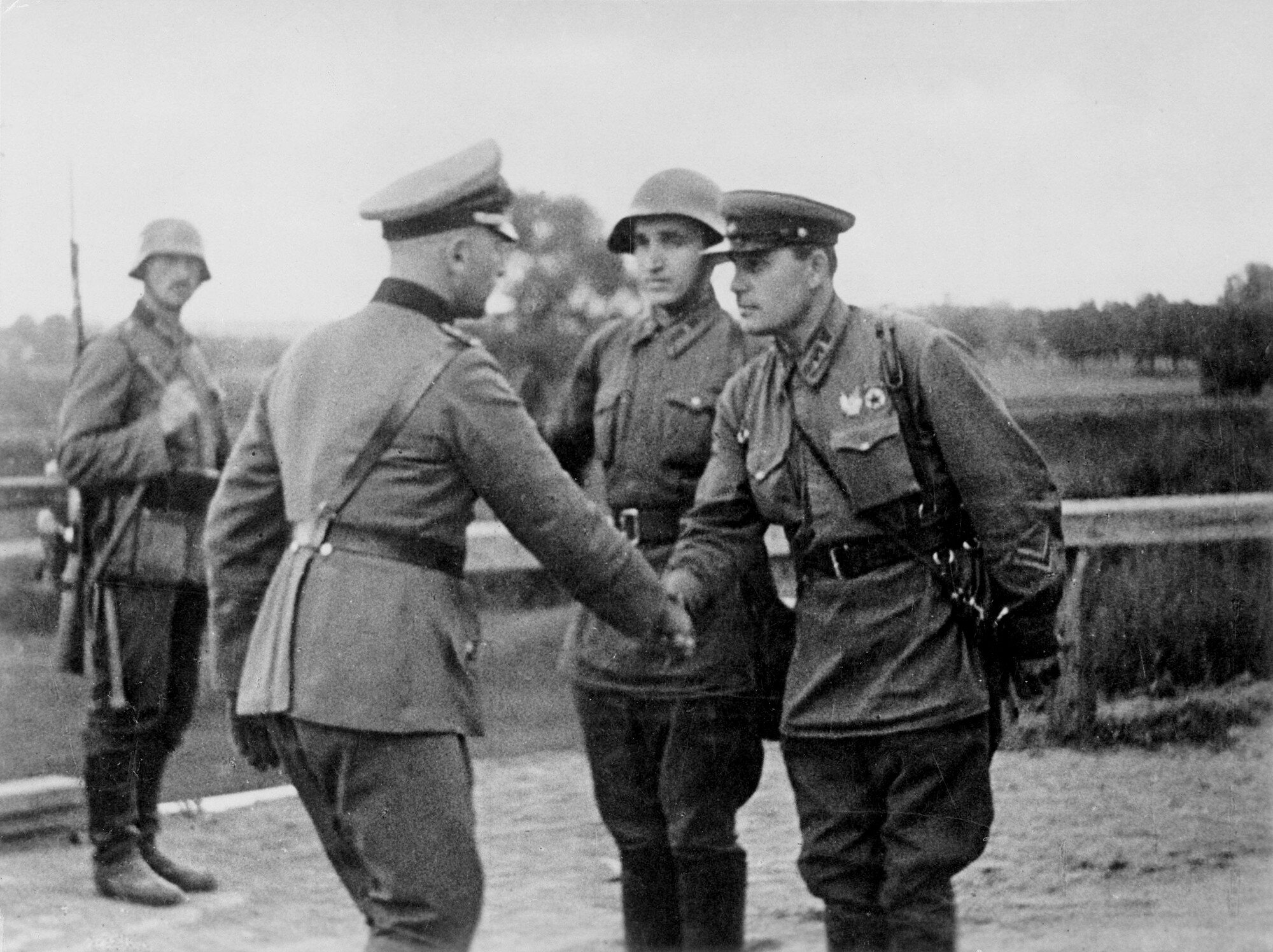

One opinion-another German/Russian Treaty

https://upload.wikimedia.org/wikipedia/commons/9/99/Spotkanie_Sojusznik%C3%B3w.jpg

"Brest-Litivosk 1918, Rappallo, 1922, Treaty of Berlin 1926, Molotov-Ribbentrop pact 1939.
I think Russia is enticing Germany to her side", from my friend....
I heard this from a military man today, and I decided to share with you the wiki bits on the 1922 treaty. It will be about the Ukraine. Do not kid yourselves, this is coming. I have known there would be war soon maybe from something like this since 2008 at least. I am not sure it would involve Germany and Russia, but America is out of the picture in the EU and nations will start making moves. Putin does not like the Muslims, as we know from history. 
And, the economy of Russia "needs a war" like America did in 1940.
Here is the wiki bit from the Treaty of Rapallo entry.

The plenipotentiary of the German Government, namely Freiherr von Maltzan, Permanent Under-Secretary for Foreign Affairs; the plenipotentiary of the Socialist Soviet Republic of the Ukraine, namely, Herr Waldemar Aussem, Member of the Central Executive Committee for all Ukraine, and also the plenipotentiary of the Government of the Socialist Soviet Republic of White Russia, the Socialist Soviet Republic of Georgia, the Socialist Soviet Republic of Azerbaijan, the Socialist Soviet Republic of Armenia, and the Republic of the Far East, namely Herr Nikolaus Krestinski, plenipotentiary and Ambassador of the Russian Socialist Soviet Republic in Berlin; having communicated their full powers, which were found in good and due form, agreed to the following provisions:
Article 1
The Treaty signed at Rapallo, on April 16, 1922, between the German Reich and the Russian Socialist Soviet Republic shall apply, mutatis mutandis, to the relations between the German Reich, on the one hand, and; [1] the Socialist Soviet Republic of the Ukraine; [2] the Socialist Soviet Republic of White Russia; [3] the Socialist Soviet Republic of Georgia; [4] the Socialist Soviet Republic of Azerbaijan; [5] the Socialist Soviet Republic of Armenia, and; [6] the Republic of the Far East,---- hereinafter referred to as States allied the R S F S R --- on the other hand. As regards Article 2 of the Treaty of Rapallo, this shall be valid for the application down to April 16, 1922, of the laws and measures specified therein.
Article 2
The German Government and the Government of the Socialist Soviet Republic of the Ukraine are agreed that the determination and the settlement of such claims as may have arisen in favour either of the German Government or of the Government of the Ukraine since the conclusion of the state of war between Germany and the Ukraine during the period in which German troops were present in the Ukraine shall be reserved.

This comment on the Buchanan post deserves attention

Brother Augustine of Nubia said...
Gearing up for World War IV.

Here is how I see it playing out...

Step 1: Sanctions against Russia

Step 2: Rise of Nationalism in Russian and to a extent Germany

Step 3: Belarussian hyperinflation

Step 4: Belarussians wish to rejoin Greater Russia ( Belarus means "white russia" the soil there is grey or white in color)

Step 5. NATO sets a "red line". Russia reoccupies Belarus.

Step 6. "Border Incident" with Poland or Lithuania

Step 7: German nationalists seize power in Germany.
Seek re-alignment with Russian/NATO/EU/Banking System

offer to trade Koingsburg/Kalingrad/East Prussia for Belarus and Right Bank Ukraine.

Step 8: General War

Russia re-occupies Right Bank Ukraine. Iran seizes parts of Caucasian regions/ Greater Persia. Azerbaijan/Baku area perhaps Shi'a portion of Iraq. China perhaps siezes parts of India and Afghanistan and Africa for mineral resources. Perhaps even Taiwan.

Rump Ukraine with realign with Poland and perhaps Lithuania/Latvia.

Questions:

At what point will German nationalists side with the new order?

Where will the new partition lines be drawn.

How will this play out in East Asia/Pacific? Will Japan seek greater alignment with China or Korea?

When will the US get involved?

Where will the Polish/Lithuanian border incident occur?
2 January 2015 at 12:5

If we had kept the Feast of the Circumcision

 
...we would have celebrated the naming of Jesus on January 1.

Tomorrow is His Name Feast in the NO.

Vintage Buchanan

http://buchanan.org/blog/is-war-in-the-cards-for-2015-15413

“According to the respected Moscow ‘Levada Center,’ which measures political sentiment in Russian society,” the New York Observer reports, “74 percent of Russians have negative feelings towards the USA. … In the 1990s, 80 percent had positive attitude toward America.
“Currently, 76 percent of Russians hate Obama personally and only a meager 2 percent like him. … These are the maximum peaks of anti-American feelings in Russia in years. … Just last week Visa and MasterCard completely stopped their operations in Crimea, leaving more than 2 million people there without access to their money.”

Of course, this does not happen here


"A fine Pugin chasuble!"


Published on Dec 17, 2014
Traditional Roman Catholic Mass, organised by the Durham Chapter of Juventutem. Excuse any mistakes -there was time for only a few minutes rehearsal for the singers and no practice at all for the servers!

Please pray for this family and the young men-so tragic

http://www.lepetitplacide.org/


http://www.lepetitplacide.org/article-r-i-p-125309669.html

Nice


A sweet reader of another blog on another blog said that Etheldredasplace was the "Garrigou". Out of about 8950 posts, at least one fourth either quote the great Dominican, Garrigou-Lagrange, or refer to his works. Possibly more than 2,000....I do not keep track. Maybe closer to a third....

I have referred to Third Ages of the Interior Life many times, as it is the cornerstone of the perfection series, Grace, Providence, Predestination, Beatitude, Christ the Savior, and other books. On my desk is his Reality—A Synthesis Of Thomistic Thought, which I have also used on the blog.

I noticed that Rorate has an excellent article on the suppression of Thomism, which is not new, as this was happening when I was studying philosophy a very long time ago now.

Yes, I am an unabashed Thomist. If you want Thomism, this is one of the blogs!

And, while thinking of saints, besides St. Thomas Aquinas, the two other most quoted saints on this blog are St. Catherine of Siena, and of course, St. Bernard of Clairvaux, my favorite. The two Carmelites, Teresa and Therese come in on the top ten list as well as St. Benedict and St. Augustine.

By the way, I am going to write on The Trinity and God the Creator, extensively, soon.


Disorders and Demons

In the past several years, because of the shortage of exorcists, many lay people have "come forward" to pray over people regarding demons.

Now, I have written many times on this blog that most of those people, who are usually charismatics, should not be in this type of ministry. One of the problems is that they are not under any authority of a bishop, they have not been trained by professional exorcist priests, they are not necessarily living the strict type of life necessary for a person who does pray for "deliverance" and they are not necessarily the persons who should be out on the front lines.

After many years, almost 40, of observing, studying and learning about these ministries myself, (and the Catholic Church does not want us to use that term as lay people, btw), I have come to the conclusions that the vast majority of people in so-called deliverance "ministries" should be not be involved at all.

One of the primary problems is the lack of orthodoxy among many of these people. I know, personally, women who regularly pray over others without a priest present, who believe in women priests and civil unions for gays.

Just one example of the inappropriateness of some groups' members.

Without training and discipline, these people, mostly women, cause more harm than good.

So, I have a few bullet points concerning this problem, which is out-of-control in the West, in the States, in Canada, and in Europe.


  • Never let anyone touch you or pray over you unless an bishop appointed exorcist is present.
  • Never let another person pressure you about falling down or speaking in tongues. Many, if not, most, tongues are false, even demonic.
  • Never tell people you do not know you innermost secrets.
  • If a person is known to have unorthodox opinions contrary to Catholic teaching, not only avoid them but report them to the bishop or chancery office as someone representing the Church falsely.
  • Be aware that much of the language in these "ministries" is from either Protestant or New Age sources and do not apply to Catholic theology. There is much confusion about the "baptism of the Spirit, Confirmation, Confession, and sin.
  • Ask questions about a group. Ask many questions as to orthodoxy, authority, training.
  • Realize that the devil appears as an angel of light and some people who seem wonderful and have great "witnesses" are not what they seem to be.
  • Read Catholic books, not Protestant ones, on healing and deliverance. Listen to the many talks by Fr. Chad Ripperger.
  • Never go to a Protestant service for healing or deliverance. Satan laughs at Protestants, as he knows that only the authority given in the Catholic Church is the true authority.
  • Beware of groups which charge money for healing or deliverance. These are truly false "ministries".
  • If a so-called "minister" has a life or family life which is "not in order", avoid them. For example, a so-called minister was working in deliverance and having an extra-marital affair. That woman would not be working with or in God's grace.
I have written about some of these things before and I thought the wild healing and deliverance groups of the seventies and eighties were fading away. Not so....

Demons can use anyone to bring people out of the one, true, holy, apostolic Catholic Church, even those who seem to be doing good deeds. I have known people become more ill and more oppressed by being prayed over by those who are "out of order".

I Lied


Months ago, I said I would not write any more posts on community. I lied.

I have been thinking about community while I have been in Malta. Malta is an island of communities, but they rarely overlap.

Most Maltese and Gozitans see their families as their primary communities, which is natural and good. This was a greater good when the families were all practicing Catholics, but with the falling away of the youth and the dying out of the stalwart old Catholics, family life is no longer Catholic community life.

Many families do not go to church together. And, with the new large and obvious immigrant populations, there are new non-Christians communites which do not overlap.

Of course, the old British ex-pat communities do not overlap, either. If I could, I would draw many, many circles over Malta which never, like Venn Diagrams, create subsets. These are the isolated and intrinsic communities of Malta and Gozo.

But, with the loss of religion as the glue keeping families together, some communities have faded away. And, as in all EU countries, young people move for careers elsewhere. The new people coming to Malta have money, but many are self-employed or connected to foreign companies. Therefore, the overlapping of business communities is changing as well

It is extremely interesting to me, to live for months in a country the size of my home city, that I have discovered many Maltese and Gozitans who have rarely been to other places outside their own towns or cities. When I discuss that I get on a bus and go to the English Mass in Sliema from St. Andrew's, people are astounded. I am, apparently, outside my so-called community. But, there is none here.

Neighbors say hello but no one goes into each other's houses, like we use to do in the Midwest.

Houses are family bastions, or have been. But, Malta and Gozo need a big dose of community building. The government thinks that events like marathons and holiday concerts do the trick, but those things are ephemeral. Real community is about the day to day commitment of others to each other.

There is nothing like the Bruderhof here, no groups which come together and stay together for religious purposes. Most of the orders are dying out, except for one or two, and like the families, those institutions which were based on religion are having trouble finding people to join in any really committed way.

I am becoming convinced of two phenomena. One is that cities absolutely must have a core of Christian communities in order to serve each other and for the sake of evangelization. The group which comprises my best friends here is one which is made up of very close friends who are also mature Catholic women, but they are very small, even for Malta.

The second thing of which I am convinced is that those of us who have experienced community must get on with creating some before it is too late and it is almost too late.

Real communities have faith, hope, and love at the core. A long time ago, a woman in England told me I was a community builder. Sadly, I have not had the ability to live in one place long enough to do this. As a catalyst type of person, I know I am a community builder. I know how not only to organize but to encourage, which the early Christians did by having communities.

Families need communities to survive. To think that the small, or even large family unit can survive in a vacuum is a fantasy. Sometimes families move thinking that they will find a community and are disappointed when this just does not happen.

Communities just do not happen. People have to be committed to making them happen. I am afraid that the increasing fragmentation of the Maltese culture will make it harder and harder to have real communities.

I pray for a renewal of the Church here, because the Church must be the center of any real, working, effective community. I love Malta and her people, but I fear for the future of the Church here unless people work at community. If I could stay, I would build community, as I have in other places. Individual families, or even extended families wherein young ones are not getting married, not having children, cannot sustain the Faith on their own.

It is time to start thinking of real podding in Malta.


Yesterday's Series

If you missed the series concerning the Synod yesterday, go back and read all ten posts.

Being Christmasy

As I do not have a tree, I thought I would share some of my favorite ornaments with you today on the blog.

Have fun!


Thursday, 1 January 2015

Reposts on Basil for Tomorrow

Friday, 15 March 2013


DoC and Perfection: St. Basil "Ουρανοφαντωρ"


There are now over 318 posts on the Fathers of the Church and Perfection.....I have lost track myself as to how many I have written on the Eastern Fathers, as not all were labelled as such. Good luck!
Some very cool chant http://www.abbaziagreca.it/en/origins/basil.asp

I love St. Basil. I used to have a magnificent icon of him which I gave to a Basilian priest. One reason I love this Doctor of the Church so much is that he helped us to understand the Holy Spirit. Also, he wrote so much, he keeps one quite busy and, in addition, he died early. I am always astounded as to how much work these men and women accomplished; he has over 300 letters alone.

Grace.

But, here is a snippet to begin a few posts on St. Basil. From Letter VIII.  My comments are in blue.


So much must suffice for the present on the subject of the adorable and holy Trinity.  It is not now possible to extend the enquiry about it further.  Do ye take seeds from a humble person like me, and cultivate the ripe ear for yourselves, for, as you know, in such cases we look for interest.  But I trust in God that you, because of your pure lives, will bring forth fruit thirty, sixty, and a hundred fold.  For, it is said, Blessed are the pure in heart, for they shall see God.1865  And, my brethren, entertain no other conception of the kingdom of the heavens than that it is the very contemplation of realities.  This the divine Scriptures call blessedness.  For “the kingdom of heaven is within you.”1866

Immediately, we see the key points of perfection: 1) that only the pure in heart see God'; 2) contemplation brings about the awareness of the kingdom of heaven,; and 3) the kingdom of heaven is within us.

Perfection is possible and needed to see God, and because of the sacraments, we have the Indwelling of the Holy Spirit, and, therefore, the Kingdom of God within. For the modern person, the busyness of daily life impinges on the pursuit of holiness, of perfection. 


Contemplation is the thinking awareness of the attributes of God. It is not meditation on a passage of Scripture, but the direct, immediate focusing on God Himself, and where He meets one.

The inner man consists of nothing but contemplation.  The kingdom of the heaven, then, must be contemplation.  Now we behold their shadows as in a glass; hereafter, set free from this earthly body, clad in the incorruptible and the immortal, we shall behold their archetypes, we shall see them, that is, if we have steered our own life’s course aright, and if we have heeded the right faith, for otherwise none shall see the Lord.  For, it is said, into a malicious soul Wisdom shall not enter, nor dwell in the body that is subject unto sin.1867  And let no one urge in objection that, while I am ignoring what is before our eyes, I am philosophizing to them about bodiless and immaterial being.  It seems to me perfectly absurd, while the senses are allowed free action in relation to their proper matter, to exclude mind alone from its peculiar operation.  Precisely in the same manner in which sense touches sensible objects, so mind apprehends the objects of mental perception.  This too must be said that God our Creator has not included natural faculties among things which can be taught.  No one teaches sight to apprehend colour or form, nor hearing to apprehend sound and speech, nor smell, pleasant and unpleasant scents, nor taste, flavours and savours, nor touch, soft and hard, hot and cold.  Nor would any one teach the mind to reach objects of mental perception; and just as the senses in the case of their being in any way diseased, or injured, require only proper treatment and then readily fulfil their own functions; just so the mind, imprisoned in flesh, and full of the thoughts that arise thence, requires faith and right conversation which make “its feet like hinds’ feet, and set it on its high places.”1868  

Basil moves from an orthodox treatment on the Holy Spirit to a thoughtful contemplation of God. He is noting that the mind, the intellect, as part of the soul, is made for contemplation.

How astounding is this idea for modern men and women, who, too often, only see what is material and not what is spiritual.

What helps the mind in contemplation? Basil tells us it is faith and right conversation.

How simple this sounds and yet, how deep...as one is raised above the mindlessness of daily stress and work to be brought into the high places. 


Surround yourself with good and holy friends, people who want to be perfect as well.


The same advice is given us by Solomon the wise, who in one passage offers us the example of the diligent worker the ant,1869 and recommends her active life; and in another the work of the wise bee in forming its cells,1870 and thereby suggests a natural contemplation wherein also the doctrine of the Holy Trinity is contained, if at least the Creator is considered in proportion to the beauty of the things created.

But look here, busy lay person. Basil tells all of us that the ant and the bee thrive in work and that we too, in doing our duty, find the Holy Trinity is the simplicity of our lives. All living things have a beauty created by God and in that beauty is the natural ability to do what one must to find God.

Before I leave, here is a bit about his amazing family. He was born in 330. To be continued...

St Basil’s mother St Emilia was the daughter of a martyr. On the Greek calendar, she is commemorated on May 30. St Basil’s father was also named Basil. He was a lawyer and renowned rhetorician, and lived at Caesarea.
Ten children were born to the elder Basil and Emilia: five sons and five daughters. Five of them were later numbered among the saints: Basil the Great; Macrina (July 19) was an exemplar of ascetic life, and exerted strong influence on the life and character of St Basil the Great; Gregory, afterwards Bishop of Nyssa (January 10); Peter, Bishop of Sebaste (January 9); and Theosebia, a deaconess (January 10).


Sunday, 8 December 2013


Doctors of the Church 2:29

St. Basil wrote these words on gratitude.  I would like to describe a dear friend of mine who is full of gratitude, a forgotten virtue.

She is one of the most peaceful and gracious persons I know. I have rarely heard her complain in the long years I have known her. Sadly, as we do not live close to each other, I do not see her often, but let me describe this good, Catholic woman.

She is grateful for her entire life, including the time when she was far away from God. Her re-version to the Catholic Church began a life of gratitude.

She always praises God for all things, all the gifts in her life. She knows she has earned nothing. He has given all.

She never, never complains. She may state facts about her health, (which is not as good as one would like), just to let me know what is happening in her life, but she does not complain.

She never speaks negatively about anyone. If she must share something serious, it is always in an attitude of intercessory prayer. She does not spread gossip or negativity about anyone.

She never complains about the weather, the economy, and is positive about God working in our times, albeit through hardships.

Her attitude is one of complete gratitude to God for life, her children, her husband, her daily work.

She knows from where all good gifts come. And, she thanks God for all these.

Because of being out in the world shopping for food and other chores, I have overheard many conversations of very many unhappy people. I want to say to those who have lived in Iowa their entire lives, "Why complain about the weather? It has always been this way?"

I am convinced that complaining and a lack of gratitude come from pride-a person wants something to be or to go in a certain way, and if life does not meet the demands of that person, that person is not grateful.

We live in a time of trial, but we can even be grateful for that, as saints come out of tribulation.

St. Basil writes this:

What words can adequately describe God’s gifts? They are 
so numerous that they defy enumeration. They are so great 
that any one of them demands our total gratitude in 
response. 

Yet even though we cannot speak of it worthily, there is one gift which no 
thoughtful man can pass over in silence. God fashioned man in his own image 
and likeness; he gave him knowledge of himself; he endowed him with the ability 
to think which raised him above all living creatures; he permitted him to delight in 
the unimaginable beauties of paradise, and gave him dominion over everything 
upon earth. 

Then, when man was deceived by the serpent and fell into sin, which led to death 
and to all the sufferings associated with death, God still did not forsake him. He 
first gave man the law to help him; he set angels over him to guard him; he sent 
the prophets to denounce vice and to teach virtue; he restrained man’s evil 
impulses by warnings and roused his desire for virtue by promises. Frequently, 
by way of warning, God showed him the respective ends of virtue and of vice in 
the lives of other men. Moreover, when man continued in disobedience even 
after he had done all this, God did not desert him. 

No, we were not abandoned by the goodness of the Lord. Even the insult weoffered to our Benefactor by despising his gifts did not destroy his love for us. On 
the contrary, although we were dead, our Lord Jesus Christ restored us to life 
again, and in a way even more amazing than the fact itself, for his state was 
divine, yet he did not cling to his equality with God, but emptied himself to 
assume the condition of a slave. 

He bore our infirmities and endured our sorrows. He was wounded for our sake 
so that by his wounds we might be healed. He redeemed us from the curse by 
becoming a curse for our sake, and he submitted to the most ignominious death 
in order to exalt us to the life of glory. Nor was he content merely to summon us 
back from death to life; he also bestowed on us the dignity of his own divine 
nature and prepared for us a place of eternal rest where there will be joy so 
intense as to surpass all human imagination. 

How, then, shall we repay the Lord for all his goodness to us? He is so good that 
he asks no recompense except our love: that is the only payment he desires. To 
confess my personal feelings, when I reflect on all these blessings I am 
overcome by a kind of dread and numbness at the very possibility of ceasing to 
love God and of bringing shame upon Christ because of my lack of recollection 
and my preoccupation with trivialities. 


Repost on Mercy and Justice Because of Earlier Posts Today

Mercy vs. Judgement

Many Catholics have been confused by statements in the media attributed to our Pope regarding judgment and sin.

I have been talking with two Catholics who are very confused on the two ideas of Judgment and Mercy.

The problem, again, is the inability to think in terms of objectivity.

As I wrote in the perfection series, the saints learn to be objective.

Objective thinking means, simply, standing back and looking at one's own sins. A person learns mercy through objectivity, not subjectivity.

St. Bernard, in The Steps of Humility and Pride, writes this.

"The Son of God, the Word and Wisdom of the Father, mercifully assumed to himself human reason, the first of our powers. He found it oppressed by the flesh, held captive by sin, blinded by ignorance, distracted by outward things. He raised it by his might, taught it by his wisdom, drew it to things interior. More wonderfully still, he delegated it his own power to Judge. To judge is the proper act of Truth and in this it shared when out of reverence for the Word to which it joined it became accuser, witness and judge against itself. 

Humility had been born from the union of the Word with human reason. Then the Holy Spirit lovingly visited the second power, the will; he found it rotten with the infection of the flesh, but already judged by reason.

Gently he cleansed it, made it burn with affection, made it merciful until, like a skin made pliable with oil it would spread aborad the heavenly oil of love even to its enemies. The union of the Holy Spirit with the human will give birth to charity."

There is more which I shall highlight later. If one is not being objective with one's self and others, one is not pursuing holiness. As long as Catholics are stuck in the subjective, they cannot move into the levels of holiness demanded by God for salvation and in order to avoid purgatory.

We can judge, ourselves and objective actions. Not to do so shows a tendency to self-deceit.

Do not listen to sound bites or the media. Listen to the wisdom of the Church.

To be continued...


Repost for Gregory of Nazianzen NO tomorrow

Monday, 12 May 2014


I have left in a duplicate on purpose for some of you know the old numbering. It may help with the confusion as to the series. 

This series grew "like Topsy".


Saturday, 16 March 2013


Part 88: DoC: Gregory Nazianzus and Perfection


If it had been permitted to Paul to utter what the Third Heaven... contained, and his own advance, or ascension, or assumption thither, perhaps we should know something more about God's Nature, if this was the mystery of the rapture. But since it was ineffable, we too will honour it by silence. Thus much we will hear Paul say about it, that we know in part and we prophesy in part.... This and the like to this are the confessions of one who is not rude in knowledge,...who threatens to give proof of Christ speaking in him, the great doctor and champion of the truth. Wherefore he estimates all knowledge on earth only as through a glass darkly,... as taking its stand upon little images of the truth. Now, unless I appear to anyone too careful, and over anxious about the examination of this matter, perhaps it was of this and nothing else that the Word Himself intimated that there were things which could not now be borne, but which should be borne and cleared up hereafter,' and which John the Forerunner of the Word and great Voice of the Truth declared even the whole world could not contain. Found here


Gregory of Nazianzus is considered one of the greatest orators of the Church. He, like the Doctors we have seen here is glimpses. wrote a great deal on the Holy Spirit and the Trinity.

What always strikes me about the Doctors of the Church is how comfortable and consistent they are in discussing lofty, mysterious yet possible perfection.

Silence follows the unitive state experience, of course.

To be continued......

Saturday, 16 March 2013


Part 89: DoC and Perfection: Gregory of Nazianzus


The Orations, from which I took the last post and this one, are phenomenal works. These are found on the above link.

We moderns think we are so much more intelligent than ancient peoples. Silly idea. The sublime writings of Gregory on the Trinity provide beautiful meditations.

But, here, I am concentrating on perfection. I wonder is St. Teresa got her image of the Mansions from Gregory as well as the Scriptures? Comments in blue....


VIII. And yet, O talkative Dialectician, I will ask thee one small question,24 and answer thou me, as He saith to Job, Who through whirlwind and cloud giveth Divine admonitions.25 Are there many mansions in God's House, as thou hast heard, or only one? Of course you will admit that there are many, and not only one. Now, are they all to be filled, or only some, and others not; so that some will be left empty, and will have been prepared to no purpose? Of course all will be filled, for nothing can be in vain which has been done by God. And can you tell me what you will consider this Mansion to be? Is it the rest and glory which is in store There for the Blessed, or something else?-No, not anything else. Since then we are agreed upon this point, let us further examine another also. Is there any thing that procures these Mansions, as I think there is; or is there nothing?-Certainly there is-What is it? Is it not that there are various modes of conduct, and various purposes, one leading one way, another way, according to the proportion of faith, and these we call Ways? 

I hope you, dear readers, find the repetition of the possibility, as well as the call, to perfection in all the writers so far comforting?


This persistent thread shows us all that we are called to this journey and we miss out on what it means to be truly human if we do not respond to grace and knowledge.

Must we, then, travel all, or some of these Ways ... the same individual along them all, if that be possible; or, if not, along as many as may be; or else along some of them? And even if this may not be, it would still be a great thing, at least as it appears to me, to travel excellently along even one.-"You are right in your conception."-What then when you hear there is but One way, and that a narrow one,26 does the word seem to you to shew? That there is but one on account of its excellence. For it is but one, even though it be split into many parts. And narrow because of its difficulties, and because it is trodden by few in comparison with the multi-trade of the adversaries, and of those who travel along the road of wickedness. "So I think too." Well, then, my good friend, since this is so, why do you, as though condemning our doctrine for a certain poverty, rush headlong down that one which leads through what you call arguments and speculations, but I frivolities and quackeries? Let Paul reprove you with those bitter reproaches, in which, after his list of the Gifts of Grace, he says, Are all Apostles? Are all Prophets? etc.27


Oration 16 in the Pennsylvania University Museum
The reference to Paul underlines the great respect all the Doctors have for the Apostle to the Gentiles. But, what is noted is the use of Paul for the way to perfection-the response to grace.

IX. But, be it so. Lofty thou art, even beyond the lofty, even above the clouds, if thou wilt, a spectator of things invisible, a hearer of things unspeakable; one who hast ascended after Elias, and who after Moses hast been deemed worthy of the Vision of God, and after Paul hast been taken up into heaven why dost thou mould the rest of thy fellows in one day into Saints, and ordain them Theologians, and as it were breathe into them instruction, and make them many councils of ignorant oracles? Why dost thou entangle those who are weaker in thy spider's web, if it were something great and wise? Why dost thou stir up wasps' nests against the Faith? Why dost thou suddenly spring a flood of dialectics upon us, as the fables of old did the Giants? Why hast thou collected all that is frivolous and unmanly among men, like a rabble, into one torrent, and having made them more effeminate by flattery, fashioned a new workshop, cleverly making a harvest for thyself out of their want of understanding? Dost thou deny that this is so, and are the other matters of no account to thee? Must thy tongue rule at any cost, and canst thou not restrain the birthpang of thy speech? Thou mayest find many other honourable subjects for discussion. To these turn this disease of thine with some advantage. Attack the silence of Pythagoras,28 and the Orphic beans, and the novel brag about "The Master said." Attack the ideas of Plato,29 and the transmigrations and courses of our souls, and the reminiscences, and the unlovely loves of the soul for lovely bodies. Attack the atheism of Epicurus,30 and his atoms, and his unphilosophic pleasure; or Aristotle's petty Providence, and his artificial system, and his discourses about the mortality of the soul, and the humanitarianism of his doctrine. Attack the superciliousness of the Stoa,31 or the greed and vulgarity of the Cynic.32 Attack the "Void and Full" (what nonsense), and all the details about the gods and the sacrifices and the idols and demons, whether beneficent or malignant, and all the tricks that people play with divination, evoking of gods, or of souls, and the power of the stars. And if these things seem to thee unworthy of discussion as petty and already often confuted, and thou wilt keep to thy line, and seek the satisfaction of thy ambition in it; then here too I will provide thee with broad paths. Philosophize about the world or worlds; about matter; about soul; about natures endowed with reason, good or bad; about resurrection, about judgment, about reward, or the Sufferings of Christ. For in these subjects to hit the mark is not useless, and to miss it is not dangerous. But with God we shall have converse, in this life only in a small degree; but a little later, it may be, more perfectly, in the Same, our Lord Jesus Christ, to Whom be glory for ever. Amen.


This is the language aimed even at the New Agers and Atheists of our own time. What a fantastic orator is this great saint. I hope you smile in recognition of the vanities of human errors which he lists here.


How modern he sounds to us. To be continued.....


Saturday, 16 March 2013


Post 90: DoC: Gregory "The Theologian" and Perfection continued


I do not think comments are necessary here. Gregory is called "The Theologian". However, he was also known for his poetry. Tomorrow, I shall share some of his poetry.


No one has yet discovered or ever shall discover what God is in his nature and
essence. As for a discovery some time in the future, let those who have a mind to it
research and speculate. The discovery will take place, so my reason tells me, when
this God-like, divine thing, 


I mean our mind and reason, mingles with its kin,
when the copy returns to the pattern it now longs after. This seems to me to be the
meaning of the great dictum that we shall, in time to come, “know even as we are
known.” (Unitive State)


But for the present what reaches us is a scant emanation, as it were a small beam from a great light 

(Illumination/Illuminative State)


which means that anyone who “knew” God or whose
“knowledge” of him has been attested in the Bible, had a manifestly more brilliant
knowledge than others not equally illuminated. This superiority was reckoned
knowledge in the full sense, not because it really was so, but by the contrast of
relative strengths.


And a convenient answer to our Protestant brethren, who do not necessarily believe in perfection....


To Whom was that Blood offered that was shed for us, and why was It shed? I
mean the precious and famous Blood of our God and High priest and Sacrifice.
We were detained in bondage by the Evil One, sold under sin, and receiving
pleasure in exchange for wickedness. Now, since a ransom belongs only to him
who holds in bondage, I ask to whom was this offered, and for what cause?
If to the Evil One, fie upon the outrage! If the robber receives ransom, not only
from God, but a ransom which consists of God Himself, and has such an illustrious
payment for his tyranny, a payment for whose sake it would have been right for
him to have left us alone altogether.


But if to the Father, I ask first, how? For it was not by Him that we were being
oppressed; and next, On what principle did the Blood of His Only begotten Son
delight the Father, Who would not receive even Isaac, when he was being offered
by his Father, but changed the sacrifice, putting a ram in the place of the human
victim?


Is it not evident that the Father accepts Him, but neither asked for Him nor
demanded Him; but on account of the Incarnation, and because Humanity must be
sanctified by the Humanity of God, that He might deliver us Himself, and
overcome the tyrant, and draw us to Himself by the mediation of His Son, Who
also arranged this to the honour of the Father, Whom it is manifest that He obeys

On November 27, 2004, those relics (of Gregory) (along with the remains of John Chrysostom), were returned to Istanbul by Pope John Paul II, with the Vatican retaining a small portion of each. They are now in a place of honor at the Patriarchal Cathedral of St. George in the Phanar (from wiki). With the problems of Islamists burning monasteries and some churches in Turkey at this time, I wish those relics had stayed in Rome.


Modern Silifke,  place of ancient Seleucia ad Calycadnum