Recent Posts

Thursday, 29 August 2013

This Is Depressing..


US Map of the Highest Paid Public Employees by State


http://twistedsifter.com/2013/08/maps-that-will-help-you-make-sense-of-the-world/


And we wonder why education is not creating real thinkers....

Sigh, no such thing as anonymous

http://www.washingtontimes.com/news/2013/aug/28/british-spy-group-european-web-phone-communication/

Home Schooling and Religion Part 16 and XI-The Altar

http://www.stpius.net/index.cfm?load=page&page=253
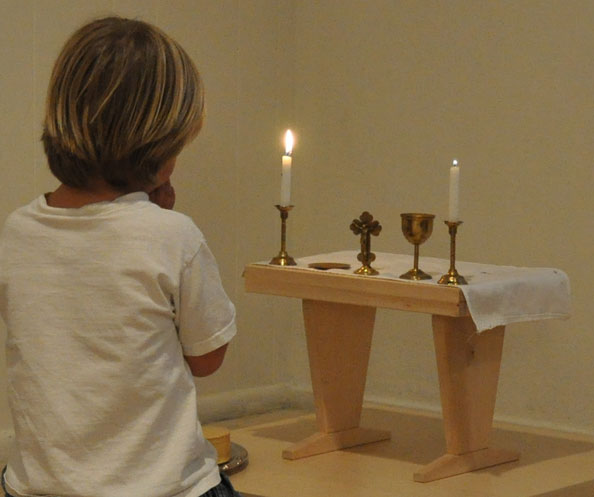
The altar for the home school was so easy to make and believe it or not, I found the little chalice, paten, candlestick, candle snuffer, and bells all in second hand stores. I had purificators and other altar linen which had been in the family for years.

I am merely going to show you some photos from on line sources for this main element in teaching the Mass, with the Last Supper figures noted in previous posts.

This one is quite elaborate, but one, sadly, can find relics still on e-bay. This is more of a family altar, but I want to emphasize altars which are child-sized and can be handled by the children.

http://www.stpeterslist.com/3562/the-domestic-church-7-steps-to-a-proper-catholic-home/


http://www.sacredheartprescott.com/Ministries/CGS/CGS.html
http://www.memphis-umc.net/news/detail/864
http://voxpastoris.org/


Home Schooling Series Part 15 Religion and the Child X-Lent


In recent times, there has been an odd reaction to fasting and abstinence in many Catholic families. Let me make some comparisons.

In the old days, when I was a child, Friday abstinence from meat was almost a worldwide Catholic practice. Even though the age of abstinence is 14, all families I knew and the Catholic school lunches did not have meat on Friday or Ash Wednesday. This was an old custom.

The idea that all of the sudden a young adult of 14 will start eating only fish or eggs on Friday is ludicrous. Catholic families should all be abstaining together, from little on.

As to fasting, the same applies but most ridiculous is the age in America, 18-60. I grew up fasting with my parents, as part of formation and character building. Again, for a normal healthy child, this is possible. And, by the way, in England, where the abstinence rule has been reinstated, all the over 60s I know are abstaining from meat on Fridays, including me.

To think an adult at 18 going off to college will suddenly do something he has never done at home is again, an indication of too much laxity on the home front regarding character building.

Remember, that millions of us fasted from midnight and then for three hours before Holy Communion most of our childhood, if not all.

There is no reason why a healthy toddler cannot abstain for meat and have fish and/or eggs.

Lenten observance should affect the entire family. It is supposed to be hard. We ate waffles and egg souffle as well as various types of fish. To this day, my son love the hot tuna salad with macaroni, peas, cheese, mayo, onions and so on which is a staple in many Midwest families for Fridays.

Lenten practices for children at an early age should include the Stations of the Cross, which one can make at home with drawings, having a penny poor box on the dining room table to remind one of those who cannot eat and need help, giving up deserts all Lent, or candy.

Things which are pro-active include visiting old people with the children on the weekend-in fact, one can ask one's pastor for names of shut-ins. Reading the Passover experience of the Jews and working on that with acting out or peg-dolls are other activities.

If, and I hope not, you have television, no television for Lent is a great penance, or no computer games. I know mothers and dads who had the children stop computer games during Lent. Many good things came out of that practice.

Helping in food banks during Lent is something teens can do through the diocesan programs.

And, most importantly, extra hours of Adoration. Children can go to Adoration easily. Start with a half-hour and build up.

I know of several home schooling families which are part of regular Adoration. The parishoners love their witness, as in one case, the mom brings in five children, the oldest being about twelve.

Lenten hymns or Gregorian Chant may be done in the home, and do not forget the Icon Corner.

Also, Lent is the time to teach about both Justice and Mercy.  Maria Montessori points out in her book which is being highlighted off and on in this series, that justice is a great light of faith, "which assures to each one of us a reward for every good action we have done." Justice is not merely punishment, but reward, and the sheep and the goats parable can be emphasized in Lent with the parable boxes.
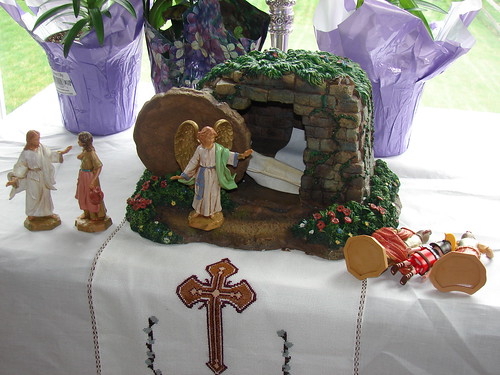
I like the recumbent Roman soldier here

I am not at this time going to do an Easter Time post, but the family can make the empty tomb as in this photo, and mom can make a lamb cake, which is not that hard. Link here.

To be continued...


Some Dems Are Waking Up

http://www.weeklystandard.com/blogs/dem-congressman-constitution-requires-congressional-authorization-use-force-against-syria_751350.html

Well, there is democracy in Britain still

http://www.telegraph.co.uk/news/worldnews/middleeast/syria/10272555/Cameron-backs-down-on-urgent-Syria-strikes.html

http://www.newsmaxworld.com/GlobalTalk/syria-conflict-britain-debate/2013/08/29/id/522894?s=al&promo_code=14B1C-1

Need Prayers Please

All the women I know in Dublin who are saintly are ill, very ill, and having serious problems in the family, serious. Also, I am ill today again, (though not in the holiness category of these ladies). There is something behind all of this. And, three of them are living alone. No coincidences. I hope I can blog more later.

Prayers for Lynda, Margaret, Anna, and me. Thanks so much.


For those Brits and Americans Who Think Christian and Islamic Morality is the Same

http://www.washingtontimes.com/news/2013/aug/26/al-qaeda-urges-fighters-widows-show-support-throug/?utm_source=RSS_Feed&utm_medium=RSS

And, Obama's crude joke about the Christians being persecuted-not only bad form, but more...

http://www.christianpost.com/news/obama-admin-criticized-for-joke-over-christians-attacked-in-egypt-103059/ 

And, on Syria

http://www.longwarjournal.org/archives/2013/06/al_nusrah_front_clai_14.php?utm_source=feedburner&utm_medium=feed&utm_campaign=Feed:+LongWarJournalSiteWide+%28The+Long+War+Journal+%28Site-Wide%29%29

The Feast of The Beheading of John the Baptist

One of my favorite saints is John the Baptist. I have noted the masterpiece of Caravaggio which is in the Co-Cathedral in Valletta on this blog before, as I love this painting.

Let us pray to this saint, who is a saint for our times.

The friend of the bridegroom, who stands and listens for him, rejoices greatly when he hears the voice of the bridegroom: therefore my joy is now complete. Lauds


God our Father,
  you appointed St John the Baptist
  to be the herald of the birth and death of Christ your Son.
Grant that as he died a martyr for justice and truth,
  so we also may courageously bear witness to your word.
Through our Lord Jesus Christ, your Son,
  who lives and reigns with you and the Holy Spirit,
  one God, for ever and ever. Lauds from Universalis.

The Predominant Fault: Parents Part 14 and Religion Part IX: Section A


Many of my readers have followed the long perfection series and some have been following the series on home schooling.

Now, a happy combination of thoughts allow me to write on both more succinctly. Do you remember in the perfection series when I wrote about Garrigou-Lagrange pointing out that we must deal with our predominant fault? Here are some of those posts.

21 Jul 2012
In Chapter 22, the great Dominican writes of "The Predominant Fault".The holy priest lists most of the obvious sins, but I want to highlight one, but in a different manner. We know that Pride is most likely the worst of all sins and ...

 Etheldredasplace: Perfection Series: Our Predominant Fault Two
22 Jul 2012
Garrigou-Lagrange states that "it is of primary importance that we recognize our predominant fault and have no illusions about it. This is is so much the more necessary as our adversary, the enemy of our soul, knows it quite ...
24 Jul 2012
Perfection Series continued-the predominant fault--four. Posted by Supertradmum. St. Augustine tells us, using Garrigou-Lagrange, that God never asks us to do the impossible. If God desires us to be one with Him and He ...
22 Jul 2012
Our wills must respond to God like a damsel fly in the air, turning directions quickly and deftly. Promptness of will means two things. That we are listening and in sanctifying grace. Garrigou-Lagrange writes, referring to a ...
30 Jan 2013
More than fear as a great evil, the state of living in a hidden sin, allowing one to keep on sinning and not dealing with the predominant fault, keeps people from the Truth, 


Now, here is the really COOL THING. Dr. Montessori in her book on the child in the Church, has a chapter on The Spiritual Training of the Teacher. What is so wonderful is that Dr. Montessori has a Thomistic background. I have another book which is out of print (in a box in Illinois) which are notes of a Thomistic Conference discussing Montessori in terms of Aquinas.

But, this chapter, to which I am referring reveals her deep understanding of the necessity of a teacher, and in this case, a parent, to deal with the predominant fault.

Rightly so, the author points out two of the greatest sins in those who raise and form children.

Pride and anger. Now, one must find out what one's predominant fault is, but I want to emphasize a few points from this chapter.

One, pride is allied, as the good doctor states, to anger, and one reacts to authority in anger when one is proud. For example, and this is my example, some married couples become angry when faced with the Church's teaching against contraception. They make excuses and fall into lies. They believe that NFP is a way of life, instead of a temporary solution to exterior pressures on the family and so on. Such parents are not open to orthodoxy.

Two, Montessori states that we cover up our main fault in two ways. By disguising our fault "under the pretext of noble and necessary duties"and by surrounding ourselves with people who act like we do. Again, in my example, those who do not see that the use of condoms, or the continual use of NFP are sinful acts, surround themselves with like-minded people, including priests whose consciences have been badly formed.

The same is true, Montessori points out, with all the seven deadly sins.  People avoid facing this predominant fault.

Now, to be able to teach and form children, one must deal with both anger and pride. Daily, it becomes more difficult, writes Montessori, in agreement with Garrigou-Lagrange, (it would be interesting to know if she had read him), and one becomes defensive about one's main fault.

Montessori points out that a child, that children, feel the effects of these two main faults, pride and anger. And, in order to deal with these in the teacher, and in my extrapolation, with the parent, the child becomes defensive-fear, deceit, timidity, caprice, and many other signs of unhappiness in the young child can be a result of such.

Let me remind parents of what they know and what Montessori emphasizes. To the young child, an adult in authority represents God Himself. And ,it is only, as she notes, when the child begins to grow up, that the adolescent or adult child realizes the tyranny he may have been under. Old faults or sins in the adult can be traced many times to childhood patterns of dealing with highly imperfect parents.

Anger and pride in a parent seriously effect the home schooling environment. I wish I had been much more aware of the predominant fault when I was raising my son. But, God is good and helps us and our children.

For those who teach, especially parents, the work of perfection is more, then, than one's personal relationship with God. Love, as St. John of the Cross notes, is the goal of perfection. Montessori repeats this by noting St. Paul.

But, as a teacher there is an added dimension. And, here is the key, which must be understood in a special way for Catholics. Charity is absolutely needed in teachers, in parents.


Most teachers in our day and age see two things in children-they either see only the bad for correction or they do not see the goodness which is a result of grace and nature. They see a false interpretation of goodness, denying Original Sin, as many Catholics do, now believing in universal salvation, which creates a false impression of innocence or goodness in the child.

Pay attention to the distinctions here. Maria Montessori warns against confusing real love and seeing goodness with the "vague forms of optimism".  One does not call evil good, but one finds the good which is there always in the person.

Too many parents do not discipline because of their own predominant fault. They do not want anyone telling them what to do in their spiritual lives and therefore, they do not see how this effects their children.

Montessori writes, "The kind of goodness to which everything seems good and evil non-existent is, therefore, something totally different from the charity which is necessary to become good teachers to the young."

She uses an extensive modern comparison in the growing of wheat and corn. The kernel of the truth here, to make a little pun, is that all seeds need nourishment, weak ones and hardy ones. As she states, "Good conquers evil or evil conquers good....The fact is, therefore, that if good things are not nourish, we suffer not only from the lack of them, but also from presence of worse things."

One must cultivate the good in children and that demands real love from the parents Real love, not sentimentality.

I shall continue on this theme in the next post.

Home Schooling Advice Part 13 Religion And The Child VIII

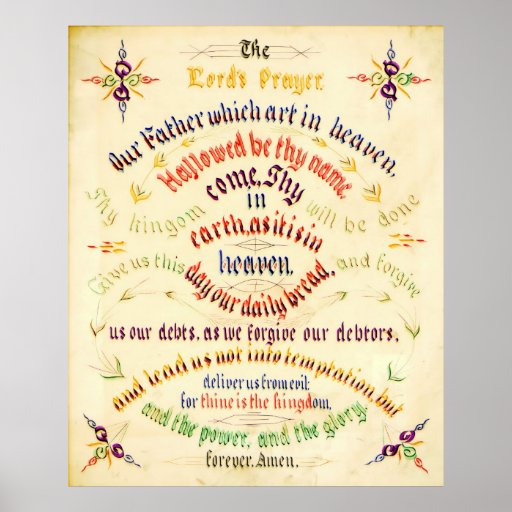
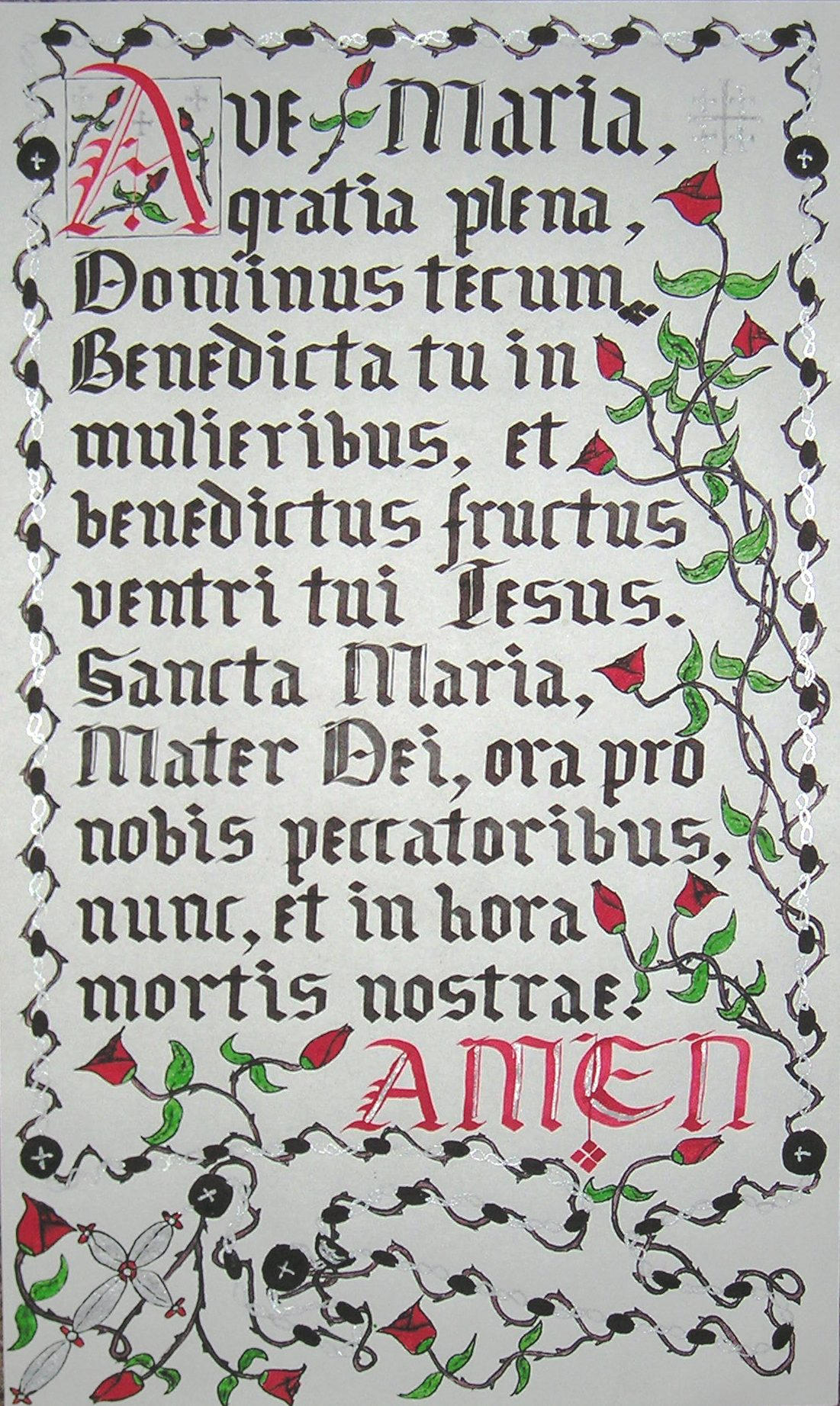
Things for the walls in the home schooling classroom, besides great art, could include the following, from a list from Dr. Montessori.

Sacred Mottos-such as Sanctus, Sanctus, Sanctus.

Definitions of the Sacraments in a few words.

The Corporal and Spiritual Works of Mercy

The Confiteor

The Lord's Prayer

The Hail Mary

The Gloria 

The Apostle's Creed

The Ten Commandments.

The Commandments of the Church


And, I add, the patron saints of the children.

Also, make sure these are beautifully done, as in medieval calligraphy, as she noted and as I wanted spontaneously being so Benedictine at heart.

May I add that drawings of the great cathedrals, monasteries and the tabernacle and Temple of Solomon could also be added, if one does not have or want models. Some many be found for sale here. 

I shall write more on the role of the parent, Lenten practices, character building in children, and the teaching of the Mass...not necessarily in that order.

Not a mini-series...

to be continued....


Homeschooling Advice Part 12 Religion and the Child VII

The main point in the formation of the child is realizing that the child is geared by the graces of baptism to be formed.

Religion is not one more course among many. Although there is a discipline of the study of religion, the religious atmosphere should permeate home schooling.

If a parent is teaching music, the child can learn Marian hymns, even Latin hymns.


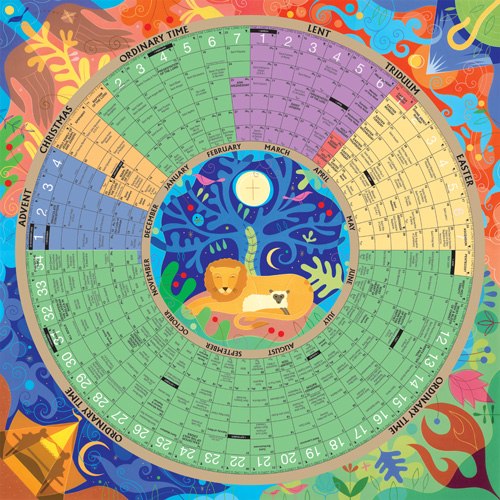
If a parent is teaching colour, as I showed in the photos in the last posts, the child can learn the liturgical year.

When I was home schooling, yearly, I bought the large circular liturgical year calendar. We followed the year in the house alongside the secular calendar.These are for sale on line.


To be a Catholic is a way of life, like saying grace before meals, stopping for the Angelus and so on.

Small church structures even made out of legos can include a lectern, altar, pulpit, confessional, baptismal font and so on.  I did a history of architecture with my son when he was 4-5, walking around the village, learning the basics of medieval, Renaissance, and the subsequent forms and he also recognized those styles, such as Romanesque and Gothic in church architecture. I found post cards and photos from magazines for him to paste and write about in a little blue book.

None of this is expensive.

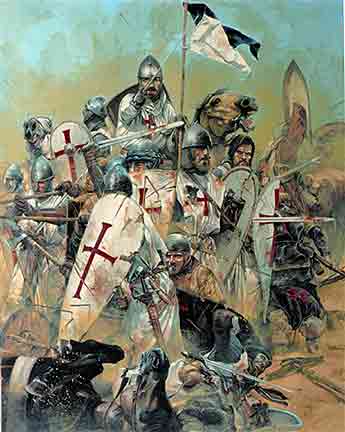
Instead of merely making lego scenes of pirates, one can act out the Crusades, or the English Civil War in specific battles for teaching. Look at this magnificent Seige of Zara from an online source. Fantastic.


Having an altar for Mary in May and October was a fun thing to do, as well as the usual Advent and Lenten children's activities.

In Advent, we made a little manger for a Christ Child and if my son was good, he could put in a piece of straw to make Baby Jesus's bed comfortable and, is he did something naughty, the straw would come out.


My mother did this with us. We enacted the night of the Nativity in the family, having costumes and props. and going from door to door in the house, with one of us standing behind saying no room at the inn and so on. Then baby Jesus was "born" and put into the hopefully snug straw filled manger, with quilt added.

We had a holy water font in the child's room, as I did as a child. And a crucifix in each room of the house, or an icon. We especially had fun on the feast of St. Nicholas, who always came secretly with candy, fruit and little toys. By the way, growing up in Iowa, with snow on the ground on the night of December 6th, we all looked for his footprints. He always came when the entire family was at supper, and it was not until I was in my forties that my mother told me that the Lutheran man next door would bring the things wearing his snowshoes so that there would be no prints. My mom brought stuff over to their house for years earlier in the day.

Of course, we have a magnificent Jesse tree wall hanging made by a non-religious woman who loved the boy and it was used all Advent, day by day. We used straight pins and said a prayer with each symbol, from a book I had bought in Minneapolis when I was about 25 and I have put these types of symbols on my blog in the past. I can do so again. If the children are old enough, they can draw these themselves. From there to Sherborne....(I wish I had my photos of these things, as I kept of record of most things). This photo from another family on line shows the same book symbol.


At the feast of January 6th, we had a house procession of the Three Kings with candles, as the Epiphany means Christ showing forth into the world. We also had made candles out of toilet paper rolls and cotton with the names of the Apostles on each one to remind the child that the Apostles brought the light of Christ to the nations.

These are just a few things we did, and more like making St Lucy Kat which you can find here
http://supertradmum-etheldredasplace.blogspot.ie/2012/12/st-lucy-kats.html

I shall write about Lenten practices tomorrow.

Home Schooling Advice Part 11 Religion VI Reflection and Meditation 101

This topic will surprise many parents.

A very young child can learn reflection and basic meditation.

Now, a warning, from Dr. Montessori, with which I agree 100%.

A CHILD BEFORE SIX SHOULD NOT BE INTRODUCED TO FANTASY.

That is a shock to those who think little ones need Walt Disney.

No. No. No.

Fantasy must be held off until the child is grounded in reality or the mind will not be properly formed.

Fantasy follows nature studies, learning that when a glass falls it breaks and one has to sweep it up, that birds build nests and some baby birds die, that the pet dog needs feeding and watering and walking daily, that pouring juice without spilling is possible for a three year old and so on. Reality is making Popsicles and watching them melt in the hot sun. Reality is .....


When fantasy is introduced too early, the child will be confused about reality and fiction. Many young people today cannot tell the difference.

Of course, for the Catholic, the Bible is true, real and not mythological. Therefore, Bible studies can be introduced as early as two and a half or earlier with those adorable hard religious books for toddlers.

I knew a four year old, not my son, who was memorizing Scripture passages like I make popcorn, and he understood the passages his parents chose. He was using his own God-given drive to be a saint.

Some children at three get the long years in the desert of the Hebrews if a mom uses bead counting chains.


So, too, anything can be used to explain the Sacraments or sacramentals. What five year old girl would not love dressing up as a little bride, or a little nun instead of a Disney princess?

But, meditation and reflection must be based on reality, and a child is quite capable of both.

Examples: one can take a passage in Scripture and let the young child act it out. Like the finding of the lost lamb with a toy lamb, or even with the farm set on the floor. Like the parable boxes, acting out reinforces truth.

The child can dress up like Bible personages. Kids love this, and if one has a large family, the plays could be highly involved. Some home schooling families put on pageants for others or for other family members as entertainment. I had a dress-up box when I was a child. One should have one in the home school with old elaborate clothes for such use. Children can enact manners.


Having a picture of a saint and asking the child how the saint might think or feel in the picture-like one of St. Lucy, or St. Gemma Galgani. Let the child imitate, enact the saint by a mime. Montessori has exercises in the book I put on a post yesterday and here again. Interpretation of emotions and activities may be applied to religious themes.

Giving the child silence is absolutely essential for spiritual formation. The normal time a three to four year old can concentrate on one thing is 45 minutes. If the child's natural ability for concentration has been ruined by television or ceaseless activities, this is a tragic development. I know parents who say the entire rosary with the children in the car instead of other parents, who have to put in the latest Disney in the car DVD player.

There is no reason why a normalized child cannot be quiet for up to a half-hour thinking about Jesus on the Cross, or the Birth of Christ. Just holding the Crucifix and asking the child  How do you think Jesus felt? is a beginning of meditation and reflection. A child might say, scared, or cold, or lonely.

Every Good Friday, when my brothers and I were very young, from 1-3, we had to go to our rooms and be quiet. Now, we did not pray the entire time, of course. We could play quietly, but my mother said that first we must sit down for a few minutes and think of Jesus on the Cross. The entire house was quiet. At three, we went to church.

We managed.

From early on, I made my son have quiet time in his room. He was encouraged to read and look at saints' lives. I was fortunate that he began reading at four. But, his quiet time was the beginning of reflection, daily. Then, we would talk about his saint, or Moses, or the Blessed Mother.

By five, I was teaching a basic examination of conscience. Did you do anything today which would displease God, or make mum or dad sad? I would encourage this in just the evening, but not everyday. My son made his First Confession at five and knew what to look for making his mental list of little sins. He made his First Communion at six. His dad and I did all the prep, including a book of sacraments, which the son made, starting with his baptism-and he did all the coloring and writing and pasting. I just provided pictures from old bulletins, or cards he got on that day, or photos. He wrote about baptism and confession, and his upcoming First Communion in the album.

Reflection leads to meditation, a practice we all do on the way to holiness. Meditation is based usually on Scripture, but one can, with the child, meditate on the words of a song, or a prayer, like the Hail Mary. One can teach the child to reflect on his patron saint. Very young children love repetition and we learned lots of songs.

Pictures can help and imagining the scene. One can say to the child, for example, Let us think of walking with Jesus to Lake Galilee. What sounds might you hear, or smells or what would you see and so on?

A quiet environment in the home takes planning and time. It means the home schooling parent has priorities. It means no radio or tv, but times for music. It means scheduling.

What the child can do is amazing if we let them do it and provide them with the means, especially the environment.

One of the most successful things I did was make an Icon Corner. This changed according to the liturgical season or saint's day, and even as a teenager, up until college when son went away, that was a little locus of prayer.

One can do this in the children's room as it is safe.

At night, after a mini examen, we said the Angel of God prayer, the prayer of  Venerable Fulton J. Sheen for the adoption of the baby in danger of abortion, the St. Michael prayer and a litany of family saints-which changed as one was confirmed and so on.

The rosary we mostly said in church with others, or on our own, after the child learned it. It is important for a child to pray both with people and on his own. I had a set of pictures of the meditations on the rosary which one can still buy. To this day, my son prefers saying his rosary alone-now an "old" habit.

All these things can be started as early as your child is aware,  and everything I have mentioned can be done with pre-schoolers on up.

Especially in these days, parents need to help their children be saints.

To be continued...and another on line book. And, here is an Orthodox mom's website of home schooling ideas, including an icon corner, similar to what I had. And, for the fun of it, here is St. Therese, at a later age, acting out a play of St. Joan of Arc. And. one more blog on children dressed up for All Saint\s Day. Cute.


Wednesday, 28 August 2013

Just Because-Eye Candy a la Francis Bedford

http://vintagephotosjohnson.com/2012/05/30/francis-bedford-1816-1894-bibliography/

Duh!

http://www.newsmaxworld.com/GlobalTalk/syria-russia-intervention-catastrophic/2013/08/28/id/522579?s=al&promo_code=14AC9-1

Dark Night of The Soul And Patience: Part 44


I wrote here about the theological virtues and the Dark Night.
http://supertradmum-etheldredasplace.blogspot.ie/2013/08/consumerism-materialism-pride-and.html

There are many other posts on the life of the virtues, which is the most misunderstood area of our Catholic lives and rarely taught correctly. Just put the title virtues in the search bar, or use the tags.

In all of my long years, I have only heard one sermon from the pulpit, and Fr. Chad Ripperger's talks in which a priest actually delineated the need for purification BEFORE the life of the virtues is being exemplified. This is indicated in Garrigou-Lagrange and in St. John of the Cross. Why priests do not share this information can only mean that they do not know it, or are dumbing down the process of living in the virtues.

We are given the theological and cardinal virtues as gifts in baptism. Every time we receive the Eucharist or go to Confession, we allow God to stir up those virtues as it were.

However, to live in the holiness of the life of the virtues, a person must go through purification, must.

Why?

Several reasons. The first is that most adults have sins and tendencies which clog up the heart, mind, soul and will like slug in mechanical works. Years of bad habits, turning away from grace, the lack of penances and the avoidance, or hatred of suffering create obstacles to the free flowing of the virtues.

Purification is like putting Drano in the drains so that the river of grace can enter into every part of one's being. Sadly, some of us need more than the liquid or gel; we need the drain snakes.

A second reason is pride, the basic sin of all of us. Without humility, the opposite of pride, one is not free enough to use the virtues for God alone, instead of for one's own ego.


Now, one of the greatest blockages is the sin of impatience, which St. John of the Cross notes is an impediment to holiness.

One becomes impatient with others, and one's self; impatience with events; and worse, with suffering.

The value of getting older is that impatience becomes less a burden. The older person is forced by nature, by the slowing down of the body's ability to do everything extremely well and in a timely fashion, to become patience.

If an old or older person is impatience, this is a huge sign that he is not cooperating with the suffering of the Dark Night. I have written several posts using the lunge line in horse training as a metaphor for the discipline which comes in the Dark Night. Aging is a lunge line.


Suffering, because of our fallen state, is a necessity for this
purification. Sadly, many of us run away from suffering,
especially Americans, who frequently strive after the cult
of comfort.

If one fights this discipline and dies outside the life of the virtues, one will go to purgatory.

Virtues are not emotions, but effect the life of the emotions. Patience is the acceptance of imperfection, not a feeling. It is the acceptance of one's sinful nature and the limitations of the soul, the mind, the will.

When I was a child, some of my favourite books were the horse series by Marguerite Henry. How does a horse become a champion? Training, discipline, love, hard work...


This all takes time and effort. Ask yourself whether becoming holy and living the life of virtue are priorities in your life.

And, the worst part, in my mind, of Catholics not cooperating with the purification needed for the living of the life of the virtues, which, in another phrase, could be called living in the Indwelling of the Trinity as fully as possible while on earth, is that without persons exhibiting the virtues, the Church remains weak and ineffective in the world.

Can you imagine a Church full of power, changing the world, because of every individual member cooperating with grace and living in the life of the virtues? A Church of thoroughbreds?

Cultivate the life of virtue in your children. In coming posts, I shall give some concrete advice on how to do this.

To be continued...

Home Schooling Advice Ten Religion V: Called By Name


Some things I just know by instinct and by intellectual training. As one who has studied Aristotle, Aquinas and Montessori, I am steep in the real, the necessity for experience as well as working on the intellectual.

In May of 1927, Dr. Montessori was interviewed about religion and the child. If I had a scanner, I would scan the entire interview. However, I shall highlight some main points.

The first is connected to Aristotle, Aquinas and how we all learn. I knew this point she made, which is coming after this long introduction, instinctively. This is it.

The Protestants spoiled religion, of course, in many ways, but one of the biggest ways was destroying Tradition including the Sacramental life of the Church. By only emphasizing the Bible, as people who only believed in private interpretation, they ruined the concept that religion is mostly learned by doing.

Learning about Baptism with water, candle and shell

Montessori uses this truth by stating in the interview that millions of people who never learned how to read were good, even holy, Catholics.  This is because of the Liturgy, primarily, and the Sacraments, as well as sacramentals.

She makes the point that the child learns by making the sign of the Cross, putting his finger in holy water, kneeling down at Mass, following all the actions in the Mass.

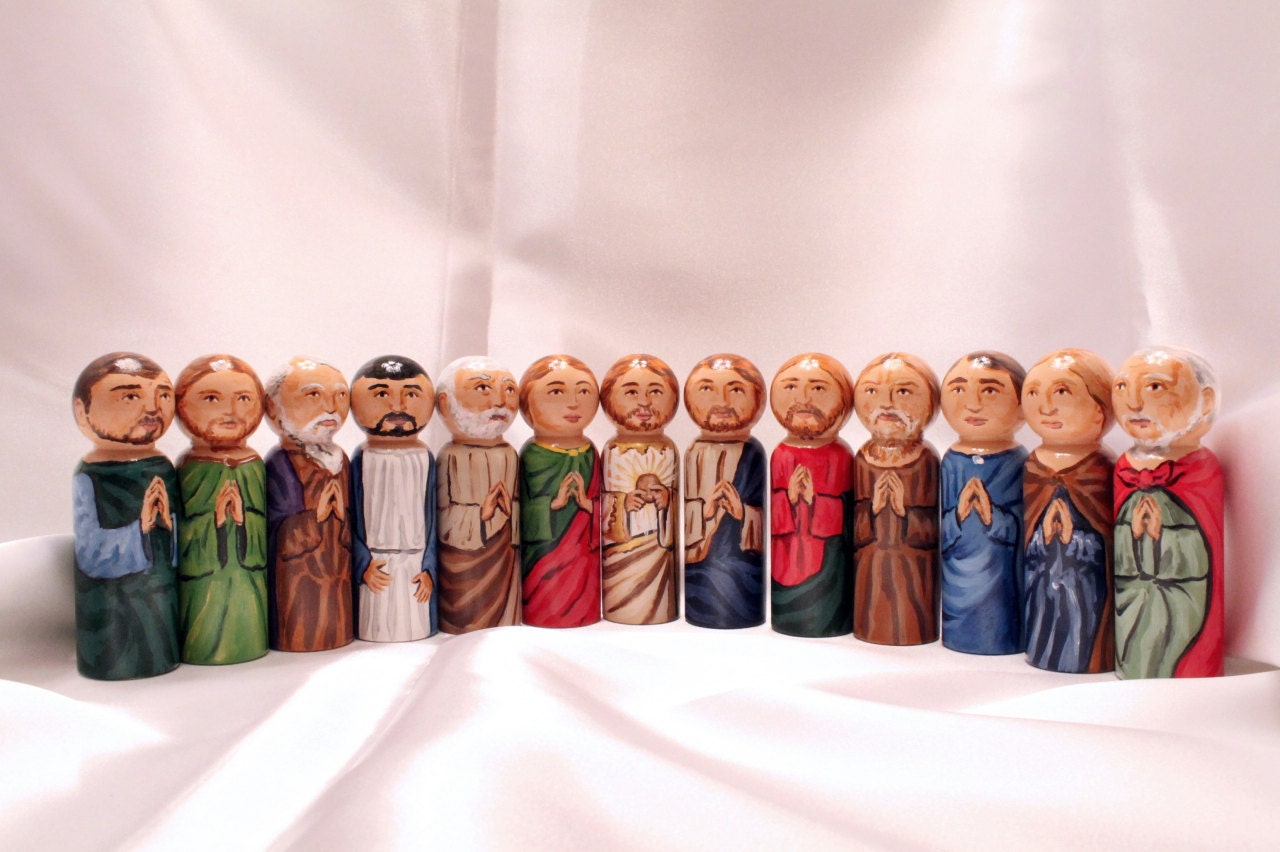
Jesus and Apostle figures for the Last Supper

She notes that what she is teaching in her method, things such as the silent game, which I played with my son, and proper deportment, carrying glass objects (real Montessori rooms have NO plastic) and so on.

The natural development of both small and large motor movements aid the child in doing the lay rubrics of the Mass and children should be made to do these.

Just yesterday, I was appalled at a grandmother letting a child old enough to sit, stand, kneel, run around the aisles and in the back of the Church. This is not necessary. Children KNOW appropriateness in certain places if they are encouraged to do so.  As Dr. Montessori notes, the child's daily activities in learning "are lifted to a higher plane to acquire a new and deeper meaning".

The problems are not in the child but in the parents who think children are not capable of sublime religious experiences.

Part of her interview reveals the basis of her method, that memorizing the Catechism, which she totally thinks is necessary, comes after the child has experienced the Mass, hymns, sacramentals and so on.

Dr. Montessori is very aware of modernism and states that the child should memorize the Catechism EXACTLY, as exact definitions are important.

The use of "didactic material" followed by formal Catechism memorization would create a powerful little Catholic.

If you have not visited the Catechesis of the Good Shepherd site do so.

I learned most of this on my own, obviously not realizing that the Holy Spirit was inspiring me. How exciting when I learned that the Good Shepherd materials were what I had made spontaneously.

Experience and words, according to the ability and age of the child...not just words...

There should be, as Montessori notes in the interview, no BREAK between daily life and religion. But, the religious teaching materials should be kept separate out of respect and the sense of the spiritual. Also, as she notes, the special shelves are like a little prayer corner, which I also had for my son-with small icons. If one has a large house, one should have one room devoted to prayer and the religious materials for teaching-a little chapel for the entire family. The house I had did not allow for this, but a section of the school room sufficed. Maria Montessori developed her idea of the Atrium from medieval  architecture. That is why in the Catechesis of the Good Shepherd, the name of the special room is called the Atrium. And, years and years ago, one of the most beautiful ones I saw next to an Episcopalian Church, purpose built for the children, had a large sunroof in the shape of a cathedral tower in the middle, leaving light in through the glass as in a church. It was almost perfect....


This would make an ideal Atrium


My son on the religion shelves, starting at age three, had boxes of the parables with little clothes peg characters we made together. The Lost Coin, the Lost Sheep, the Good Shepherd, the Prodigal Son complete with pigs, the Good Samaritan and so on were made out of pegs, pipe cleaners, glue and felt. The Bible was kept on the same shelf.

One day, when he was about four, and could read by that time, he was working on the timeline of the Old Testament. We decided to do the Exodus. For a week, we used about 99 clothes pegs to make an angry Pharaoh in gold lame with a crown, Moses, Miriam, Aaron, Caleb, Joshua and many, many Israelites and soldiers. Then we had to figure out how to do the Red Sea. Happy Days...Now the Exodus is a real event and the parables are stories, but my son was savvy enough to know the difference.

Now the key to these things, besides making them together, is that mom must read the real passages out of the Bible, not out of a paraphrased version, but the real deal.

The child listens to the passage, the parable and then acts it out with the clothes peg people, and what fun...

I spent years on my hands and knees on the floor teaching the Old and New Testament. Timelines are made with ribbons and circles with the main events of the two Testaments. I chose twenty of each Testament, made circles with my cookie cutter shapes tracing around those on white heavy paper, writing the event and NOT the date (I did draw symbols, however, connected to the events) and had my son learn to put them in order after I showed him. As soon as the child can read, one can do this, and then, read the appropriate passages with the 40 events.

Great fun....Here is another example of the Twelve Apostles and Jesus for the Last Supper part of pre-Communion training like the one above.

Here are some quotations from an Orthodox CGS site which partially summarizes this post:

In the Children's Room the child  is honored, nurtured,  and given a place for experiential activity,  reflection, and expression of their religious instincts. 

The prepared environment is one that supports the child's natural inclination to be in relationship with God and the child's way of being.

The Children's Room supports the child’s natural rhythm of movement as the children are free to move in a purposeful way.

I highly recommend parents to read, Sofia Cavalletti, The Religious Potential of the Child 

To be continued...silence and meditation for children comes next.....................


Home Schooling Part 9 Religion IV First Communion Prep in 1923

I cannot copy these photos but take a look at children in the 1920s on First Communion Day and May Crowning in England. http://www.addiewellheritage.org.uk/page_id__57.aspx

Now, many parents think that children cannot be silent or reflect. This is simply not true. When I was working in Montessori schools in the 1970s and early 1980s, and I do not mean day care centers, but proper schools. silence was the norm.

Silence is crucial for the nurturing of the spiritual life in a child.

And, children respond to silence.  In taking children to church, for example, parents should not bring toys or food. The child begins to understand by watching, and then, slowly comprehending the depth of what is happening at Mass.

As Montessori writes, the child of four knows the difference between the water in the holy water stoup and that of the sink where he washes his hands.

Here are her words, "...intellectual labour which the little creature initiates when he begins to realize that he is a child of God, lovingly received into the house of the great Heavenly Father..." follows the senses of absorbing what is around him in the church.
I made my First Communion in 1957, and my dress and veil were very like the second girl in line, just after the break in the line.

She quoted an aunt who stated that her nephew wanted to go to Mass daily because he was allowed to put out the candles, which captured his imagination. Just as the great cathedrals and abbeys captured the imagination of adults in days past, so too, the child responds to beauty and symbolic gestures.

The Sacraments are understood because the child pays attention to the things, the physical objects which are the matter of the Sacraments: water, oil, and so on.  Little by little, as Montessori points out, the child begins to understand the realities behind the actions and matter.

In fact, Montessori noted that some of the little ones were explaining the Sacraments or Mass to their parents in profound terms  in which the parents had not thought....in much the same way that St. Joseph Cupertino, who was severely mentally challenged, could explain the Trinity to a bishop.

Maria Montessori way back in the early part of the 20th century warned against the watering down, the broadness of religious teaching to children.

Specifics teach. The little school she started on Barcelona, after the ones, she set up in Italy, England and other places,  planted wheat and grapes in a small garden so that children could understand "I am the Vine, you are the branches", plus the matter of the bread and wine which becomes the Body and Blood of Christ. The children did all the work, with help, but what an excellent way to teach, through one's hands and senses, which is the basis for the Montessori Method.


I did this in my little home school and I made most of the materials myself, out of egg cartons, baby wipe boxes, which I saved, and odds and ends. My son did gardening with me from the age of two, watering my plants and his little part of the garden with his little toddler watering can. We watched the changes in plants and animals so that my son would see the Grandeur of God and come to know the Creator through nature. This is part of Sacramental prep, as nature provides the matter for the Sacraments. But, the child is also, through watching caterpillars, or flowers, or rabbits, learning about God the Creator and His love for His Creatures, including the child himself. A child naturally takes joy in these things, and learns both mutability and beauty through nature.

So, the child learns about God through his eyes, nose, hands, mouth.

Montessori had the children pick the wheat and harvest it. They has machines for making hosts, all without electricity,  and all of these things wheat and hosts were part of the Bishop's procession on Corpus Christi.

The grapes were crushed and the juice put in an amphora as these had been made into wine with help.

Can one imagine this being part of First Holy Communion training?  We need to cultivate this type of daily awareness of the sacred. These children were younger than seven, as the next year was their First Holy Communion at that age, and this was shortly before 1924!


By the way, Montessori invented the idea of having the children's names on cards on the walls of the school so all could pray for the ones coming up for that Sacrament.

Also, preparation was always in the Church with the priest, candles, prayers. And the children had
to learn the Creed, the Ten Commandments and basic of the Faith, which they had to recite to the priest before receiving.

Here was the curriuculum in 1923 for First Communion prep: Faith, the dogmas, The Creed; Love, charity, the Commandments; Prayer, in Latin, of course, the Ave, Gloria, Pater; The Sacraments, including Confession first; the Mass, the Eucharist.

Then before the day of Holy Communion, the children went on a retreat, and let me descibe this--The were apart from their families and companions (remember, they were seven\) and dined in the school alone in recollection.

During the retreat, they spent a lot of time in the garden looking after plants and little animals.

They also made their own silver rosaries for their Communion day and they made their own little five page books for the day.

They learned on the retreat and in the sessions in the church to kneel, stand, sit quietly.
They were trained not to turn their head at distractions or noises, but to concentrate on loving and praising God

They were given lantern slides, which could be power-points today, on the lives of the saints, and learned little hymns, as well as washing their own dishes after meals and cleaning up. The humility of Christ's Birth and His Hidden Life of Nazareth would have been part of this.

Pasrt of your home schooling prep should be a little altar as in the photo earlier, with candles, missal, little paten, chalice as a start. See the Catecheis of the Good Shepherd for this presentation.

Also, the reference to the Last Supper with little characters of Jesus and the Twelve can be part of this.

If little peasant children in 1923 could learn, why not our children, unless they have been raised like weeds by careless parents.

The retreat, by the way, lasted five days.  Here is Montessori's comment. on the results.

Not only do the principles of human justice interest them (at this age), but a simple love of Jesus is born in theirs hearts and with it a great desire of purifications.

Parents, do not underestimate the holiness which your little ones can achieve at a very young age. Do not spoil what aspirations God has put in these little ones.

To be continued....


Drums


http://www.bbc.co.uk/news/world-us-canada-23845800


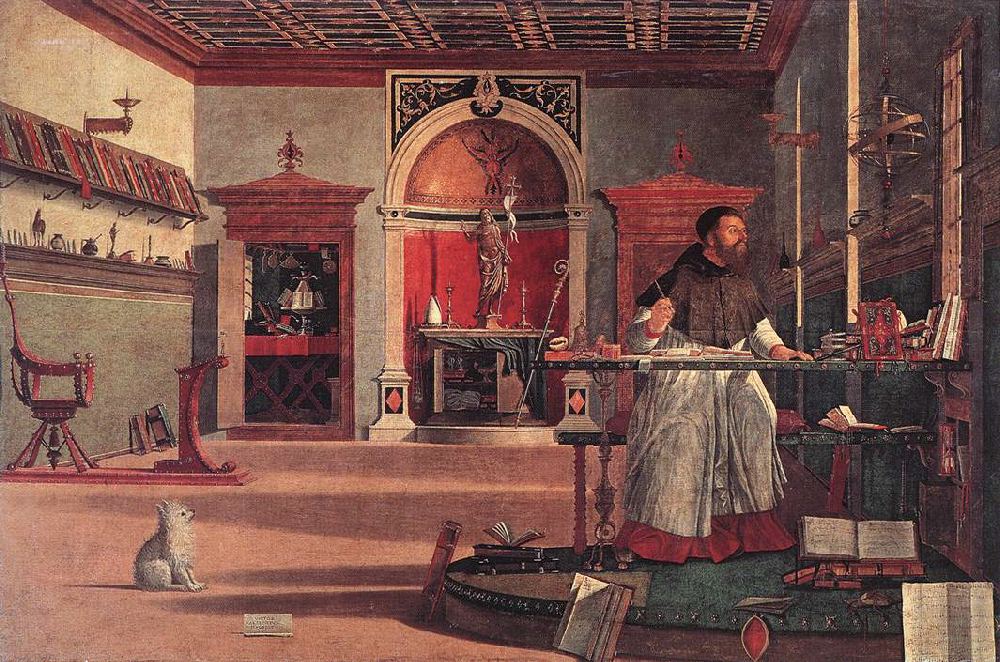
St. Augustine of Hippo, Pray for Us

If you have not read the Confessions or the City of God, do.

I actually, years ago, was asked to teach the City of God at a small Catholic college.

What a phenomenal book! I had already taught the Confessions, which was as treat.

St. Augustine, imo, is the saint for our times.

I would want to be this little dog, just sitting in Augustine's presence.