http://www.breitbart.com/Big-Government/2013/12/04/Roots-of-Common-Core-Lie-In-Association-Between-Barack-Obama-And-Bill-Ayers?utm_source=twitterfeed&utm_medium=twitter
hhmmm, Marxism in the Core....
Friday, 6 December 2013
Interesting Statistic
Between 56 and 57 percent of the 18- to-29-year-old respondents didn't approve of the Affordable Care Act or Obamacare (depending on how the question was asked); 40 to 44 percent thought their quality of care would get worse under the new law; and 50 to 51 percent said they expected costs to increase. More below...
http://www.theatlantic.com/politics/archive/2013/12/it-doesnt-matter-if-most-millennials-are-skeptical-of-obamacare/282080/
http://www.theatlantic.com/politics/archive/2013/12/it-doesnt-matter-if-most-millennials-are-skeptical-of-obamacare/282080/


Doctors of the Church 2:9
Saturday, 9 February 2013
Pope Benedict XVI on St. Hildegard of Bingen...Part Eleven and Some Words of Caution

I add one more on Hildegard, simply because I want to end this section with the words of Pope Benedict XVI. Also, read these words thinking of all the great ladies, Teresa, Therese, Catherine, Hildegard, and the greatest of all, Mary. It is important for me to stress the solid foundation of Hildegard as rooted in Catholic theology and spirituality.
We need to see her firmly in the Benedictine tradition of monastic order and prayer, as well as the medieval tradition of mysticism. Her writings are not those of some odd, eccentric woman who reaches down to an age of feminism, but the story of the response of every Christian to the Love of the Indwelling of the Trinity.
That the New Age movement has kidnapped her is most unfortunate, as the interpretations lead people astray. She is not a seer of the goddess movement, nor a prophet of feminism. Here is the Pope from the 2010 series of talks on the saint. This selection from the series is in italics, as usual, for this blog.
| http://commons.wikimedia.org/wiki/File:J_Forbes_Ruins_at_Bingen_abbey_1817.jp |

This vision burns like a flame in my breast and in my soul and teaches me to understand the text profoundly"(Epistolarium pars prima I-XC: CCCM 91).

Finally, in other writings Hildegard manifests the versatility of interests and cultural vivacity of the female monasteries of the Middle Ages, in a manner contrary to the prejudices which still weighed on that period. Hildegard took an interest in medicine and in the natural sciences as well as in music, since she was endowed with artistic talent. Thus she composed hymns, antiphons and songs, gathered under the title: Symphonia Harmoniae Caelestium Revelationum (Symphony of the Harmony of Heavenly Revelations), that were performed joyously in her monasteries, spreading an atmosphere of tranquillity and that have also come down to us. For her, the entire creation is a symphony of the Holy Spirit who is in himself joy and jubilation.

The popularity that surrounded Hildegard impelled many people to seek her advice. It is for this reason that we have so many of her letters at our disposal. Many male and female monastic communities turned to her, as well as Bishops and Abbots. And many of her answers still apply for us. For instance, Hildegard wrote these words to a community of women religious: "The spiritual life must be tended with great dedication. At first the effort is burdensome because it demands the renunciation of caprices of the pleasures of the flesh and of other such things. But if she lets herself be enthralled by holiness a holy soul will find even contempt for the world sweet and lovable. All that is needed is to take care that the soul does not shrivel" (E. Gronau, Hildegard. Vita di una donna profetica alle origini dell'età moderna, Milan 1996)
Readers, I purposefully did not use some of the drawings done by artists in the past twenty years concerning her visions and understanding of Love. Many of those do not reflect the connections between Christ and the soul, or the long history of the Illuminative and Unitive Ways which we have in the Catholic Church.
Doctors of the Church...to be continued....

The lack of seriousness among some Catholics
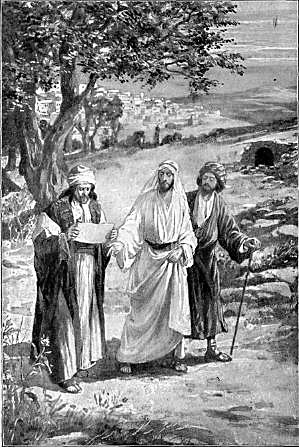 |
| On the Road to Emmaus |
In the days to come, shortly, chaos in the financial and other sectors of life will cause great confusion among people. Those who are preparing themselves for the afterlife, for eternity, will be able to meet these challenges. Those who are focused on this world will be horribly shaken, as those common cultural elements upon which they rely will horribly change and disappear.
Those who pray and reflect will be able to help others who will panic. Panic happens when one is unprepared.
There is in America a lack of seriousness among many Catholics. The idea that things in the culture will just continue as these have for decades seems to be a false security for many. Our only security is in God.
One of the ideals lost after Vatican II, but not necessarily caused by that council, was the teaching of the immediacy that one has to work for one's salvation in fear and trembling. This ideal was undermined by the false teaching that Catholics are already saints as well as the minimization of the seriousness of sin.
Too many people are not even thinking of their own salvation, but assuming it will happen.
Salvation is not a once and for all decision. It just does not happen. St. Paul knew this and warned us.
Philippians 2:12
Douay-Rheims
12 Wherefore, my dearly beloved, (as you have always obeyed, not as in my presence only, but much more now in my absence,) with fear and trembling work out your salvation.
The disciples on the Way to Emmaus were confused. Christ met them, explaining the Scriptures, the Law, the Prophets to them.
This is what we must do now.
More on The Predominant Fault AND Many Links
For those interested in most of the postings on the predominant fault, I have tried to find most of the links on this subject, which is a Catholic idea, btw, and not a protestant one.
As one who is being dragged into looking at my predominant faults, I can assure you the journey is painful, but worth it.
As Garrigou-Lagrange notes, without a struggle, we shall not be made perfect, as we are called to be.
Mortification plays a huge part in the destruction of the predominant fault.
Let God lead into those murky waters of sin in order to deal with the predominant fault. Here is a selection from the great Dominican.
The truth is that without this persevering and efficacious struggle we cannot sincerely aspire to Christian perfection, toward which the supreme precept makes it a duty for all of us to tend. This precept is, in fact, without limit: "Thou shalt love the Lord thy God with thy whole heart and with thy whole soul and with all thy strength and with all thy mind: and thy neighbor as thyself." (11)
Without this struggle, there is no interior joy or peace, for the tranquility of order or peace comes from the spirit of sacrifice. It alone establishes us interiorly in order by putting to death all that is inordinate in US.(12)
Lastly, charity, the love of God and of souls in God, finally prevails completely over the predominant fault; it then truly occupies the first place in our soul and reigns there effectively. Mortification, which makes our principal fault disappear, delivers us and assures the predominance in our soul of our true natural qualities and of our special attraction of grace. Thus little by little, we grow to be ourselves, in the broad sense of the word, that is, to be supernaturally ourselves minus our defects. We do not have to copy in a more or less servile manner another's qualities, or enter a uniform mold that is the same for all. There is a great variety in human personalities, just as no two leaves or flowers are perfectly similar. But a person's temperament must not be crushed; it must be transformed while keeping whatever is good in it. In our temperament, our character must be the imprint of the acquired and infused virtues, especially of the theological virtues. Then, instead of instinctively referring everything to self, as is the case when the predominant fault reigns, we will turn everything back to God, think almost continually of Him, and live for Him alone; at the same time we will lead to Him those with whom we come into contact.
http://supertradmum-etheldredasplace.blogspot.com/2013/09/part-three-tackling-predominant-fault.html
http://supertradmum-etheldredasplace.blogspot.com/2013/09/following-false-seers-and-predominant.html
http://supertradmum-etheldredasplace.blogspot.com/2013/09/part-five-predominant-fault-and-false.html
Doctors of the Church 2:8
Saturday, 9 February 2013
Part Ten of Doctors of the Church--The Four Ladies Plus the Most Perfect of All

In summary, the four female Doctors of the Church show us that the Illuminative State involves the enlightening of the mind and soul with grace, and the Unitive State brings the Bridal Love of Christ to the soul, enveloping the saint in grace.
These four ladies reflect the best of characteristics of women who were united with God while still on earth. That their writings help us peek into the souls of those who know God and are completely known by God is a great grace for us.
These, our sisters in Christ, lead the way to perfection.
Suffering, purgation, cleansing, filling, enlightenment, filling.
Their writings fall into the categories of theology and spirituality, guiding us and encouraging us.

Of course, they point to the most perfect of all of God's creations, the most perfect of all women, the Blessed Virgin Mary, the Theotokos, who was created from the moment of her conception in perfection and the fullness of grace.
The Immaculate Conception, (as do the four lady saints), leads us to a union with Christ, each as we were created to have.
May Our Queen and Mother Mary, Teresa, Therese, Catherine and Hildegard look kindly on us today as we just glimpse at their greatness in the Spirit.
Some Back Posts on St. Catherine, St. Teresa of Avila and St. Therese, the Little Flower...
04 Aug 2013
Teresa of Avila, Therese of Lisieux and John of the Cross and the Purification of the Spirit Pt. 24. Posted by Supertradmum. "ad lucem per crucem, and of the progressive configuration of the soul to Christ crucified."
15 Sep 2013
Fulton J. Sheen And St. Teresa of Avila. Posted by Supertradmum. Life, Truth, Love, states Ven. Fulton J. Sheen, are what we find in heaven. The soul who hates those would be tormented in heaven and that soul, who has ...
08 Feb 2013
St. John of Avila writes to a lady on what holiness is. Obviously, he was aware of those stages of perfection, and so inspired St. Teresa of Avila, to whom he wrote as well. He is summarizing all three stages here, purification, ...
02 Aug 2013
One can see the overlapping of ideas and experiences with St. Teresa of Avila. But, whereas Teresa is more descriptive, John is more systematic. 6. And in order to prove more completely how efficacious is this night of sense, ...
22 Sep 2013
The first thing, however, I want to note, is that the people of Ignatius's day, and in the days of St. Teresa of Avila, did not have access to Mass and the sacraments as we do now. People had to strive to be holy with perhaps only ...
24 Sep 2013
... by endeavoring to know God; for, beholding His greatness, we realize our own littleness; His purity shows us our foulness; and by meditating upon His humility we find how very far we are from being humble." Teresa of Avila.
09 Feb 2013
I am using a link to a post from last year for the two Teresas. Both Teresa of Avila and Therese, the Little Flower are Doctors of the Church. Sometimes, Teresa is call the Great Teresa and Therese is called the Little Therese.
14 Aug 2013
However, let us turn to St. Teresa of Avila's words for an explanation, and remember, she had not committed a mortal sin, but was shown the consequences of her evil tendencies if she did not allow God to purify her and the ...
26 Nov 2012
Here is St. Teresa of Avila's definitions, from her Life, taken from the Catholic Encyclopedeia. Also, the fruits of the prayer of quiet follow. May I note that only those who are in sanctifying grace and in complete orthodoxy with ...
03 Jun 2013
This process started for me in Missouri in 2009, when I had cancer and studied the word of Teresa of Avila and Catherine of Siena in my convalescence, beginning to understand the radical change one must allow God to do in ...
28 Feb 2012
Continuing the series on perfection, I have switched temporarily from Garrigou-Lagrange to the Interior Castle of St. Teresa of Avila. In this book, St. Teresa refers to the enlargement of the heart. Quoting Prime, Teresa writes, ...
06 Aug 2013
John of the Cross and Teresa of Avila, it seems that memory is to be avoided and the past completely set aside in the new life which God is demanding in the purification of both the senses and the soul. God has given me an ...
25 May 2013
Teresa of Avila, Angela of Foligno, Collete, Veronica Guiliani, Maria de Agreda, and Mary Magdalen de Pazzi, whose feast day is today. Here are some characteristics of a mystical marriage. The first is an almost continual ...
02 Sep 2012
She wrote hundreds of letters in her lifetime and a biography of her has just been published, literally, hot off the press. She was a mystic, in the unitive way, in the same category at St. Teresa of Avila, or St. John of the Cross.
08 Jun 2012
I seem to recall Saint Teresa of Avila writing in "Life" that, as a matter of policy, it's best to ignore elocutions, since all we need is obedience to the Church. This is what I normally tell those I meet who are "really into" some ...
26 Nov 2012
This is not the mystic state of St. Teresa of Avila or St. John of the Cross, but is the stage just prior to that state, which is called Extraordinary Contemplation. This higher contemplation is not a topic which I shall cover for several ...
04 Sep 2013
One does not know what to expect next if the symptoms are new and odd. One of the common themes in St. John of the Cross and St. Teresa of Avila is that of accepting suffering. One cannot choose the way it comes to one.
14 Aug 2013
As to books, just read the lives of the saints, and the Rule of St. Benedict, the writings of Therese the Little Flower and Teresa of Avila. One is called to a spirituality, such as Dominican-ism, or Franciscan-ism or Benedictine-ism ...
07 May 2012
So too were St. John of the Cross, St. Teresa of Avila.
St. Maximilian Kolbe and many, many other witnesses to the Faith. Many people are closed to repentance, especially if they are contracepting or in marriages which need ...
10 Jul 2013
This Rose and other roses like her, such as Catherine of Sienna, whose Illuminations I read while convalescing (two weeks) and Teresa of Avila, who I truly understand for the first time in my life, have led me to the realization ...
09 Feb 2013
Like Catherine, Teresa, and Therese, Hildegard cooperated with grace to come into unity with Christ. All these saints entered into the Unitive State. Catherine describes this, as does Teresa of Avila very clearly. Hildegard as ...
16 Mar 2013
So far, I have dipped into the writings of these great men women, Doctors of the Church, in the series. Hildegard of Binen Therese of Lisieux Teresa of Avila Catherine of Siena Augustine of Hippo Ambrose Albert the Great
08 Feb 2013
Catherine of Siena, Teresa of Avila, Therese of Lisieux and Hildegard of Bingen. I am concentrating on their holiness and some of the writings. The reason a person is declared a Doctor of the Church is sort of like an honorary ...
01 May 2012
2 comments: New Sister said... How can anyone read the writings of saints & then not inquire about/seek a spiritual director? (e.g., Francis de Sales, Teresa of Avila, John of the Cross, Faustina) Maybe that's the problem - lack ...
10 Mar 2013
Catherine of Siena Therese of Lisieux Teresa of Avila Hildegard of Bingen Augustine of Hippo Albert the Great Bede the Venerable Ephraim the Syrian Bernard of Clairvaux Peter Damian Ambrose Anselm of Canterbury
20 Nov 2012
Teresa of Avila and John of the Cross understood and practiced contemplative prayer. It is a grace, and I am convinced, for all Catholics. One must start with meditation, which is using the events in the Life of Christ in the Bible ...
18 Nov 2012
Teresa of Avila, Bernard, and many others, realizing that they were busy in the world as well. The contemplative prayer and meditation allowed them to be effective in the world. St. Catherine of Siena was a great player in the ...
10 Aug 2013
I could use more instruction on when it's appropriate to disclose sin because there are examples of saints who disclosed theirs – Saint Augustine and even the great Teresa of Avila, who in “Interior Castles” refrains from ...
02 Apr 2012
Continuing on the theme of perfection and middle-age, I come to the writings of St. John of the Cross and St. Teresa of Avila. She writes, "God gives Himself wholly to the soul which gives itself wholly to Him." Father Gabriel of ...
16 Feb 2013
There are a few saints I am sure who moved very quickly through these stages, but even Teresa of Avila took years and years. One must start as young as one can organize one's life to do so. These selections from St. Albert ...
12 Feb 2013
Emily said... One of my favorite verses--such a good reminder. Much like St. Teresa of Avila's bookmark. 12 February 2013 17:34 · Post a Comment · Newer Post Older Post Home. Subscribe to: Post Comments (Atom) ...
09 Aug 2012
I did the same thing, quite spontaneously. She loved the spirituality of the Carmelites, and so do I, although I am more Benedictine by practice and temperament. But, she took St. Benedict's name as well as Teresa of Avila's for ...
Subscribe to:
Posts (Atom)